加权平均关税税率(WATR)

Search documents
“对等关税”若被推翻,特朗普的B计划是什么?
Hua Er Jie Jian Wen· 2025-11-14 12:38
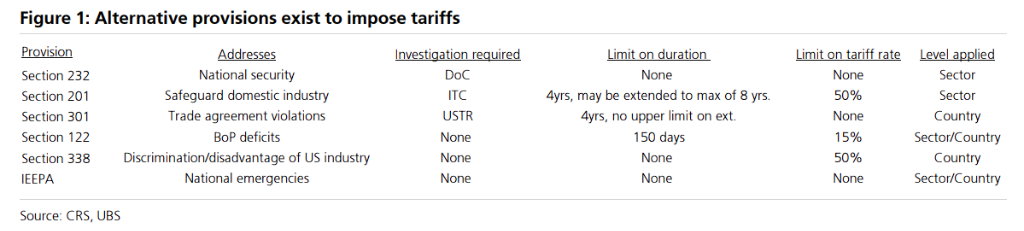
Core Viewpoint - The article discusses the potential implications of the U.S. Supreme Court's review of Trump's tariff policies, particularly the legality of tariffs imposed under the International Emergency Economic Powers Act (IEEPA) and the government's readiness with alternative legal tools to maintain tariffs even if the court rules against them [1][2][3]. Group 1: Legal Challenges and Tariff Implications - The U.S. Supreme Court is reviewing the legality of tariffs imposed under IEEPA, with indications that many justices are skeptical about its use for tariff imposition [2]. - If the Supreme Court rules against the government, it could lead to significant questions regarding which tariffs would be eliminated and the process for refunding paid tariffs [2]. - A ruling against IEEPA could see the U.S. weighted average tariff rate (WATR) drop from 13.6% to 7.2%, but this low rate is expected to be temporary [2][3]. Group 2: Alternative Legal Tools - UBS reports that the government has prepared a "B Plan" to utilize other legal authorizations to maintain tariffs, indicating that a complete removal of tariffs is unlikely [3]. - The government can invoke the Trade Act of 1974, Section 122, allowing for a temporary 15% import surcharge for up to 150 days, which could serve as a short-term solution [4][6]. - Long-term strategies include using Section 301 of the Trade Act of 1974 to combat unfair trade practices, which could restore WATR to 11.8% or higher depending on the scope of investigations [7]. Group 3: Specific Tariff Provisions - Section 232 of the Trade Expansion Act of 1962 allows for tariffs based on national security concerns, which are not affected by IEEPA rulings [8]. - Ongoing Section 232 investigations could cover imports valued at up to $466 billion, potentially filling any tariff gaps created by IEEPA challenges [8]. - Section 338 of the Tariff Act of 1930 permits tariffs of up to 50% against countries discriminating against U.S. industries, though its implementation is more challenging [8].