
动机刹车

Search documents
拖延没动力?可能是大脑在保护你
3 6 Ke· 2026-02-05 02:27
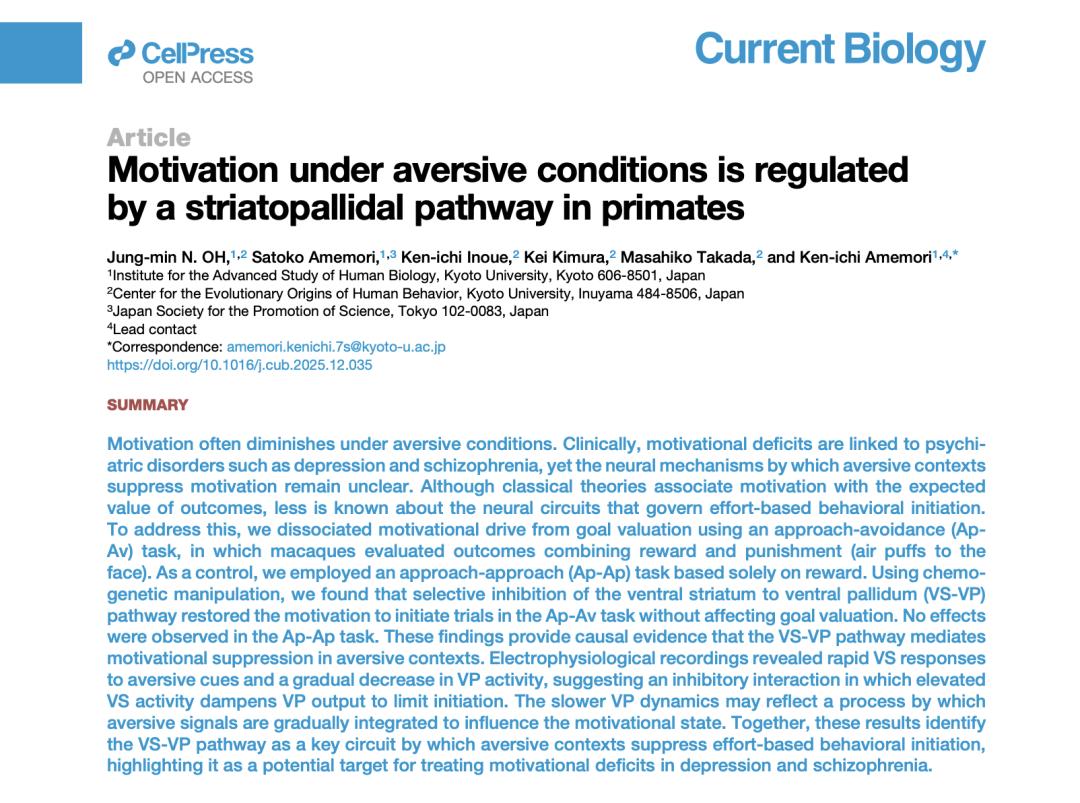
几乎每个人都经历过这样的时刻:明明知道事情并不复杂,比如给领导打一个电话、打开一份拖了很久的文档,或者开始准备一场让人紧张的汇报,可真 正要行动时,却像被什么东西按住了一样,迟迟无法开始。这种体验常常被误解为拖延、懒惰或意志力不足, 一项发表在《当代生物学》(Current Biology)的最新研究则提示,问题可能并不在"想不想",而在于大脑里真的存在一套专门"踩刹车"的机制。 京都大学高等人类生物学研究所的研究团队选择从灵长类动物入手,试图把"知道要做"和"真正开始做"这一步拆分开来。他们训练猕猴完成两类任务,一 类任务只有奖励,完成后能得到水;另一类任务则在奖励之外,附带一个不舒服的惩罚,比如朝脸上吹一股气。在每一次任务开始前,猴子都可以自由决 定要不要启动任务。研究者关注的不是猴子最后选了什么,而是一个更基础的问题:它们愿不愿意迈出第一步。 在医学上,当这种"启动不了"的状态变得严重时,被称为意志缺乏症。患者并非不知道该做什么,也不是对结果毫无兴趣,而是大脑迟迟无法发出"开 始"的信号。这种症状在抑郁症、精神分裂症以及帕金森病中都很常见,严重影响日常生活和社会功能。长期以来,神经科学认为动机主要来自对 ...

科学家发现大脑“刹车”机制
Xin Lang Cai Jing· 2026-01-17 14:40
Core Insights - A recent study on high-IQ monkeys reveals a neural pathway in the brain that regulates motivation, acting as an internal "brake" that inhibits the impulse to take action when faced with uncomfortable or stressful tasks [1][2][3] Group 1: Research Findings - The study identifies a neural circuit that suppresses motivation, providing insights into "lack of willpower" cases, which are not due to laziness but rather an inability to initiate action despite knowing what to do [1][3] - The research team trained monkeys to complete tasks with varying rewards, observing that when tasks included negative consequences, monkeys often chose to forgo action, indicating a significant impact of perceived costs on motivation [2][3] - By temporarily weakening the neural pathway between two brain regions (ventral striatum and ventral pallidum), the study found that monkeys showed increased willingness to start tasks associated with discomfort, suggesting a distinct role of these regions in the cognitive-to-action transition [3][4] Group 2: Implications for Mental Health - The findings may provide new insights into conditions like depression and schizophrenia, where severe motivation loss is common, suggesting potential interventions such as deep brain stimulation or novel drug strategies to modulate this "brake" mechanism [3][4] - The existence of this "motivation brake" is significant, as excessive braking can lead to willpower deficits and procrastination, while overly flexible braking may result in burnout, highlighting the need for a balanced motivational state [4]