
动物实验

Search documents
从斑马鱼到机器鱼:机器人实验重塑神经行为研究
机器之心· 2026-02-04 03:25
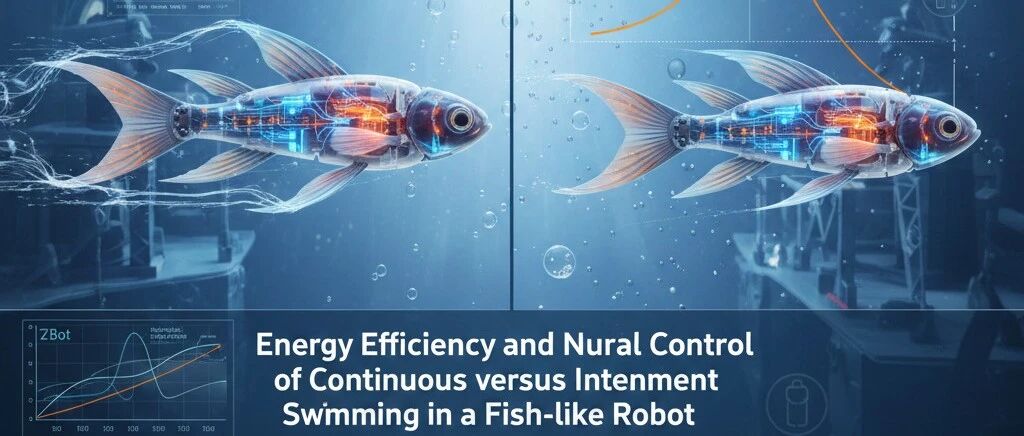
Core Viewpoint - The research conducted by a collaborative team from EPFL, Duke University, and a Portuguese institution focuses on using robotic systems to replace animals in physiological experiments, aiming to explore the neural control mechanisms of intelligent behaviors in animals [2][3]. Group 1: Research Background - The paper titled "Energy Efficiency and Neural Control of Continuous versus Intermittent Swimming in a Fish-like Robot" was published in the January 2026 issue of the journal Science Robotics [2][3]. - Zebrafish have gained attention as a model organism in scientific research due to their transparent bodies and high reproductive rates, making them ideal for observing real-time correlations between neuronal activity and behavior [5]. Group 2: Robotic Experimentation Advantages - Robotic experiments, such as those conducted with the ZBot, provide a cost-effective and ethically unbound alternative to traditional animal experiments, allowing for precise verification of causal relationships between neural circuits and motor performance in a controlled environment [7]. - The ZBot, designed to mimic the morphology of larval zebrafish, can replicate various swimming behaviors, including slow swimming and routine turns, and can simulate additional swimming gaits by adjusting motor neuron output parameters [9]. Group 3: Fluid Dynamics and Motion Mechanisms - The study investigates the impact of fluid viscosity on the swimming efficiency of the ZBot, revealing that as fluid viscosity increases, the propulsion efficiency significantly decreases, with displacement in high-viscosity fluid being only about one-thirtieth of that in normal water [15]. - Despite the decrease in propulsion efficiency, the turning functionality remains largely unaffected by fluid viscosity, indicating that the ZBot can maintain a turning angle of approximately 45 degrees in high-viscosity fluid [15]. Group 4: Energy Efficiency Insights - The research proposes a new hypothesis that intermittent swimming enhances energy efficiency by keeping the actuators or muscles in a more efficient operational range, rather than solely reducing water resistance during gliding [17]. - Experimental comparisons between biological muscles and the servo motors used in the ZBot show that both exhibit a U-shaped efficiency curve, with peak efficiency at moderate loads [17]. Group 5: Implications for Future Research - The findings from the robotic experiments provide deeper insights into biological motion behaviors and mechanisms, suggesting that intermittent driving should be prioritized for energy efficiency in mid-speed cruising scenarios, while continuous driving should be used for high-speed maneuvers [18].

昭衍新药尾盘涨超9% 机构看好公司受益猴价上涨 海外离岸外包业务具增长潜力
Zhi Tong Cai Jing· 2025-08-13 07:56
Core Viewpoint - Zhaoyan New Drug (603127) has seen a significant stock price increase of 9.23%, reaching HKD 24.62, with a trading volume of HKD 391 million, indicating positive market sentiment towards the company [1] Company Analysis - Huatai Securities reports that after experiencing high growth from 2018 to 2022, Zhaoyan New Drug is expected to face order volume and price pressures from 2023 to 2025, but these negative factors are gradually being resolved. Starting in 2026, the company is anticipated to enter a new growth phase driven by domestic recovery and offshore outsourcing [1] - The price of experimental monkeys, a key indicator of supply and demand in the safety evaluation industry, is currently stable at RMB 80,000 to 100,000 per monkey, with a slight upward trend expected as supply-demand dynamics tighten [1] - The report suggests that as the supply-demand gap widens, monkey prices may enter a new upward cycle, having previously reached RMB 150,000 to 200,000 per monkey in 2022 [1] Industry Outlook - Contrary to market concerns regarding the impact of new FDA regulations and the growth potential of overseas business, Huatai Securities believes that the new regulations are primarily focused on the monoclonal antibody sector and have not yet been adopted domestically. In the short term, animal testing will remain the dominant method in global drug safety evaluation for the next 3 to 5 years [1] - Long-term prospects for new methodologies, such as AI and organoids, remain uncertain and will require careful evaluation of transitional results and technological maturity [1] - The report expresses optimism about the collaborative evolution of animal testing and new methodologies, which could drive overall industry development, and highlights the company's proactive positioning in adopting new methodologies to enhance its comprehensive capabilities [1]
