
雷诺数

Search documents
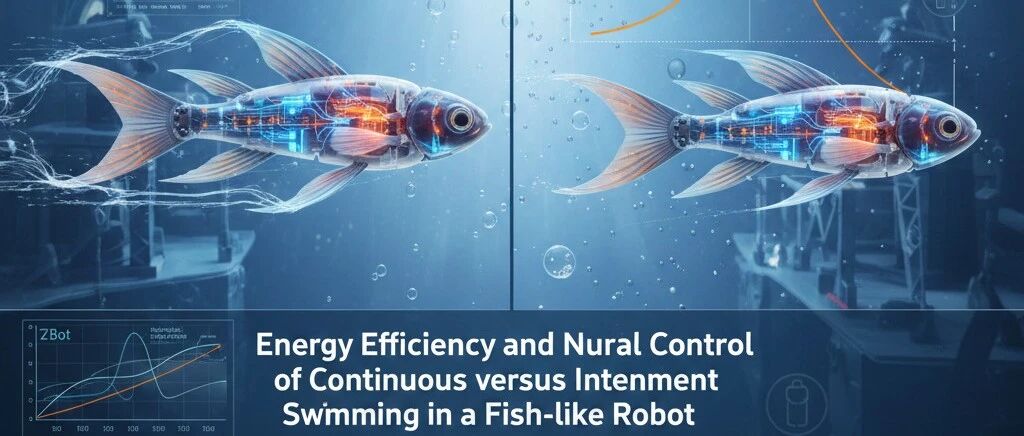
从斑马鱼到机器鱼:机器人实验重塑神经行为研究
机器之心· 2026-02-04 03:25
Core Viewpoint - The research conducted by a collaborative team from EPFL, Duke University, and a Portuguese institution focuses on using robotic systems to replace animals in physiological experiments, aiming to explore the neural control mechanisms of intelligent behaviors in animals [2][3]. Group 1: Research Background - The paper titled "Energy Efficiency and Neural Control of Continuous versus Intermittent Swimming in a Fish-like Robot" was published in the January 2026 issue of the journal Science Robotics [2][3]. - Zebrafish have gained attention as a model organism in scientific research due to their transparent bodies and high reproductive rates, making them ideal for observing real-time correlations between neuronal activity and behavior [5]. Group 2: Robotic Experimentation Advantages - Robotic experiments, such as those conducted with the ZBot, provide a cost-effective and ethically unbound alternative to traditional animal experiments, allowing for precise verification of causal relationships between neural circuits and motor performance in a controlled environment [7]. - The ZBot, designed to mimic the morphology of larval zebrafish, can replicate various swimming behaviors, including slow swimming and routine turns, and can simulate additional swimming gaits by adjusting motor neuron output parameters [9]. Group 3: Fluid Dynamics and Motion Mechanisms - The study investigates the impact of fluid viscosity on the swimming efficiency of the ZBot, revealing that as fluid viscosity increases, the propulsion efficiency significantly decreases, with displacement in high-viscosity fluid being only about one-thirtieth of that in normal water [15]. - Despite the decrease in propulsion efficiency, the turning functionality remains largely unaffected by fluid viscosity, indicating that the ZBot can maintain a turning angle of approximately 45 degrees in high-viscosity fluid [15]. Group 4: Energy Efficiency Insights - The research proposes a new hypothesis that intermittent swimming enhances energy efficiency by keeping the actuators or muscles in a more efficient operational range, rather than solely reducing water resistance during gliding [17]. - Experimental comparisons between biological muscles and the servo motors used in the ZBot show that both exhibit a U-shaped efficiency curve, with peak efficiency at moderate loads [17]. Group 5: Implications for Future Research - The findings from the robotic experiments provide deeper insights into biological motion behaviors and mechanisms, suggesting that intermittent driving should be prioritized for energy efficiency in mid-speed cruising scenarios, while continuous driving should be used for high-speed maneuvers [18].

科学家揭示特定尺度下“推进力反转”现象
Ren Min Wang· 2025-10-18 21:58
Core Viewpoint - A research team led by Professor Ding Yang from Beijing University of Posts and Telecommunications has discovered a phenomenon called "thrust reversal" in propellers operating in specific fluid environments, challenging traditional understandings of propeller mechanics [1] Group 1: Research Findings - The study reveals that at millimeter to sub-millimeter scales, clockwise rotating propellers do not propel micro submarines forward but instead cause them to move backward [1] - The research indicates that in different Reynolds number environments, objects exhibit distinctly different motion characteristics [1] - At ordinary scales, propellers generate forward thrust by pushing water backward, while at smaller scales, the water flow is deflected outward, creating a suction effect at the propeller's center that pulls the submarine in the opposite direction [1] Group 2: Implications - This discovery has significant implications for applications such as micro medical robots and pipeline inspection devices, which often measure only a few millimeters in size [1] - Traditional propeller propulsion systems may fail in these small devices, necessitating research into how to adjust parameters to mitigate or utilize this centrifugal suction effect [1]