南海争议

Search documents
我驻菲大使:中国把菲当做朋友、邻居,真心相助,不求回报
Xin Lang Cai Jing· 2026-01-22 13:01
Group 1 - The Philippines and China are working towards managing maritime disputes through diplomatic dialogue, with both sides expressing a desire to avoid conflict and maintain communication channels [2][5] - The Philippines has been a significant trade partner for China, with a notable trade deficit, but China encourages the Philippines to export more products, especially high-quality agricultural goods [2][4] - Recent developments include the successful completion of infrastructure projects, such as the Bucana Bridge, which enhances transportation and economic development in the region [4][6] Group 2 - There is a growing interest in Chinese technology and investment in the Philippines, particularly in sectors like renewable energy and waste management, which could benefit the local economy [3][4] - The recent announcement of a 14-day visa exemption for Chinese citizens is seen as a positive step towards increasing tourism and strengthening bilateral relations [5][6] - The Chinese embassy emphasizes the importance of constructive dialogue and the role of media in fostering a positive narrative around China-Philippines relations [6][7]
“不管找1个、10个还是100个帮手,中方随时奉陪,而且奉陪到底”
Xin Lang Cai Jing· 2026-01-13 07:31
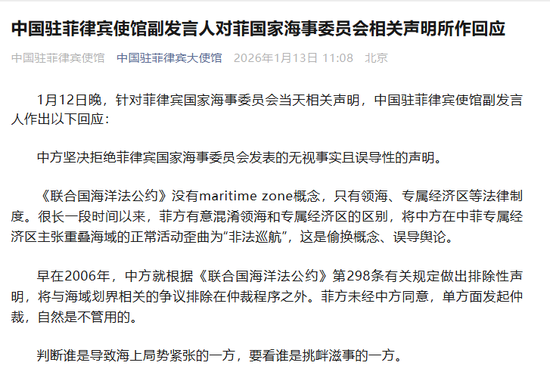
Group 1 - The core viewpoint is that China firmly rejects the misleading statements made by the Philippines' National Maritime Council, asserting that the concept of "maritime zone" does not exist in the United Nations Convention on the Law of the Sea [1][6] - China emphasizes that the Philippines has been intentionally confusing the distinction between territorial waters and exclusive economic zones, misrepresenting China's normal activities in overlapping areas as "illegal patrols" [1][6] - China has made a declaration under Article 298 of the United Nations Convention on the Law of the Sea since 2006, excluding disputes related to maritime delimitation from arbitration procedures, and considers the Philippines' unilateral arbitration attempts as ineffective [1][6] Group 2 - The Philippines is accused of provoking tensions by illegally grounding a military ship at the Second Thomas Shoal in 1999, which China claims is a serious infringement of its territorial sovereignty [2][7] - Since the second half of 2023, the Philippines has repeatedly sent coast guard and other vessels into Chinese territorial waters, prompting China to take necessary protective measures [2][7] - The Philippines' coast guard vessel 9701 illegally remained at the Xianbin Reef for nearly five months from April 17 to September 14, 2024, raising suspicions about its intentions to create another "grounding" incident [2][7] Group 3 - China asserts that it has shown maximum restraint and patience in response to provocations, questioning why dialogue and negotiation cannot resolve the disputes between China and the Philippines, unlike other territorial disputes China has managed with neighboring countries [3][8] - The statement emphasizes that the best approach to maritime disputes is through respectful dialogue and negotiation, rather than confrontation [3][8] - China expresses willingness to engage in honest dialogue with the Philippines to manage differences, while opposing individuals who distort facts and incite confrontation [3][8] Group 4 - Some individuals are accused of using the banner of "rights protection" to promote confrontation and escalate tensions, potentially leading the Philippines towards geopolitical competition and conflict with China [4][9] - The narrative suggests that such actions could severely damage the fundamental and long-term interests of the Philippines [4][9]