
历史遗迹保护

Search documents
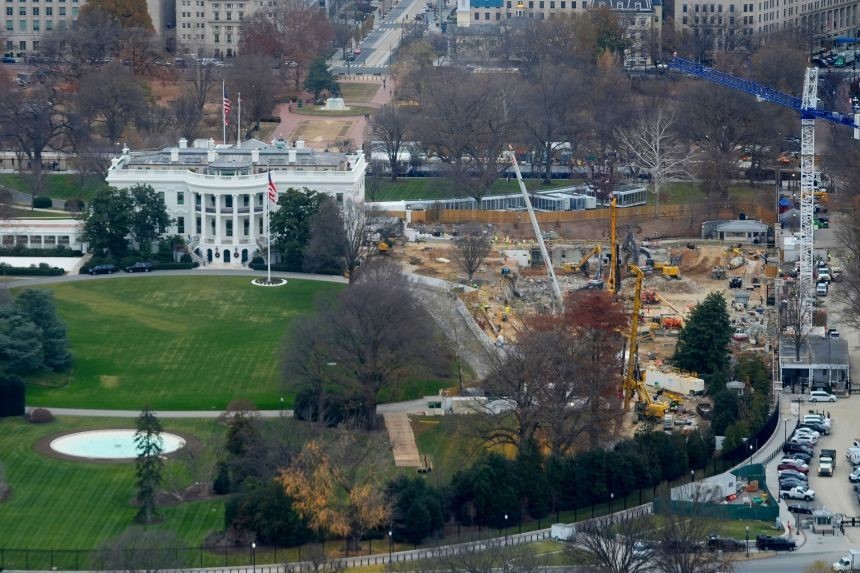
美媒:回应起诉,特朗普政府称白宫宴会厅改造项目事关国家安全
Huan Qiu Wang· 2025-12-16 01:27
Core Viewpoint - The Trump administration asserts that the renovation of the White House East Room is essential for national security, responding to a lawsuit from the National Trust for Historic Preservation that seeks to halt the project until a comprehensive design review and public consultation are conducted [1][3]. Group 1: Lawsuit and Government Response - The National Trust for Historic Preservation filed a lawsuit on October 12, seeking to stop the renovation project until it undergoes thorough design review and public input, as well as Congressional approval [1][4]. - In response, the Trump administration submitted a court document stating that the renovation must continue for security reasons, including a statement from the U.S. Secret Service indicating that further work is needed to meet security requirements [3]. - The government argues that the lawsuit is moot regarding the demolition of the East Wing, as the work cannot be undone, and claims that the National Trust has not demonstrated any irreparable harm from the project [3]. Group 2: Project Details and Timeline - The renovation project was announced in late July with a budget of approximately $300 million, expected to be completed by 2029, before the end of Trump's term [4]. - The expanded East Room will cover over 8,300 square meters and accommodate around 1,000 guests [4]. - The demolition of the East Wing was carried out swiftly in October to make space for the new East Room, which faced opposition from preservation organizations and criticism from Congressional Democrats regarding the lack of transparency in the process [4].

两千年的报恩圣地:南京大报恩寺|访古
Jing Ji Guan Cha Bao· 2025-06-21 00:45
Core Insights - The article discusses the historical significance and archaeological findings of the Da Bao En Temple, tracing its origins from the Eastern Wu period to its reconstruction during the Ming Dynasty, highlighting its cultural and architectural importance in Chinese history [2][4][16] Historical Background - Da Bao En Temple was originally built as Jianchu Temple in 248 AD during the Eastern Wu period, making it the second temple in China after the White Horse Temple in Luoyang [2] - The temple underwent several reconstructions and name changes, including its renaming to Changgan Temple and later to Da Bao En Temple during the Ming Dynasty [3][5] Archaeological Discoveries - Significant archaeological findings include the discovery of a thousand-year-old underground palace beneath the temple, which revealed numerous artifacts such as the Seven Treasures Ashoka Tower and various Buddhist relics [6][9][16] - The excavation has uncovered a variety of relics, including gold and silver items, ceramics, and inscriptions that provide insights into the temple's historical evolution and the development of Buddhist art in China [14][16] Architectural Features - The temple's architecture features a grand nine-story glazed pagoda, which was a significant landmark in Nanjing and is noted for its intricate design and construction [5][9] - The layout of the temple complex includes various halls and structures, with the main buildings arranged along a central axis, showcasing traditional Chinese architectural principles [7][8] Cultural Impact - The Da Bao En Temple has been recognized as one of the most important ancient temple sites in China, with its archaeological findings contributing to the understanding of Buddhist culture and royal rituals during the Ming and Qing dynasties [16] - The site has been developed into a cultural park that not only preserves the archaeological remains but also serves as a tourist attraction, allowing visitors to engage with the historical and cultural significance of the temple [16]