双矢量推进技术

Search documents
哈工大双模微型机器人登上IEEE,会省电还会杂技?
机器人大讲堂· 2026-01-19 09:09
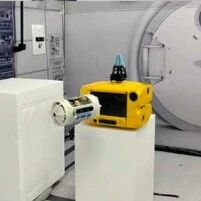
Core Viewpoint - The article discusses the innovative design and capabilities of a new micro autonomous flying robot named FRDP, developed by a research team from Harbin Institute of Technology, which features a dual-mode propulsion system for enhanced efficiency and maneuverability in space station operations [1][2][25]. Group 1: Design and Features - FRDP is a compact robot weighing only 600 grams and measuring 9 cm in diameter, making it significantly smaller and lighter than previous models [1][4]. - The robot incorporates a unique dual-modal propulsion system that allows for both quiet cruising and agile maneuvering, enabling it to perform a variety of tasks in the confined environment of a space station [1][2][10]. - Compared to earlier flying robots, FRDP achieves a maximum acceleration of 1.366 m/s² in performance mode, showcasing superior maneuverability [4][22]. Group 2: Operational Modes - FRDP operates in two distinct modes: an energy-saving mode for long-distance inspections and a performance mode for high-precision tasks, allowing for intelligent switching based on task requirements [13][14]. - In energy-saving mode, the robot can maximize its operational efficiency, while in performance mode, it can execute complex maneuvers such as tracking and close-range inspections [14][15]. Group 3: Control System - The robot features a sophisticated control system that combines nonlinear model predictive control (NMPC) and PID control, ensuring stable and accurate autonomous flight [16][17]. - The NMPC serves as the upper layer for planning, while the PID control manages the execution of commands, allowing for precise adjustments in real-time [16][17]. Group 4: Testing and Validation - The research team conducted simulations and physical experiments to validate FRDP's design and control algorithms, demonstrating its ability to perform complex three-dimensional trajectory tracking tasks with high accuracy [20][22]. - The robot successfully showcased its capabilities in a ground-based microgravity simulation platform, confirming the feasibility of its design and control system [22][25].