
名士文化

Search documents
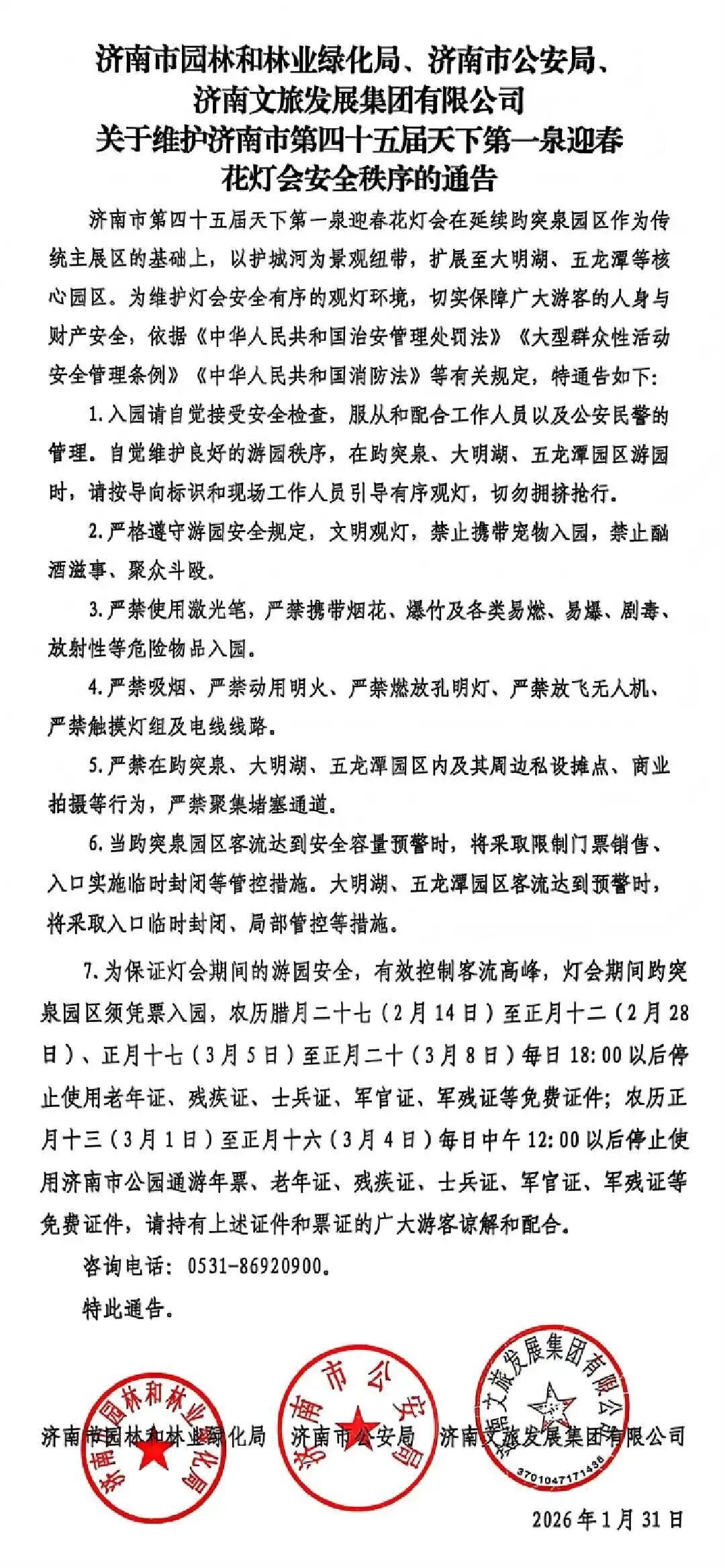
视客流情况,济南天下第一泉迎春花灯会可能限制售票、临时封闭
Qi Lu Wan Bao· 2026-02-15 05:10
Core Viewpoint - The 45th Spring Lantern Festival in Jinan, themed "Three Sceneries Merging with the River, Light Reflecting the Spring City," aims to showcase the unique cultural heritage of Jinan through a series of themed lanterns and events, while ensuring safety measures are in place during the event [1][4]. Group 1: Event Details - The festival will officially open on February 14, 2026, and will feature the Baotu Spring scenic area until March 8, 2026, while the Daming Lake and Wulongtan areas will remain open until March 22, 2026 [6]. - The event will connect three major scenic areas: Baotu Spring, Daming Lake, and Wulongtan, using the moat as a dynamic link [1][4]. Group 2: Cultural Significance - The festival will deeply integrate Jinan's spring water culture, literary heritage, and intangible cultural heritage, creating a vibrant atmosphere that blends tradition with modernity [4]. - The festival aims to present a visual feast that combines aesthetics, interactivity, and cultural elements for both citizens and tourists [4].

唐代越州本土诗人与浙东唐诗之路
Xin Lang Cai Jing· 2025-12-28 22:36
Core Viewpoint - The local poets of Yuezhou played a significant role in the formation, development, and continuation of the Tang Poetry Road in Eastern Zhejiang, contributing uniquely to the cultural landscape of the region [1][8]. Group 1: Contributions of Local Poets - Yuezhou's local poets, including Yu Shinan, He Zhizhang, Yan Wei, and others, produced around 1,000 poems, which, although not numerous, were pivotal in promoting the poetry road [1]. - The open and inclusive nature of Yuezhou poets enhanced the cultural appeal of Eastern Zhejiang, facilitating a blend of Northern and Southern cultures, particularly after the "Yongjia Southward Migration" [1][2]. - The Dali Eastern Zhejiang Poetry Recital, held in Yuezhou, marked a significant literary event, showcasing the region's unique cultural identity through its natural beauty and historical depth [4]. Group 2: Regional Characteristics in Poetry - The poetry of Yuezhou's local poets often reflects distinct Jiangnan regional characteristics, with vivid depictions of local geography and cultural references, enhancing the cultural allure of Eastern Zhejiang [3][4]. - He Zhizhang's deep affection for his hometown is evident in his poetry, which features iconic imagery of local landmarks like Jinghu Lake, contributing to the poetic identity of the region [3][6]. - Wu Rong, despite spending much time away from Yuezhou, incorporated numerous local geographical and cultural symbols in his poetry, further enriching the cultural narrative of the Tang Poetry Road [4][5]. Group 3: Influence and Legacy - The achievements of local poets like Yu Shinan and He Zhizhang significantly expanded the cultural influence of Yuezhou, establishing it as a notable center in the broader cultural landscape of the Tang dynasty [5][6]. - The literary activities of these poets not only enhanced their personal reputations but also facilitated the dissemination of Yuezhou's cultural symbols across the nation, contributing to the formation of the Tang Poetry Road [6][7]. - The interactions and exchanges among poets, including those from other regions, fostered a vibrant literary ecosystem in Yuezhou, which played a crucial role in the development of the Tang Poetry Road [2][7].
时光里的绍兴:大禹之后,江南之间
Jing Ji Guan Cha Bao· 2025-11-06 02:06
Core Points - The article explores the historical significance and cultural evolution of Shaoxing, particularly focusing on the region of Kuaiji Mountain and its connection to ancient Chinese civilization [1][2][3] Historical Context - Kuaiji Mountain, named after its historical significance, has been a center of political and cultural activities since the Qin Dynasty, with its administrative status changing over time [1][4] - The region was known for its agricultural development and strategic importance, especially during the reign of Emperor Yu, who is credited with controlling floods and establishing the Xia Dynasty [3][5] Cultural Significance - The article highlights the cultural richness of Shaoxing, particularly during the Eastern Jin Dynasty, when it became a hub for scholars and poets, exemplified by the famous "Lantingji Xu" written by Wang Xizhi [14][15] - The area has been a witness to various historical events, including the rise and fall of different dynasties, contributing to its rich literary and artistic heritage [18][21] Economic Development - Shaoxing's economy flourished during the Southern Song Dynasty, becoming a significant urban center with advancements in agriculture, handicrafts, and trade, particularly known for its ceramics and textiles [22][24] - The establishment of the Jinghu Lake irrigation project laid the foundation for Shaoxing to become a prosperous agricultural region, often referred to as a "land of fish and rice" [16][18] Urban Planning and Architecture - The article discusses the urban planning of Shaoxing, particularly during the Southern Song Dynasty, where the city expanded significantly with a well-structured layout of streets and markets [24][25] - The architectural style of the city reflects a blend of local traditions and influences from other regions, showcasing the ingenuity of ancient Chinese urban design [11][24]