商业航天产业体系化发展

Search documents
中科宇航迁址背后 广州空天产业的格局演进
Nan Fang Du Shi Bao· 2026-01-06 23:08
Core Viewpoint - Zhongke Aerospace's strategic relocation of its headquarters from Nansha to Huangpu is a significant move in the context of its upcoming listing on the Sci-Tech Innovation Board, reflecting a shift towards scale and ecological integration in the commercial aerospace sector in Guangzhou [1][3][10] Group 1: Company Overview - Zhongke Aerospace, backed by the Chinese Academy of Sciences, has established itself as a leading player in the commercial rocket launch market, holding the largest market share in 2023 [2] - The company’s main product, the "Liyuan-1" rocket, has achieved multiple successful launches, capturing approximately 70% of the commercial rocket launch market in 2024 [5] Group 2: Strategic Relocation - The relocation to Huangpu is not merely an address change but signifies a deeper restructuring of the aerospace industry landscape in Guangzhou, transitioning from homogeneous competition to differentiated collaboration [3][9] - The move is part of a strategic upgrade from "Nansha incubation" to "Huangpu scaling," indicating the company's evolution from startup to maturity [3][5] Group 3: Industrial Ecosystem Development - The establishment of the Guangzhou Aerospace Town in Huangpu aims to create a comprehensive aerospace industrial ecosystem, integrating manufacturing, research, and living spaces [6][9] - The collaboration between Nansha and Huangpu is likened to an "internal relay race" within a mega-city, where Nansha focuses on incubation and core manufacturing, while Huangpu handles scaling and capital integration [2][10] Group 4: Future Prospects - The successful implementation of a cross-regional collaboration model could maximize the efficiency of the entire aerospace supply chain, enhancing the overall capacity to support national strategic industries [9][10] - The planned liquid propulsion system testing center in Conghua will serve as a key platform for developing medium to large liquid rocket engines, further solidifying the region's aerospace capabilities [8]

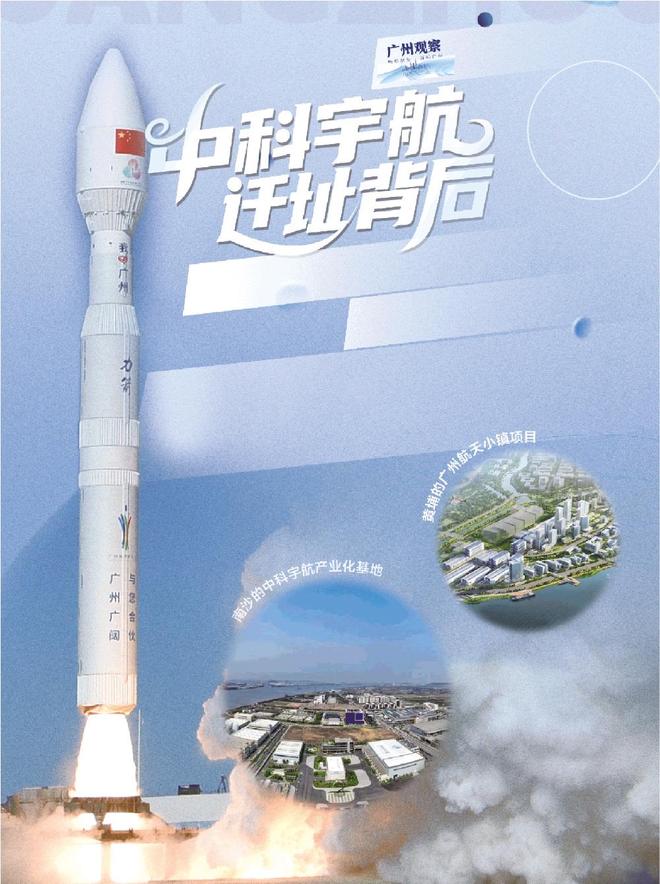
航天独角兽新布局,助推广州空天产业格局演进
Nan Fang Du Shi Bao· 2026-01-04 16:58
Core Viewpoint - Zhongke Aerospace Technology Co., Ltd. has made a significant strategic adjustment by relocating its headquarters from Nansha District to Huangpu District in Guangzhou, which reflects a deeper adjustment in the aerospace industry landscape in Guangzhou and the company's strategic positioning based on development factors [2][4][11]. Group 1: Company Overview - Zhongke Aerospace is backed by the Chinese Academy of Sciences and has successfully launched its "Liyuan-1" rocket multiple times, leading the commercial rocket launch service market in 2023 [2][4]. - The company aims to establish a complete aerospace industry ecosystem in Guangdong, which has been lacking a leading rocket enterprise [4][6]. - In 2024, Zhongke Aerospace achieved a revenue of 243 million yuan, while its net profit was -748 million yuan, indicating a typical high-investment phase in the industry [6]. Group 2: Strategic Relocation - The relocation to Huangpu is not merely an address change but a strategic move to enhance the company's operational efficiency by being closer to high-end manufacturing resources and research institutions [8][12]. - Huangpu District is recognized for its advanced manufacturing capabilities and is planning to develop a national aerospace town, which will serve as a hub for the aerospace industry [7][11]. Group 3: Industry Development - The aerospace industry in Guangzhou is evolving from a "single-point breakthrough" to a "systematic development," with a focus on collaborative networks among different districts [11][16]. - The establishment of the Guangzhou Aerospace Town aims to create an integrated aerospace industry ecosystem, combining manufacturing, research, and living spaces [7][10]. Group 4: Future Prospects - The collaboration between different districts (Huangpu for R&D and manufacturing, Nansha for assembly and testing, and Conghua for testing centers) is expected to maximize the efficiency of the entire aerospace industry chain [12][16]. - The successful implementation of this collaborative model could enhance Guangzhou's capacity to support national strategic industries and foster a more mature and coordinated aerospace industry landscape [16].