四维融合

Search documents
国家给低空经济立规矩
Xin Lang Cai Jing· 2026-02-07 01:11
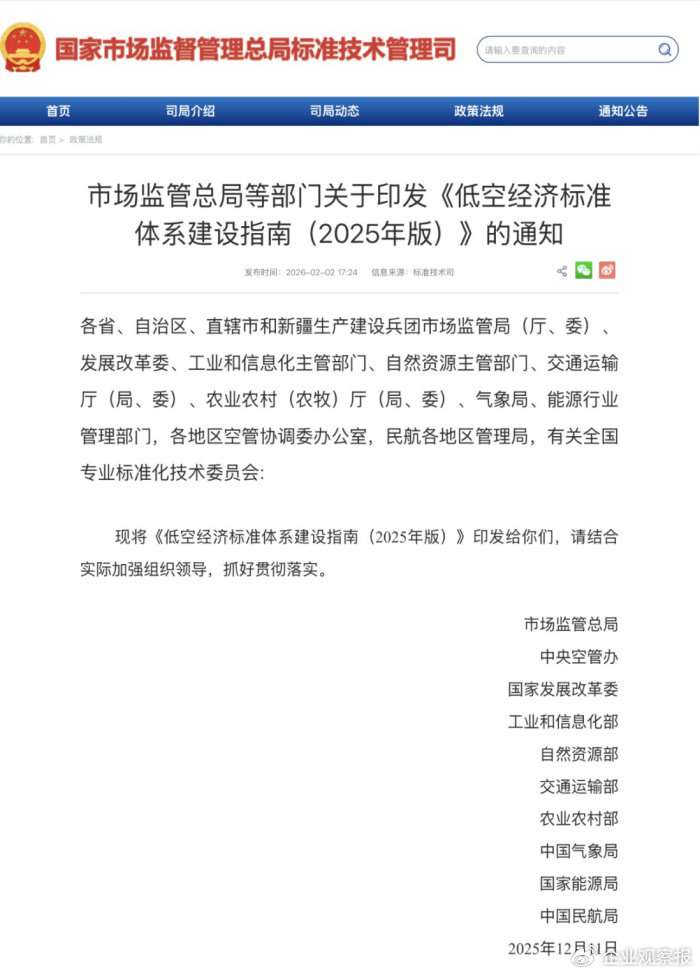
Core Viewpoint - The release of the "Low Altitude Economy Standard System Construction Guide (2025 Edition)" marks a significant step towards the standardized development of China's low altitude economy, addressing industry pain points and laying a foundation for high-quality growth [4][6][8]. Group 1: Industry Growth and Market Dynamics - By 2025, nearly 50,000 new low altitude economy-related companies are expected to be registered, reflecting a 141% increase compared to 2024 [5]. - The market size of China's low altitude economy reached approximately 505.95 billion yuan in 2023, with a projected growth of 32.5% to 670 billion yuan in 2024 [5]. - The China Civil Aviation Administration forecasts that the market size will reach 1.5 trillion yuan by 2025 and exceed 3.5 trillion yuan by 2035 [5]. Group 2: Challenges and Pain Points - The low altitude economy faces three core challenges: an incomplete safety regulation system, insufficient collaboration across the industry chain, and difficulties in balancing international integration with domestic innovation [6]. - The need for a top-level design to address these issues has become urgent, as the industry grapples with fragmented standards and safety concerns [6][10]. Group 3: Standardization and Regulatory Framework - The "Construction Guide" focuses on five key areas: low altitude aircraft, low altitude infrastructure, low altitude air traffic management, safety regulation, and application scenarios, aiming to create a comprehensive standard system [4][6]. - The guide proposes a "four-dimensional integration" standard supply system, merging technical standards with management norms, domestic standards with international rules, mandatory standards with recommended ones, and basic standards with scenario-specific standards [8][9]. Group 4: Implementation and Future Outlook - A clear timeline is set in the guide, aiming to establish the standard system by 2027 and develop over 300 standards by 2030, ensuring the industry's safe and healthy development [8][9]. - Local initiatives, such as those in Shenzhen and Shanghai, have already begun exploring low altitude economy standards, providing valuable experiences for national-level coordination [9]. Group 5: Safety and Operational Standards - The standardization of low altitude aircraft is crucial for ensuring safety and efficiency in low altitude operations, with specific requirements for future aircraft, including obstacle avoidance capabilities and robust communication links [10][12]. - Ground infrastructure must also be standardized to support the operation of low altitude aircraft, ensuring reliable takeoff and landing facilities, communication networks, and navigation services [11]. - The establishment of air traffic management standards is essential for maintaining order in low altitude airspace, enabling predictable flight paths and efficient traffic flow [11][12].