
低空航空器

Search documents
国家给低空经济立规矩
Xin Lang Cai Jing· 2026-02-07 01:11
Core Viewpoint - The release of the "Low Altitude Economy Standard System Construction Guide (2025 Edition)" marks a significant step towards the standardized development of China's low altitude economy, addressing industry pain points and laying a foundation for high-quality growth [4][6][8]. Group 1: Industry Growth and Market Dynamics - By 2025, nearly 50,000 new low altitude economy-related companies are expected to be registered, reflecting a 141% increase compared to 2024 [5]. - The market size of China's low altitude economy reached approximately 505.95 billion yuan in 2023, with a projected growth of 32.5% to 670 billion yuan in 2024 [5]. - The China Civil Aviation Administration forecasts that the market size will reach 1.5 trillion yuan by 2025 and exceed 3.5 trillion yuan by 2035 [5]. Group 2: Challenges and Pain Points - The low altitude economy faces three core challenges: an incomplete safety regulation system, insufficient collaboration across the industry chain, and difficulties in balancing international integration with domestic innovation [6]. - The need for a top-level design to address these issues has become urgent, as the industry grapples with fragmented standards and safety concerns [6][10]. Group 3: Standardization and Regulatory Framework - The "Construction Guide" focuses on five key areas: low altitude aircraft, low altitude infrastructure, low altitude air traffic management, safety regulation, and application scenarios, aiming to create a comprehensive standard system [4][6]. - The guide proposes a "four-dimensional integration" standard supply system, merging technical standards with management norms, domestic standards with international rules, mandatory standards with recommended ones, and basic standards with scenario-specific standards [8][9]. Group 4: Implementation and Future Outlook - A clear timeline is set in the guide, aiming to establish the standard system by 2027 and develop over 300 standards by 2030, ensuring the industry's safe and healthy development [8][9]. - Local initiatives, such as those in Shenzhen and Shanghai, have already begun exploring low altitude economy standards, providing valuable experiences for national-level coordination [9]. Group 5: Safety and Operational Standards - The standardization of low altitude aircraft is crucial for ensuring safety and efficiency in low altitude operations, with specific requirements for future aircraft, including obstacle avoidance capabilities and robust communication links [10][12]. - Ground infrastructure must also be standardized to support the operation of low altitude aircraft, ensuring reliable takeoff and landing facilities, communication networks, and navigation services [11]. - The establishment of air traffic management standards is essential for maintaining order in low altitude airspace, enabling predictable flight paths and efficient traffic flow [11][12].

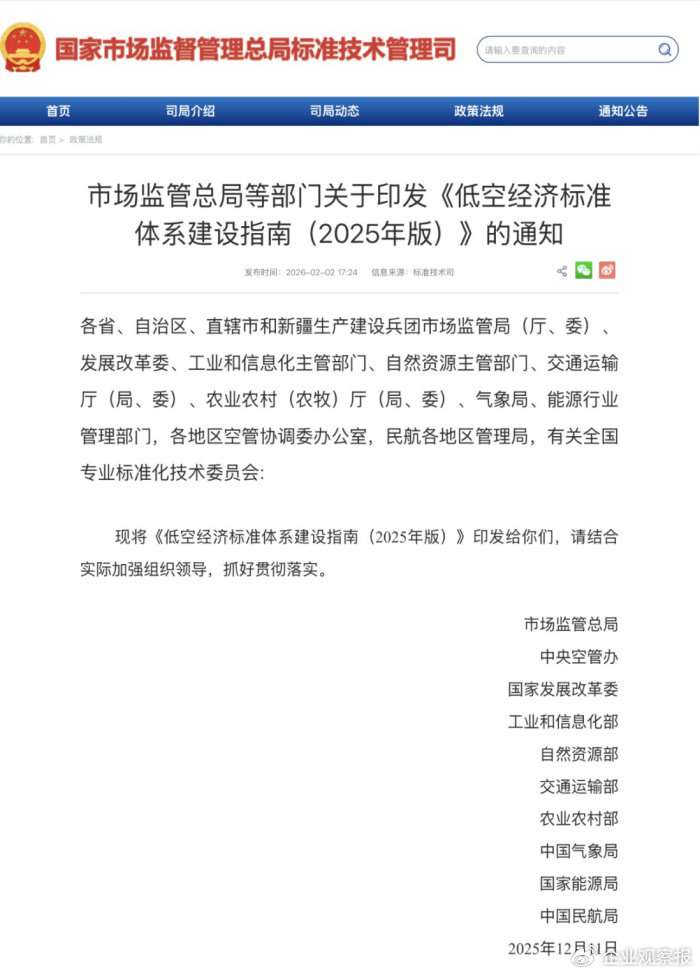
十部门联合发文明确 到2027年低空经济标准体系基本建立
Zhong Guo Zheng Quan Bao· 2026-02-02 22:10
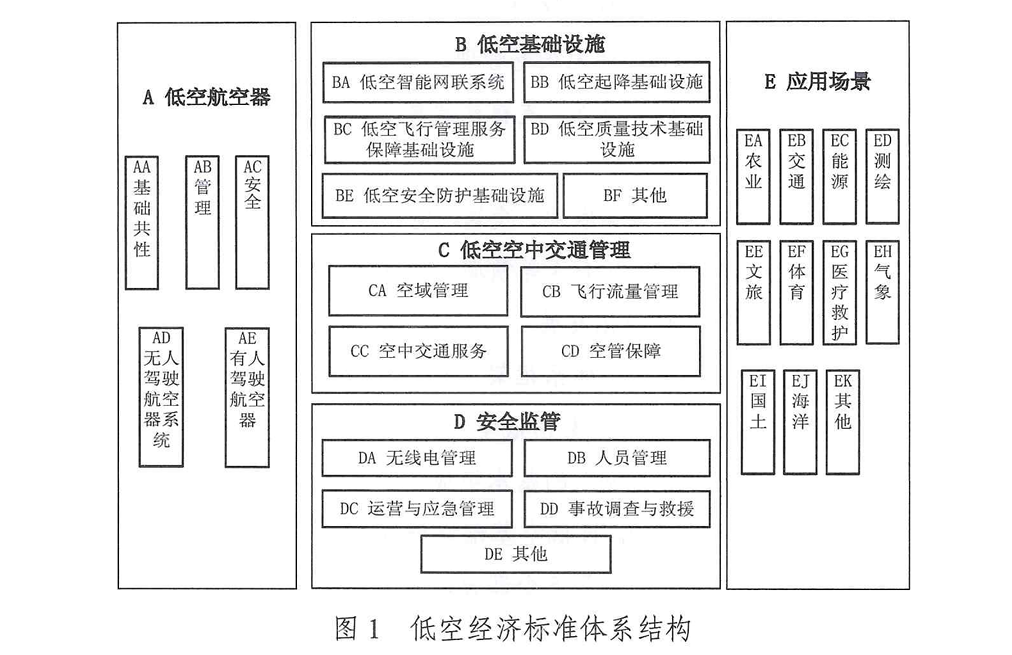
Group 1 - The core viewpoint of the news is the release of the "Low Altitude Economy Standard System Construction Guide (2025 Edition)" by ten government departments in China, indicating that the low altitude economy is entering a period of accelerated industrialization and aims to establish a comprehensive standard system by 2027 and 2030 [1][2] - The guide emphasizes the importance of standardization in promoting the high-quality development of the low altitude economy, aiming for a unified national approach and a "four-dimensional integration" standard supply system [1] - By 2030, the goal is to have over 300 standards in the low altitude economy sector, with an optimized structure that is advanced, reasonable, and internationally compatible [1] Group 2 - The low altitude aircraft standards are a core part of the standard system, focusing on safety and unmanned aerial vehicle (UAV) system standards to enhance safety, reliability, and performance levels [2] - The low altitude infrastructure standards include intelligent network systems, take-off and landing infrastructure, and safety protection infrastructure, which are essential for the efficient operation of the low altitude economy [2] - The low altitude air traffic management standards are crucial for ensuring the safe and orderly conduct of low altitude flight activities [2] Group 3 - Safety regulation standards encompass radio management, personnel management, and emergency management, which are vital for the safe and orderly development of low altitude economic activities [2] - Application scenario standards cover various fields such as agriculture, transportation, energy, and tourism, indicating a shift from concept validation to practical applications in the low altitude economy [3] - The rapid growth of low altitude-related enterprises and the continuous expansion of the low altitude economic market highlight the need for improved infrastructure, unified regulatory standards, and a market-oriented operational system for achieving scalable operations [3]
到2027年低空经济标准体系基本建立
Zhong Guo Zheng Quan Bao· 2026-02-02 20:44
Core Insights - The low-altitude economy in China is entering an accelerated industrialization phase, with a comprehensive ecosystem spanning technology research and development, equipment manufacturing, operational services, and infrastructure [1] - The guideline aims to establish a standardized system for the low-altitude economy by 2027, with over 300 standards expected by 2030 to support safe and healthy development [1] Group 1: Standardization Framework - The guideline emphasizes a "four-dimensional integration" standard supply system, merging technical standards with management norms, domestic standards with international rules, mandatory standards with recommended standards, and foundational standards with scenario standards [1] - The structure of the low-altitude economy standard system includes five core areas: low-altitude aircraft, low-altitude infrastructure, low-altitude air traffic management, safety regulation, and application scenarios [1] Group 2: Low-Altitude Aircraft Standards - Low-altitude aircraft standards are central to the standard system, focusing on safety, reliability, and performance, which will drive the upgrade and development of the aircraft manufacturing industry [2] - Key areas for standard development include safety standards, unmanned aerial vehicle systems, perception and obstacle avoidance, data link network security, and flight control system data recording [2] Group 3: Infrastructure and Management Standards - Low-altitude infrastructure standards encompass intelligent network systems, takeoff and landing facilities, flight management service support, quality technology infrastructure, and safety protection infrastructure, which are essential for efficient operation [2] - Air traffic management standards cover airspace management, flight flow management, air traffic services, and air traffic control support, ensuring safe and orderly low-altitude flight activities [2] Group 4: Safety and Application Standards - Safety regulation standards include radio management, personnel management, operational and emergency management, accident investigation and rescue, which are crucial for the orderly development of low-altitude economic activities [2] - Application scenario standards involve various sectors such as agriculture, transportation, energy, surveying, tourism, and healthcare, indicating a shift from concept validation to practical applications in the low-altitude economy [3]
十部门联手 低空经济迎重磅指南
Xin Lang Cai Jing· 2026-02-02 20:06
Core Viewpoint - The release of the "Guidelines for the Construction of Low-altitude Economic Standard System (2025 Edition)" aims to establish a comprehensive standard system for the low-altitude economy, addressing key areas such as low-altitude aircraft, infrastructure, air traffic management, safety supervision, and application scenarios [1][2]. Group 1: Standard System Development - By 2027, the low-altitude economic standard system is expected to be fundamentally established to meet safety and health development needs [1]. - By 2030, over 300 standards in the low-altitude economic field are anticipated, forming an optimized, advanced, reasonable, and internationally compatible standard system [1]. Group 2: Industry Structure and Market Potential - The domestic low-altitude economy has developed a complete industrial chain, including low-altitude manufacturing, operation, infrastructure, and supporting services [1]. - The market size of low-altitude aircraft manufacturing and operation services accounts for nearly 55% of the total, indicating significant economic value and development potential [1]. Group 3: Challenges and Solutions - Current challenges in the low-altitude economy include an incomplete safety supervision system, insufficient industry chain collaboration, and difficulties in balancing international integration with independent innovation [2]. - The standardization approach outlined in the guidelines aims to address these challenges by unifying standards for aircraft airworthiness, air traffic management, and safety supervision, thereby establishing a comprehensive risk prevention system [2]. Group 4: Impact on Enterprises and Regional Development - Compliance with standards will become a prerequisite for enterprises, driving them to increase R&D investment and improve product and service quality [3]. - Standard unification is expected to promote the formation of low-altitude economic industry clusters, attracting upstream and downstream enterprises and becoming a new growth pole for regional economies [3].

事关低空经济,十部门联合发布
Zhong Guo Zheng Quan Bao· 2026-02-02 15:26
Core Insights - The "Guidelines for the Construction of Low-altitude Economic Standard System (2025 Edition)" was jointly released by ten government departments, indicating that China's low-altitude economy is entering an accelerated industrialization phase [1] - The guidelines aim to establish a comprehensive standard system by 2027, with over 300 standards in the low-altitude economy sector by 2030, supporting safe and healthy development [1] Group 1: Standard System Structure - The low-altitude economic standard system includes five core areas: low-altitude aircraft, low-altitude infrastructure, low-altitude air traffic management, safety supervision, and application scenarios [1] - Low-altitude aircraft standards focus on safety, reliability, and performance, particularly for unmanned aerial systems and manned aircraft [2] - Low-altitude infrastructure standards encompass intelligent network systems, takeoff and landing facilities, and safety protection infrastructure, which are essential for efficient low-altitude economic operations [2] Group 2: Air Traffic Management and Safety - Air traffic management standards cover airspace management, flight flow management, and air traffic services, ensuring safe and orderly low-altitude flight activities [2] - Safety supervision standards include radio management, personnel management, and emergency management, which are crucial for the orderly development of low-altitude economic activities [3] Group 3: Application Scenarios - Application scenario standards address various fields such as agriculture, transportation, energy, and tourism, highlighting the need for standards in low-altitude applications like smart agriculture and logistics [3] - The low-altitude economy is transitioning from concept validation to practical applications, with a rapid increase in related enterprises and market scale [3]
《低空统计分类》正式印发,主要包含这些内容→
Xin Lang Cai Jing· 2025-12-26 13:54
Core Viewpoint - The release of the "Low Altitude Economy and Its Core Industry Statistical Classification (Trial)" aims to clarify the concepts and categories of the low altitude economy, supporting the development of this emerging industry in China [2][5]. Group 1: Background of the Low Altitude Economy - The Central Committee and the State Council emphasize the importance of developing the low altitude economy as part of the 15th Five-Year Plan, highlighting it as a strategic emerging industry [2]. - The low altitude economy in China is in its initial stages, with a rapidly improving policy framework, infrastructure, and business entities, showing a positive overall trend [2]. Group 2: Principles of Compilation - The statistical classification is designed to be systematic, scientific, and practical, reflecting the development characteristics of the low altitude economy [3]. - It focuses on innovation, encompassing manufacturing and service activities related to low altitude aviation, showcasing the technology-driven nature of the industry [3]. - The classification aims for precision, based on existing national economic classifications and international standards, ensuring operability and relevance to key areas of the low altitude economy [3][4]. - It balances immediate and long-term needs, allowing for adaptability to current developments while considering future growth potential [4]. Group 3: Content of the Statistical Classification - The low altitude economy consists of four main categories: low altitude manufacturing, low altitude operations, low altitude infrastructure and information services, and low altitude supporting industries, with a total of 23 subcategories and 65 small categories [5]. - Low altitude manufacturing includes the production of aircraft and related materials, while low altitude operations cover various flight services [5]. - Low altitude infrastructure and information services pertain to the construction and engineering services supporting low altitude activities, and low altitude supporting industries provide technical research and support services [5][6].
“空中纽北”落户大鹏
Nan Fang Du Shi Bao· 2025-12-10 23:14
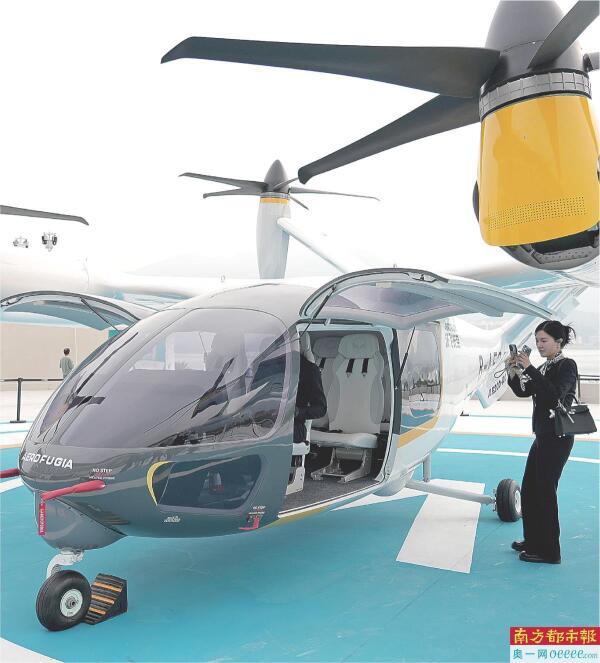
Core Insights - The Dapeng New Area drone testing base in Shenzhen, Guangdong, has officially opened, showcasing various low-altitude aircraft [2] - Twelve companies will be the first low-altitude scene partners to settle in the base [2] - The base aims to create China's first eVTOL "Air Nürburgring" track, providing comprehensive testing space for enterprises [2] - The focus will be on real-world scenario pilot projects in three main directions: island logistics, low-altitude tourism, and emergency rescue [2]
我国将稳妥推动低空装备产业安全健康发展 “多点发力”完善发展路径
Yang Shi Wang· 2025-11-30 02:48
Core Insights - China is set to promote the safe and healthy development of the low-altitude equipment industry, focusing on multiple aspects to improve the development path of the industry [1][3] Group 1: Industry Development Plans - The Ministry of Industry and Information Technology (MIIT) has released several research reports, including a roadmap for power battery technology for low-altitude aircraft, aiming for energy density of 220-250 Wh/kg by 2025 and 330-400 Wh/kg by 2030 [1] - A framework for the standard system of the low-altitude equipment industry has been proposed, covering seven areas including low-altitude aircraft, infrastructure, and test flights [1] Group 2: Technological Integration and Opportunities - The integration of new energy and next-generation information technology with the low-altitude equipment industry is creating new opportunities, indicating a positive development trend and significant potential for the industry [3] Group 3: Strategic Focus and Goals - The MIIT plans to enhance top-level design with a focus on intelligence, greenness, and integration, aiming to enrich the product spectrum of low-altitude equipment and build a high-level industrial and supply chain [5] - Key technologies such as aviation power batteries and flight control systems will be prioritized, along with the promotion of application demonstrations for low-altitude equipment in logistics, agricultural operations, emergency rescue, and short-distance passenger transport [7]

黑龙江“十五五”规划建议发布:做强星网产业链 发展卫星制造、测控和数据地面应用
Zheng Quan Shi Bao Wang· 2025-11-25 02:15
Core Insights - The proposal from the Heilongjiang Provincial Committee emphasizes the cultivation and expansion of emerging and future industries [1] Industry Development - Implementation of industrial innovation projects to promote the construction of innovation facilities, technology research and development, and product iteration [1] - Establishment of a national heavy equipment manufacturing base, focusing on high-end equipment, aerospace, and new materials to develop trillion-level industrial clusters [1] - Development of a northern manufacturing base for the electronic information industry and a pilot zone for large high-power intelligent agricultural machinery [1] Economic Expansion - Acceleration of the low-altitude economy, enhancing the manufacturing industry of low-altitude aircraft and expanding applications in agricultural protection, emergency rescue, and logistics [1] - Strengthening the satellite industry chain, including satellite manufacturing, control, and data ground applications [1] - Promotion of deep processing of graphite and innovation in the supply of development policies for strategic emerging industries [1] - Encouragement of large-scale application demonstrations for new technologies, products, and scenarios to accelerate the development of emerging industries [1]
广东出台低空经济新政“16条”,提出支持航空体育运动发展
Nan Fang Du Shi Bao· 2025-10-24 15:16
Core Viewpoint - The Guangdong Provincial Government has issued measures to support the high-quality development of the low-altitude economy, focusing on safety, innovation, and infrastructure development to establish Guangdong as a leading hub for low-altitude economic activities [1][2]. Group 1: Policy Measures - The measures include 16 initiatives covering low-altitude safety, research and development, airworthiness certification, infrastructure, and application scenarios [1]. - The measures will be effective for three years and apply to all enterprises and institutions engaged in low-altitude economic activities in Guangdong [1]. - A priority is placed on enhancing regulations and ensuring safety, with plans to optimize low-altitude air routes and improve airspace management [1]. Group 2: Technological Development - The measures emphasize key technologies in new aircraft configurations, critical components, basic software, and low-altitude flight support, establishing a selection mechanism for core technology projects [2]. - Financial support will be provided for low-altitude economic projects included in the provincial key research and development plan, encouraging increased R&D investment from low-altitude enterprises [2]. - Support will also be given for the establishment of provincial-level pilot platforms and engineering technology research centers in low-altitude fields [2]. Group 3: Enterprise Support - The measures aim to cultivate strong low-altitude enterprises through direct financing and leasing support for technology transformation projects [3]. - Enterprises recognized as national champions or specialized "little giants" in the low-altitude sector will receive additional incentives from local governments [3]. - The measures highlight the importance of application fields, particularly in cities like Guangzhou, Shenzhen, and Zhuhai, for developing low-altitude passenger routes and cross-border drone logistics [3]. Group 4: Application Scenarios - The measures propose the issuance of low-altitude tourism consumption vouchers and the promotion of low-altitude tourism businesses in collaboration with scenic spots and general airports [4]. - Support will be extended to aviation sports events and activities, as well as the use of low-altitude technologies in public service sectors such as emergency rescue and medical care [4]. - The creation of comprehensive low-altitude economic application scenarios will be encouraged, with selected areas receiving enhanced support for airspace security and technical backing [5].