国家实力

Search documents
柴达木盆地发现4000亿吨金属盐,外国得知后想与我国资源共享
Sou Hu Cai Jing· 2025-12-31 10:07
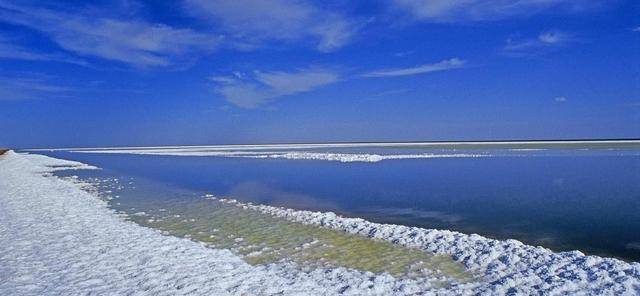
Core Viewpoint - China's vast territory and rich natural resources are crucial for its development, contributing to its rise as a global power despite some international biases against it [1]. Group 1: Resource Discovery and Environmental Protection - China has increased its focus on environmental protection, particularly regarding the extraction of non-renewable resources, moving away from excessive exploitation [3]. - Significant discoveries in the Qaidam Basin include over 400 billion tons of metal salts valued at over 90 trillion RMB, which are expected to meet China's resource needs for decades [3]. - The Qaidam Basin also contains abundant magnesium and potassium salts, which are vital for China's development [3]. Group 2: International Relations and National Strength - The discovery of resources has attracted interest from other countries, some of which express jealousy and suggest that these resources should be shared globally, a notion that China rejects [3]. - The article emphasizes the need for China to strengthen its national power to mitigate external pressures and jealousy from other nations [3]. - The belief is that only by becoming the strongest nation will China silence its detractors and secure its position on the global stage [3].

祖国强大,人人自豪!戚继光舰、沂蒙山舰在港掀起“海军热”
Xin Hua She· 2025-10-03 14:15
Core Viewpoint - The visit of the Chinese Navy's Qijiang and Yimengshan ships to Hong Kong has sparked a wave of enthusiasm for the navy among the local population, highlighting national pride and the importance of military presence in the region [1][2][6]. Group 1: Naval Presence and Activities - The Qijiang ship, a training vessel with a displacement of over 9,000 tons, and the Yimengshan ship, a Type 071 dock landing ship with a normal displacement of over 19,000 tons, represent the modern capabilities of the Chinese Navy [2]. - The naval fleet's arrival coincided with the 76th anniversary of the founding of the People's Republic of China, marked by a solemn flag-raising ceremony attended by naval personnel and local citizens [4]. - The open ship activities attracted over 20,000 participants, with 11,000 tickets issued for public visits, indicating strong community interest [2][6]. Group 2: Community Engagement and Education - The event served as a significant national security education opportunity for students, allowing them to experience the technological advancements and modernization of the navy firsthand [6]. - Activities included demonstrations of naval skills, such as knot tying and weapon handling, fostering interaction between naval personnel and the public [5][6]. - The presence of veterans and their emotional responses to the modern navy equipment underscored a deep sense of national pride and connection to the military [5][6]. Group 3: Media Coverage and Public Sentiment - The event received extensive media coverage, with major newspapers and social media platforms highlighting the activities and public engagement, further amplifying the sense of national pride [6]. - Citizens expressed their admiration for the navy's capabilities, with many sharing personal stories and experiences related to military service, reinforcing a collective identity and pride in national defense [5][6].
俄罗斯战略专家:“在伊朗心里,中国已经是最强大超级大国了”
Sou Hu Cai Jing· 2025-09-23 05:24
Core Insights - The article discusses how a country's true strength is often reflected in the attitudes of its neighbors, particularly focusing on China's influence on countries like Vietnam, Laos, and Mongolia [1] - Iran's changing perception of China is highlighted, with Iran now viewing China as the "most powerful superpower" due to China's historical actions and military capabilities [1][3] Historical Context - In the 1950s, China's military engagement during the Korean War demonstrated its capability to withstand significant pressure, earning respect from Iran [3] - The 1960s saw China resist Soviet aggression, which impressed Iranian military scholars who noted China's determination and resilience [3] - The Vietnam War in the 1970s showcased China's strategic support, leading to a significant U.S. military withdrawal, further solidifying Iran's respect for China's military prowess [3] Recent Developments - The 2019 India-Pakistan air conflict and the 2016 South China Sea standoff illustrated China's military advantages, reinforcing Iran's view of China's strength [5] - Iran's recent military shortcomings against Israel have prompted reflections on the need for advanced military technology, which China can provide [7] Economic and Strategic Cooperation - A strong nation requires not only military power but also a stable supply chain and industrial capabilities, which China has demonstrated through its partnerships with neighboring countries [8] - Iran's choice lies between continuing to face asymmetric threats alone or deepening cooperation with China across various sectors, including energy and technology [8]