国家形象

Search documents
当考拉与熊猫同框
Jin Rong Shi Bao· 2025-11-07 03:36
Core Insights - The 2025 Beijing International Coin Expo showcased unique animal-shaped precious metal commemorative coins, with the Perth Mint as a key international exhibitor [1][2] - The Perth Mint has a long history, having started refining gold in 1899 and producing investment coins since 1986, with 90% of its revenue coming from export [2][3] Group 1: Product Offerings - The Perth Mint introduced a special commemorative silver coin featuring both the koala and panda, symbolizing the cultural connection between Australia and China, with a target sales volume of 2,500 pieces [2] - A new set of three 1-ounce silver coins themed around the Year of the Horse was launched, with a total issuance of 1,500 sets, designed by a Malaysian designer [3] - The Perth Mint emphasizes the importance of annual design changes for investment coins to stimulate the secondary market, leveraging unique Australian wildlife as a continuous source of design inspiration [4] Group 2: Market Position and Strategy - The Perth Mint has established itself as a global leader in the investment coin and commemorative coin market, focusing on high-quality gold, silver, and platinum products [2][7] - The Mint collaborates with indigenous artists to enhance the cultural narrative of its coins, aligning with global collectors' values of cultural diversity and ecological awareness [4] - The Chinese panda gold coin series, launched in 1982, has become one of the world's top investment coins, promoting awareness and conservation of the giant panda while reflecting China's openness and confidence [5][6] Group 3: Investment Appeal - Investors are particularly interested in the NGC grading system, which assesses the quality of coins, with high grades leading to significant market premiums of 30% to 60% [6] - The Perth Mint's coins are viewed as art pieces, requiring high technical standards in design and production, which enhances their appeal to collectors [6]
皮尤调查:中国海外形象正在提升
Sou Hu Cai Jing· 2025-07-17 03:53
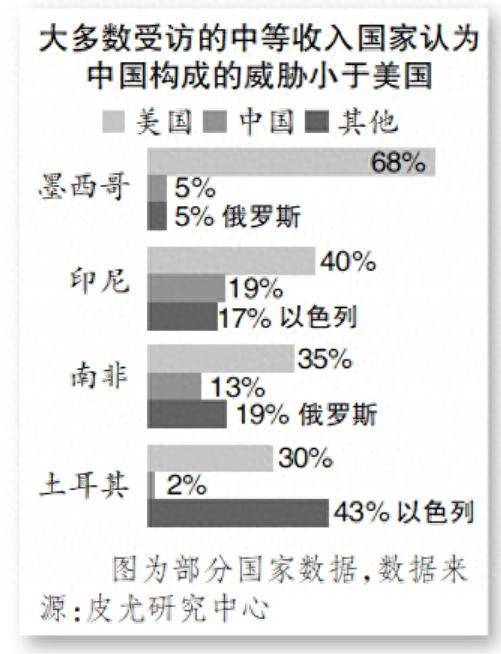
Core Viewpoint - The recent Pew Research Center survey indicates an improvement in global public perception of China over the past year, while the perception of the United States has declined, coinciding with Trump's return to the White House and his announcement of new tariffs [2][4]. Group 1: Global Perception Trends - In high-income countries, the median percentage of respondents with a positive view of China is 32%, the highest in six years, while the positive perception of the U.S. has dropped to 35%, the lowest since 2017 [2][4]. - Among 24 countries surveyed, 8 countries have a significantly higher positive perception of the U.S. compared to China, with Israel showing the largest gap at 83% for the U.S. and 33% for China [3]. - Conversely, 7 countries, including Spain and Mexico, have a higher positive perception of China than the U.S., with Mexico showing 56% positive views for China and only 29% for the U.S. [3]. Group 2: Economic Perceptions - Half of the surveyed countries consider China to be the world's leading economic power, a significant shift from two years ago when more people viewed the U.S. as the top economy [4]. - In France, 43% of respondents view both China and the U.S. as the leading economies, while by 2025, 49% are expected to see China as the top economy [4]. Group 3: Allies and Threats - Most respondents still view the U.S. as their most important ally, but many also perceive the U.S. as a significant threat, particularly in Europe and Latin America [5]. - In several European countries, the U.S. is seen as the second-largest threat after Russia, while in Latin America, it is often viewed as the top threat [5].

调查显示近八成国家对华看法正面,美媒:中国影响力稳步攀升
Huan Qiu Shi Bao· 2025-05-15 22:49
Core Insights - The survey conducted by Nira Data indicates that over three-quarters of the 100 countries and regions surveyed have a more favorable view of China compared to the United States, highlighting a significant decline in the global image of the U.S. while China's influence is steadily increasing [1][3] Summary by Categories Survey Results - The survey, conducted from April 9 to 23, gathered opinions from over 111,000 respondents globally. The countries' images were ranked on a scale from -100% to +100% [3] - Compared to 2024, the U.S. net positive image dropped from +22 to -5, while China's net positive image rose by 9 units to +14 [3] - 79% of respondents viewed China positively, with the highest support found in the Middle East, North Africa, and Sub-Saharan Africa [3] Regional Perspectives - Countries such as Algeria, Egypt, Pakistan, and Tunisia showed nearly unanimous support for China [3] - In contrast, only 45% of respondents held a positive view of the U.S., with negative perceptions prevalent in Canada, Mexico, and most EU countries, which are traditional allies of the U.S. [3] Implications - The report emphasizes that China is currently the only major power with a net positive image among the surveyed nations [3] - The CEO of Nira Data noted that the shift in public opinion reflects the evolving perceptions of different regions and political systems regarding the actions of the U.S. in international affairs [3] - A professor from the Diplomatic Academy highlighted that the poll reflects the majority's impression of the U.S.'s role in global affairs, while China's image as a stabilizing force is gaining recognition [3]