图像生成大模型

Search documents
阿里、字节同日上新,图像大模型激战“春节档”
第一财经· 2026-02-11 07:50
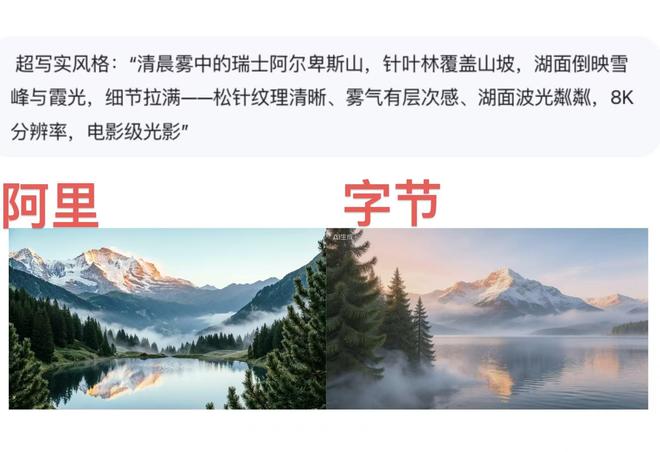
Core Viewpoint - The article discusses the rapid advancements in image generation models, particularly focusing on the competition between Alibaba's Qwen-Image-2.0 and ByteDance's Seedream 5.0, highlighting their unique features and capabilities in addressing user needs and practical applications [3][18]. Group 1: Model Comparisons - Qwen-Image-2.0 integrates both image generation and editing capabilities into a single model architecture, enhancing its ability to render Chinese characters and process complex instructions [5][22]. - Seedream 5.0 introduces features such as image retrieval and improved understanding of prompts, allowing for more detailed and precise image generation [5][22]. - In comparative tests, Qwen-Image-2.0 was favored for its realistic rendering of landscapes, while Seedream 5.0 excelled in creating atmospheric and artistic images [11][15]. Group 2: Technical Advancements - Both models have shown significant improvements in image clarity and detail, with Qwen-Image-2.0 focusing on realistic textures and Seedream 5.0 emphasizing a more impressionistic style [8][15]. - The models are evolving from merely generating images to understanding user intent and providing controllable editing capabilities, indicating a shift towards practical usability [18][20]. - Future developments may include features like "information graphics," which generate multiple related images, and layer separation for more complex editing, reflecting industry demands [23][24]. Group 3: Market Positioning and Applications - ByteDance is integrating Seedream 5.0 into its ecosystem, including platforms like CapCut, to enhance content creation capabilities and maintain a competitive edge in the market [22][24]. - Alibaba's Qwen-Image-2.0 is expected to be integrated with its e-commerce and design services, targeting applications in professional presentations and marketing materials [22][24]. - The article emphasizes the importance of aligning model capabilities with real-world applications, suggesting that Chinese companies have opportunities to leverage advancements in AIGC for rapid market deployment [24].



阿里、字节同日上新,图像大模型激战“春节档”
Di Yi Cai Jing Zi Xun· 2026-02-11 06:29
Core Insights - The competition in the image generation model sector is intensifying, with major players like Alibaba Cloud and ByteDance launching new models ahead of the Spring Festival, focusing on practical problem-solving rather than just generating visually appealing images [1][14]. Group 1: Model Comparisons - Alibaba's Qwen-Image-2.0 integrates image generation and editing capabilities into a single model, enhancing its ability to render Chinese characters and process complex instructions with an input token expansion to 1K [2][4]. - ByteDance's Seedream 5.0 introduces features like image retrieval and improved understanding of prompts, allowing for more detailed and precise image generation [2][4]. - In comparative tests, Qwen-Image-2.0 was favored for its realistic style and detail accuracy, while Seedream 5.0 excelled in creating atmospheric and artistic images [8][10]. Group 2: Technical Advancements - Both models show significant improvements in image clarity and detail, with Qwen-Image-2.0 demonstrating superior handling of textures and spatial depth, while Seedream 5.0 offers a more impressionistic aesthetic [9][10]. - The models still face challenges in accurately interpreting complex prompts, indicating room for further development in understanding user intent [13][14]. Group 3: Future Directions - The industry is shifting focus from mere image generation to creating images that effectively solve specific problems, with a growing emphasis on usability in real-world applications [14][15]. - Future developments may include features like "information graphics," which allow for the generation of multiple related images in one go, enhancing utility in fields like comics and presentations [16][17]. - The demand for "layer separation" in generated images is emerging, which would allow for more detailed editing similar to traditional graphic design software [17].