地球2.0

Search documents
【科技日报】寻找“地球2.0”
Ke Ji Ri Bao· 2025-11-26 02:48
Core Viewpoint - The Chinese Academy of Sciences' National Space Science Center announced several space exploration satellite plans during the "14th Five-Year Plan" period, including a mission to search for Earth-like exoplanets, referred to as "Earth 2.0" [1] Group 1: Importance of Searching for "Earth 2.0" - The search for "Earth 2.0" is driven by human curiosity about the existence of life beyond Earth [2] - Finding "Earth 2.0" could provide a "backup home" for humanity, addressing existential threats such as resource depletion and global warming [2] - Researching Earth-like planets may help understand Earth's past and future, and answer philosophical questions about humanity's uniqueness in the universe [2] Group 2: Criteria for "Earth 2.0" - "Earth 2.0" must meet strict criteria regarding its physical properties, stellar environment, and habitability conditions [3] - The planet's radius should be between 0.8 to 1.25 times that of Earth, ensuring a solid surface and atmosphere [3] - It must orbit a sun-like star within the "habitable zone" to maintain liquid water on its surface [3] - A suitable atmosphere and a stable global magnetic field are essential for protecting life [3] Group 3: Current Discoveries in the Search for Earth-like Planets - The Kepler Space Telescope has discovered over 6,000 exoplanets, but none have been Earth-sized and within the habitable zone [4] - Significant milestones include the first confirmed exoplanets in 1992 and the discovery of the first Earth-sized rocky planet, Kepler-10b, in 2011 [4][5] - In 2017, a system with seven Earth-sized planets was confirmed, with several potentially having conditions for liquid water [5] - China's contributions include the discovery of a "super-Earth" in the habitable zone, which is ten times the mass of Earth [5]
寻找“地球2.0”
Ke Ji Ri Bao· 2025-11-26 00:15
Core Viewpoint - The Chinese Academy of Sciences announced plans for a space exploration satellite aimed at finding Earth-like exoplanets, referred to as "Earth 2.0," during the latest highlights release of the space science pilot project on November 24 [1] Group 1: Importance of Finding "Earth 2.0" - The search for "Earth 2.0" is driven by human curiosity about the existence of life beyond Earth and the potential for finding a backup home for humanity amid existential threats like resource depletion and climate change [2] - Discovering "Earth 2.0" could provide insights into Earth's past and future, and answer philosophical questions about humanity's uniqueness in the universe [2] Group 2: Criteria for "Earth 2.0" - "Earth 2.0" must meet strict criteria, including being a rocky planet with a radius between 0.8 to 1.25 times that of Earth, ensuring a solid surface and a stable atmosphere [3] - It should orbit a sun-like star within the habitable zone to maintain liquid water, with a suitable atmosphere to filter harmful radiation and support life [3] Group 3: Current Discoveries in Exoplanet Research - The Kepler Space Telescope has discovered over 6,000 exoplanets, but none have been found that are both Earth-sized and within the habitable zone [4] - Significant milestones in exoplanet discovery include the first confirmed exoplanets in 1992 and the identification of Kepler-186f as the first Earth-sized planet in the habitable zone in 2014 [5] - China's contributions to exoplanet research include the discovery of "super-Earth" Kepler-725c, which is about ten times the mass of Earth, showcasing advancements in astronomical detection techniques [5]
中国科学家领衔国际研究团队发现“超级地球”
Huan Qiu Wang Zi Xun· 2025-06-04 08:43
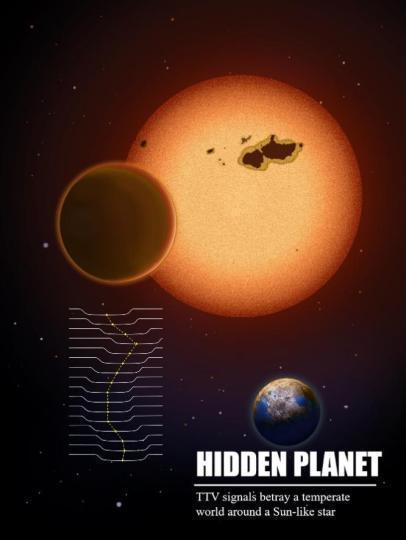
Core Insights - An international research team led by the Yunnan Astronomical Observatory of the Chinese Academy of Sciences has discovered a "super-Earth" named Kepler-725c located in the habitable zone of a sun-like star, with a mass approximately 10 times that of Earth [1][4] - This discovery marks the first time that the Transit Timing Variation (TTV) inversion technique has been used to identify such a planet in the habitable zone of a sun-like star [1][4] - The host star, Kepler-725, is a G9V type star, younger than the Sun at 1.6 billion years old, and exhibits more intense magnetic activity [1][4] Discovery Methodology - The planet Kepler-725c was not initially detected by the Kepler Space Telescope but was inferred through the observation of timing deviations in the transit of another planet within the Kepler-725 system [2][4] - The TTV inversion technique allows for the detection of "hidden" planets without needing to observe them directly, relying instead on the measurement of transit times of resonant planets [4] Future Implications - The new methodology and subsequent research outcomes will support future Chinese space astronomy missions, such as the Chinese Space Station Telescope (CSST) and the Earth 2.0 (ET) project, by providing new observational targets and detection techniques [5] - The research team plans to apply the TTV inversion technique to more exoplanet systems to search for "hidden" planets in the habitable zones of sun-like stars and red dwarf stars [5]