系外行星探测

Search documents
哈勃望远镜捕获25光年外小行星史诗级碰撞
Huan Qiu Wang· 2025-12-26 03:03
Core Insights - Astronomers have observed a rare asteroid collision event in the Fomalhaut star system, located 25 light-years from Earth, using the Hubble Space Telescope, marking a significant breakthrough in astronomical research [1][2] Group 1: Discovery and Observations - The international team discovered two independent bright spots in the Fomalhaut system's observational data in 2004 and 2023, initially misidentified as a gas giant planet named Dagon, which was confirmed in 2012 but disappeared in 2014 [2] - The latest research revealed that Dagon was not a true planet but a massive dust cloud formed from an asteroid collision, now renamed cs1, which is gradually dispersing in space [2] - In 2023, a new light source, named cs2, was identified, initially thought to be a reappearance of Dagon, but confirmed to be a distinct source through precise comparison with historical images [2] Group 2: Implications for Exoplanet Research - The phenomenon poses significant challenges for future exoplanet detection missions, as dust clouds can create false positive signals [3] - The Fomalhaut star system, approximately 440 million years old, is in a "violent growth phase" similar to the early solar system, with an estimated 300 million similar-sized asteroids potentially present in the outer region [3] Group 3: Theoretical Challenges - This discovery challenges existing astrophysical theories, as previous models suggested such large-scale collisions should occur once every 100,000 years, yet two have been observed in just 20 years [3] - The high frequency of impacts indicates that the dynamics within the Fomalhaut system are highly active, providing valuable observational samples for studying the formation and evolution of star systems [3]

【新华社】再探宇宙奥秘!我国将发射四大科学卫星
Xin Hua She· 2025-11-26 02:48
Core Insights - China's space exploration initiatives are set to advance significantly during the "14th Five-Year Plan" period, with plans to launch four scientific satellite missions aimed at uncovering the mysteries of the universe and expanding human understanding of its boundaries [2] Group 1: Satellite Missions - The "Hongmeng Plan" will deploy its first probe satellite to the far side of the moon, forming a low-frequency radio telescope array with ten satellites to capture faint signals from the universe's early chaotic period [3] - The "Kuafu-2" satellite will be the first to orbit the sun's poles, providing direct observations of solar activity and enhancing understanding of solar storms and their impact on Earth [4] - The exoplanet survey satellite aims to identify Earth-sized planets within habitable zones, potentially leading to the discovery of a "second Earth" [5][6] Group 2: Scientific Objectives - The eXTP space observatory will explore extreme environments near black holes and neutron stars, testing Einstein's theories and searching for new physical laws beyond current frameworks [7] - The overall network of satellites will cover a range of topics from cosmic origins to solar activity, extraterrestrial life, and extreme physics, with each mission having the potential to reshape our understanding of the universe [8]
【科技日报】寻找“地球2.0”
Ke Ji Ri Bao· 2025-11-26 02:48
Core Viewpoint - The Chinese Academy of Sciences' National Space Science Center announced several space exploration satellite plans during the "14th Five-Year Plan" period, including a mission to search for Earth-like exoplanets, referred to as "Earth 2.0" [1] Group 1: Importance of Searching for "Earth 2.0" - The search for "Earth 2.0" is driven by human curiosity about the existence of life beyond Earth [2] - Finding "Earth 2.0" could provide a "backup home" for humanity, addressing existential threats such as resource depletion and global warming [2] - Researching Earth-like planets may help understand Earth's past and future, and answer philosophical questions about humanity's uniqueness in the universe [2] Group 2: Criteria for "Earth 2.0" - "Earth 2.0" must meet strict criteria regarding its physical properties, stellar environment, and habitability conditions [3] - The planet's radius should be between 0.8 to 1.25 times that of Earth, ensuring a solid surface and atmosphere [3] - It must orbit a sun-like star within the "habitable zone" to maintain liquid water on its surface [3] - A suitable atmosphere and a stable global magnetic field are essential for protecting life [3] Group 3: Current Discoveries in the Search for Earth-like Planets - The Kepler Space Telescope has discovered over 6,000 exoplanets, but none have been Earth-sized and within the habitable zone [4] - Significant milestones include the first confirmed exoplanets in 1992 and the discovery of the first Earth-sized rocky planet, Kepler-10b, in 2011 [4][5] - In 2017, a system with seven Earth-sized planets was confirmed, with several potentially having conditions for liquid water [5] - China's contributions include the discovery of a "super-Earth" in the habitable zone, which is ten times the mass of Earth [5]
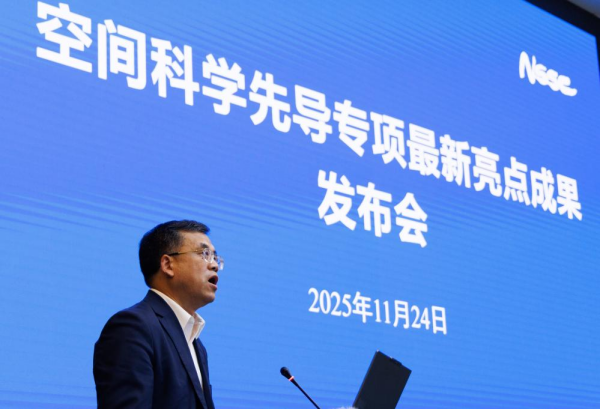
“十五五”期间,中国将实施“系外地球2.0”等科学卫星计划
Xin Jing Bao· 2025-11-24 13:53
Core Insights - The Chinese Academy of Sciences (CAS) is set to implement a space exploration satellite program during the "14th Five-Year Plan" period, which includes projects like the "Hongmeng Plan" and "Kuafu II" [1][2] - The program aims to address significant frontier issues such as the origins of the universe, space weather, and life, with a focus on achieving breakthroughs in areas like the cosmic dark ages and exoplanet detection [1] Group 1 - The CAS has successfully launched eight scientific satellite missions since 2011, achieving several major original results and setting multiple records in China and globally [1] - The "Hongmeng Plan" will utilize a "1+9" satellite configuration to investigate the early dark ages and the evolution of the universe [1] - "Kuafu II" will provide direct imaging of the solar poles, marking a significant advancement from the previous "Kuafu I" mission, which monitored the sun from the ecliptic plane [1] Group 2 - The motivation for exoplanet exploration stems from human curiosity about the existence of life beyond Earth, particularly on planets similar to Earth [2] - The Kepler Space Telescope has discovered over 6,000 exoplanets, primarily "super-Earths" that are larger than Earth, but no Earth-sized rocky planets in the habitable zone have been found yet [2] - China's upcoming exoplanet survey mission aims to locate "Earth 2.0" within the next five years [2]
宇宙人(1756期)新发现一颗"超级地球"!可能存在碳基生命;马斯克预告:SpaceX今年营收155亿美元;空客构建卫星通信生态
Sou Hu Cai Jing· 2025-06-04 14:19
Group 1: Space Exploration and Technology - An international research team led by Gu Shenghong from the Yunnan Observatory of the Chinese Academy of Sciences has discovered a "super-Earth" named Kepler-725c in the habitable zone of a sun-like star, which may support carbon-based life [2][4] - SpaceX is projected to generate approximately $15.5 billion in revenue for the fiscal year 2025, with expectations to surpass NASA's budget in 2026 [8][10] - Voyager Technologies has initiated its IPO with a target valuation of $1.6 billion, aiming to raise $367 million for research and strategic acquisitions [21] Group 2: Meteorological and Satellite Communication Developments - China's new P-band meteorological sounding system has significantly improved weather forecasting capabilities, with applications in 131 operational stations and 353 data relay stations nationwide [5] - Airbus is developing a satellite communication ecosystem through the HBCplus project, enhancing connectivity options for aircraft and allowing airlines to choose service providers [15][17] - South Korea has approved SpaceX and OneWeb to provide satellite internet services, with operations expected to commence as early as June [18][19] Group 3: Commercial Space Initiatives - Aerospace company Hangtian Hongtu reported a loss of 1.393 billion yuan in 2024 due to the suspension of military procurement qualifications, prompting a shift towards commercial space initiatives [6] - The establishment of the largest satellite ground station in Sichuan Province is underway, which will enhance satellite data transmission efficiency and attract related businesses [7]