基金公司增资

Search documents
谁在真金白银增持睿远基金?
2 1 Shi Ji Jing Ji Bao Dao· 2026-02-12 13:49
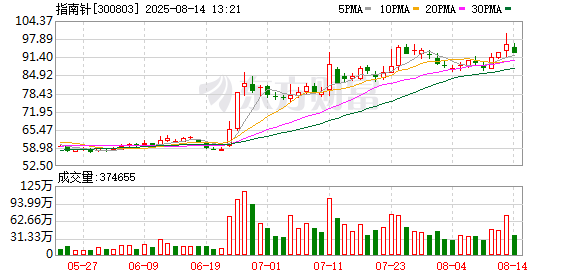
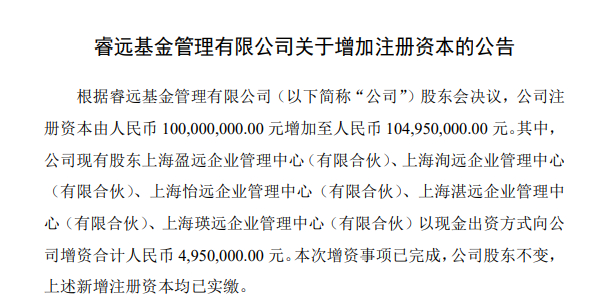
Core Viewpoint - Ruiyuan Fund has increased its registered capital from 100 million to 104.95 million yuan, with five employee stockholding platforms contributing a total of 4.95 million yuan, indicating a strategic move to enhance employee ownership rather than a response to operational pressure [1][3]. Group 1: Capital Increase Details - The capital increase was completed with contributions from five existing employee stockholding platforms, led by Shanghai Yingyuan, which contributed over 65% of the total increase [4]. - Shanghai Yingyuan's contribution increased from 1.3501 million yuan to 4.6001 million yuan, making it the largest contributor among the platforms [4][5]. - The capital increase involved 16 core employees, with four key investment research personnel each contributing 700,000 yuan [6][7]. Group 2: Shareholding Structure - After the capital increase, Chen Guangming's shareholding decreased to 47.57%, but his control over the company increased through partnership interests [3][4]. - The total shareholding of the seven employee stockholding platforms is now 24.63% [4]. - The updated shareholding structure shows Chen Guangming as the largest shareholder, followed by Fu Pengbo at 11.43% and Liu Guifang at 6.86% [5]. Group 3: Industry Context - The capital increase at Ruiyuan Fund is part of a broader trend in the industry, with several firms, including Hongyi Yuanfang Fund and Huazhong Securities, also announcing capital increases to support operations amid challenges [10]. - As of the end of 2025, Ruiyuan Fund managed approximately 64.918 billion yuan in assets, ranking 81st among 167 public fund institutions [8].

成立8年7次增资,中小公募“造血”难,哪些公司还有机会?
券商中国· 2026-02-05 03:31
Core Viewpoint - The article discusses the recent capital increase of Hongyi Yuanfang Fund, highlighting the ongoing trend of capital injections in small and medium-sized public funds, while emphasizing the need for these funds to develop internal capabilities rather than relying on external financial support [1][2]. Group 1: Capital Increase Details - On February 4, Hongyi Yuanfang Fund announced a capital increase of 29 million yuan, marking its seventh capital increase since its establishment in 2018 [1][3]. - After this increase, the registered capital of Hongyi Yuanfang Fund rose from 380 million yuan to 409 million yuan, ranking 35th among 150 public fund companies in terms of registered capital [3]. - The fund's current non-monetary management scale is 8.05 billion yuan, placing it outside the top 140 in the industry [3]. Group 2: Industry Trends and Challenges - Many small and medium-sized public funds, including Nanhua Fund and Lianbo Fund, have also received frequent capital injections, but these efforts have yielded limited results [2][7]. - The article notes that despite multiple capital increases, funds like Hongyi Yuanfang and Lianbo Fund have struggled to grow their non-monetary management scales, with Hongyi Yuanfang's scale being less than 1 billion yuan [7]. - A significant number of public funds (105 out of 150) have non-monetary management scales below 100 billion yuan, indicating a challenging environment for smaller players [9]. Group 3: Strategic Insights - The article suggests that the long-term success of fund companies relies on their internal "self-generating" capabilities rather than external capital injections [2][9]. - It highlights the "Matthew Effect," where only a few small and medium-sized public funds can thrive through differentiated competition, while many others face saturation in their business areas [9]. - The article concludes that specialized funds focusing on unique client needs may still find opportunities in the evolving market landscape, despite the challenges faced by the majority of small and medium-sized public funds [10].

外资机构,密集增资
Zhong Guo Ji Jin Bao· 2025-11-11 07:21
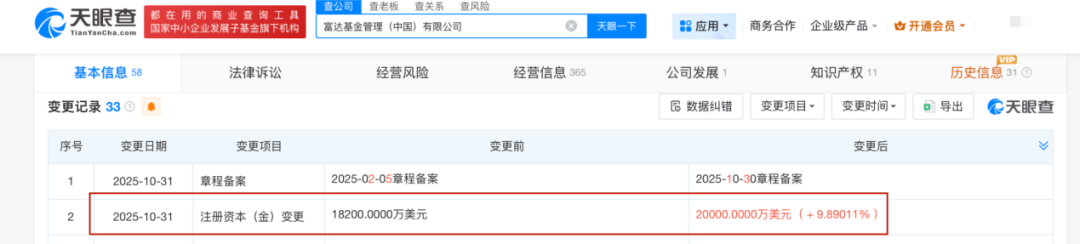
Core Insights - Fidelity Fund Management (China) has increased its registered capital from $182 million to $200 million, marking an increase of nearly 10% [1][2] - This is the second capital increase for the company this year, with the first increase occurring in February when the capital rose from $160 million to $182 million, a growth of 13.75% [2] Company Overview - Fidelity Fund Management (China) was established in May 2021 and received approval in December 2022 to conduct public offering securities investment fund management, fund sales, and private asset management [3] - The company is wholly owned by Fidelity Asia Holdings Private Limited, which is a subsidiary of Fidelity International [3] Fund Management Scale - As of the end of Q3 this year, Fidelity Fund Management (China) manages a total of 10 fund products, including equity, mixed, bond, and public fund of funds (FOF), with a total management scale of 3.571 billion yuan [4] Industry Trends - Over a dozen public fund companies have implemented capital increases this year, totaling over 2 billion yuan [5] - The capital increases are primarily seen among small to medium-sized fund companies, reflecting the competitive nature of the public fund industry [5] - Increased capital from shareholders can alleviate operational pressures and enhance capital strength, allowing companies to invest more in product management, business expansion, research, and talent development [5] - The actions of foreign public funds to increase capital indicate a long-term confidence in the Chinese capital market [6]
外资机构,密集增资
中国基金报· 2025-11-11 07:07
Core Viewpoint - Fidelity Fund Management (China) Co., Ltd. has increased its registered capital from $1.82 billion to $2 billion, marking an increase of nearly 10% [2][4]. Group 1: Company Overview - Fidelity Fund Management (China) Co., Ltd. was established in May 2021 and received approval in December 2022 to conduct public offering securities investment fund management, fund sales, and private asset management [4]. - The company is wholly owned by Fidelity Asia Holdings Private Limited, which is a subsidiary of Fidelity International [4]. Group 2: Recent Capital Increases - In 2023, Fidelity Fund Management (China) has completed two capital increases: the first from $1.6 billion to $1.82 billion in February, an increase of 13.75%, and the second to $2 billion [4]. - More than ten public fund companies have implemented capital increases this year, with a total increase exceeding $2 billion [6]. Group 3: Industry Trends - The trend of capital increases is primarily observed among small and medium-sized fund companies, reflecting the competitive nature of the public fund industry [7]. - Increased capital from shareholders can alleviate operational pressures and enhance the capital strength of fund companies, allowing for better product management, business expansion, research, and talent development [7]. - The actions of foreign public funds to increase capital indicate a long-term confidence in the Chinese capital market [8].

先锋基金4个月后再迎股东增资 注册资本提升至2.3亿元
Mei Ri Jing Ji Xin Wen· 2025-08-14 12:49
Core Viewpoint - The announcement of an increase in registered capital by Pioneer Fund indicates a positive outlook from shareholders, reflecting their willingness to invest more resources to support the company's development [1][2][4]. Group 1: Capital Increase Details - On August 14, Pioneer Fund announced an increase in registered capital from 205 million to 230 million yuan [1][2]. - This marks the second capital increase in 2023, following an increase from 150 million to 200 million yuan in April [2][4]. - The current shareholding structure post-capital increase shows that Zhina Technology holds 93.5317%, Fuzhongda Investment holds 4.99%, and Ruizhiyuan Investment holds 1.4783% [1][2]. Group 2: Industry Trends - Several fund companies have recently announced capital increases, indicating a trend among smaller public funds to bolster their financial strength [5][6]. - For instance, Nanhua Futures announced a capital increase of 100 million yuan for its subsidiary, Nanhua Fund, raising its registered capital from 250 million to 350 million yuan [6]. - The capital increases are seen as a combination of short-term relief and long-term strategic positioning for growth in a competitive market [6][7]. Group 3: Market Position and Challenges - As of the second quarter of this year, Pioneer Fund's public fund management scale was 2.738 billion yuan, ranking 142nd among 162 licensed public fund institutions [3]. - The fund has struggled to grow its management scale, remaining around 3 billion yuan in recent years, and has not launched new products since 2019 [3]. - The recent changes in leadership and capital increases are viewed as a hopeful sign for the company's future performance [4].
先锋基金再迎股东增资 注册资本提升至2.3亿元
Mei Ri Jing Ji Xin Wen· 2025-08-14 05:21
Core Viewpoint - The announcement of an increase in registered capital by Pioneer Fund indicates a positive outlook from shareholders towards the company's development and the market as a whole [2][3][4]. Group 1: Pioneer Fund's Capital Increase - On August 14, Pioneer Fund announced an increase in registered capital from 205 million to 230 million yuan, marking the second capital increase this year [2][3]. - The new shareholding structure post-capital increase shows Beijing Zhina Technology holding 93.5317%, Fuzhongda Investment holding 4.99%, and Shenzhen Ruizhiyuan Investment holding 1.4783% [2][4]. - This capital increase follows a previous increase in April, where the registered capital rose from 150 million to 200 million yuan, with the shareholder structure remaining unchanged [3][4]. Group 2: Industry Trends in Fund Capital Increases - Several fund companies, including Nanhua Futures and Huisheng Fund, have also announced capital increases recently, indicating a trend among smaller fund companies to bolster their capital [5][6]. - Nanhua Futures announced a cash capital increase of 100 million yuan for its subsidiary, Nanhua Fund, raising its registered capital from 250 million to 350 million yuan [5][6]. - The trend of capital increases among smaller fund companies is seen as a strategy to strengthen their operational capabilities and enhance competitiveness in a challenging market [7].