基金经理新老交替

Search documents
基金经理“新老交替”频繁 多位基金经理“清仓式”卸任
Mei Ri Jing Ji Xin Wen· 2025-09-22 14:04
Core Viewpoint - Several fund managers from different companies have announced their departure from managing various funds, with some underperforming in their respective sectors, particularly in pharmaceuticals and Hong Kong stocks, which have been popular investment areas this year [1][2]. Group 1: Fund Manager Departures - Hu Yi from Zheshang Fund, Hu Yaosheng from Chuangjin Hexin Fund, and Lei Yangjuan from Morgan Fund have all recently left their positions as fund managers [1][2]. - Hu Yi managed up to 20 funds, with several showing negative returns, including Zheshang CSI 300 Index Enhanced A and Zheshang Intelligent Industry Preferred Mixed A [2]. - Hu Yaosheng's departure from Chuangjin Hexin's pharmaceutical consumption stock fund also saw negative returns, ranking poorly among similar products [2]. Group 2: Performance Metrics - Hu Yi's funds, such as Zheshang CSI 1000 Index Enhanced and Zheshang Panoramic Consumption, had total assets below 50 million yuan, nearing liquidation [2]. - Lei Yangjuan's highest performing fund, Morgan Ruisheng 87-Month Open-End Bond Fund, achieved a return rate of 22.35% [4]. Group 3: New Fund Managers - The incoming fund managers generally have limited experience, with many having less than one year in investment management [5][6]. - For instance, Liu Yaqing, managing Zheshang Hong Kong Stock Connect High Dividend Index Enhanced, has only 0.08 years of experience, while Rao Zuhua has 0.07 years [5]. - The new manager for Chuangjin Hexin's pharmaceutical consumption fund, Liu Di, has an investment manager tenure of only 0.81 years [6]. Group 4: Industry Trends - The public fund industry is undergoing significant transformation, with many companies hiring new fund managers, including those with established track records [6][7]. - This trend is seen as a routine optimization of fund teams rather than a signal of distress, with new managers expected to complement existing teams and enhance performance [7]. - However, the short tenure of new managers raises questions about their ability to adapt to varying market conditions and sustain performance over time [7].
基金经理“新老交替”频繁:多位基金经理“清仓式”卸任,部分接任者投资年限较短
Mei Ri Jing Ji Xin Wen· 2025-09-19 07:42
Core Viewpoint - Several fund managers have announced their resignation from managing products, indicating potential shifts in the investment landscape and performance challenges within certain sectors [1][2][3]. Group 1: Fund Manager Resignations - On September 19, multiple fund managers, including Hu Yi from Zheshang Fund and Hu Yaosheng from Chuangjin Hexin Fund, announced their departure from managing various funds, with reasons ranging from personal issues to internal transfers [1][2]. - Hu Yi managed up to 20 funds, with several showing negative returns, such as the Zheshang CSI 300 Index Enhanced Fund, which has struggled to maintain a viable scale, falling below 50 million yuan [2]. - Hu Yaosheng's resignation from the Chuangjin Hexin Medical Consumption Stock Fund also came amid disappointing performance, with a negative return in a year where the medical sector was expected to perform well [2]. Group 2: Performance of Managed Funds - The funds managed by the departing managers have generally underperformed, with Hu Yaosheng's Hong Kong Internet Fund showing a return of -42.22% over three months and -20.41% annualized, placing it below peers [2]. - Lei Yangjuan from Morgan Fund, who resigned on September 18, had managed bond funds, with the highest return being 22.35% for the Morgan Ruisheng 87-month open-end bond fund [3]. Group 3: New Fund Managers - The incoming fund managers for the resigned positions often have limited experience, with many having less than a year in investment management, which is unusual in the industry [4][5]. - For instance, Liu Yaqing, managing the Zheshang Hong Kong Stock Connect High Dividend Index Enhanced Fund, has only 0.08 years of experience, while Rao Zuhua has 0.07 years managing multiple Zheshang funds [4]. - The trend of hiring less experienced managers raises questions about their ability to navigate different market conditions, especially in actively managed equity funds that require higher skill levels [5][6]. Group 4: Industry Trends - The public fund industry is undergoing significant transformation, with many firms hiring additional fund managers, including those with established reputations, which has drawn market attention [5]. - This trend is seen as a routine optimization of fund teams rather than a signal of risk, with strategies like mentorship and workload distribution among managers being key factors in these changes [5].
知名基金副总经理,退休
Zhong Guo Ji Jin Bao· 2025-04-29 10:48
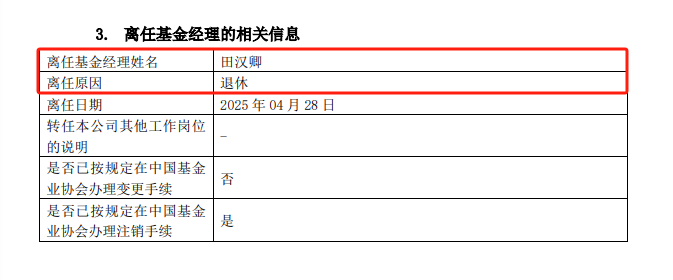
Group 1 - The core point of the news is the retirement of Tian Hanqing, the Deputy General Manager of Huatai-PB Fund, who has stepped down from managing 10 funds, marking the end of her over 11-year career as a fund manager [1][2] - Tian Hanqing is recognized as a leading figure in the domestic public quantitative fund sector, having previously worked at Barclays Global Investors (BGI) before joining Huatai-PB Fund in 2012 to establish its quantitative investment team [1][5] - The quantitative team at Huatai-PB Fund focuses on a "fundamental-based quantitative investment model," utilizing multi-factor models to achieve stable excess returns, with the Huatai-PB Quantitative Enhanced Mixed A fund returning 205.13% since Tian took over on August 2, 2013, outperforming the CSI 300 Index's 136.71% during the same period [5] Group 2 - The retirement of Tian Hanqing is part of a broader trend in the industry, with 174 new fund managers entering the market this year, bringing the total number of fund managers in the public fund sector to over 4,000 [1][8] - The industry is experiencing a generational shift, with veteran fund managers retiring, which may lead to adjustments in product strategies and a potential transition period for the funds they managed [8] - To adapt to this transition, fund companies are encouraged to establish a "de-starization" research and investment system and improve their fund manager training mechanisms, focusing on company culture as a core competitive advantage rather than individual personalities [8][9]