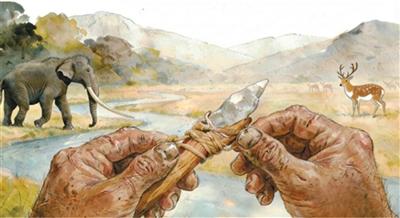
复合工具

Search documents
颠覆对东亚旧石器时代文化和技术传统认知
Ren Min Ri Bao Hai Wai Ban· 2026-02-02 03:28
Core Insights - The research on the Xigou site in Henan Province reveals a systematic production strategy of small stone flakes and the earliest known tool hafting technology in East Asia, challenging the long-held belief that East Asian Paleolithic culture was conservative and technologically stagnant [2][3][4] Group 1: Research Findings - The study identified 2,601 stone artifacts at the Xigou site, dating from approximately 160,000 to 72,000 years ago, providing a precise chronological framework for human activities during this period [2][3] - The stone tools exhibited specialization and diversity, including scrapers, drills, notched tools, serrated blades, pointed tools, and carving tools, indicating a complex understanding of tool-making [4][5] - The research identified 22 hafted tools through technical-type analysis and micro-wear analysis, marking the earliest evidence of composite tools in East Asia, significantly advancing the timeline for the emergence of hafting technology [4][5] Group 2: Implications for Human Evolution - The findings suggest that during a period of significant climate fluctuations, ancient humans in East Asia developed flexible and diverse stone tool technologies as survival strategies, indicating a close relationship between technological innovation and cognitive abilities [4][5] - The study emphasizes the need to reassess the significance of quartz and quartzite as materials for fine stone tools in East Asia, highlighting the efficient management of local resources by ancient humans [5] - Recent discoveries at other sites in China, such as the Lingjing and Saraus sites, further support the notion that complex cultural behaviors, including tool-making and symbolic practices, were present in East Asia between 300,000 and 50,000 years ago, comparable to those in Africa and Western Eurasia [5]