多摄融合

Search documents
新股消息 | 立景科技递表港交所 为全球领先的精密光学解决方案提供商
智通财经网· 2025-12-01 03:48
Company Overview - Lijing Technology is a leading global provider of precision optical solutions, focusing on high-end optical modules and system integration for consumer electronics, automotive electronics, smart office applications, and emerging fields such as smart robotics and XR smart terminals [4][5] - The company is a key supplier for major global smartphone brands and the only precision optical solution provider capable of serving both major smartphone system ecosystems in the camera module sector [4] Market Position - According to Frost & Sullivan, Lijing Technology ranks second globally and first among Chinese manufacturers in the consumer electronics camera module market based on revenue for 2024 [5] - The company also holds the second position globally and first among Chinese manufacturers in the high-end smartphone camera module market, and ranks first in the notebook and tablet camera module sectors [5] Financial Performance - Revenue for Lijing Technology was approximately 12.75 billion RMB in 2022, 15.25 billion RMB in 2023, and is projected to reach 27.91 billion RMB in 2024 [6] - The company reported profits of 688.97 million RMB in 2022, 588.66 million RMB in 2023, and is expected to achieve 1.05 billion RMB in 2024 [7] - Gross profit margins were 12.2% in 2022, 12.0% in 2023, and are projected to be 10.8% in 2024 [9] Industry Overview - The global market for precision optical solutions in consumer electronics grew from approximately 70.5 billion USD in 2020 to about 79.6 billion USD in 2021, but declined to around 72.7 billion USD in 2023 due to economic slowdown and weak demand [11] - The market is expected to recover, reaching approximately 79 billion USD in 2024, with a compound annual growth rate (CAGR) of 2.9% from 2020 to 2024 [11] - The AI-driven growth in the market is significant, with the precision optical solutions market for AI consumer electronics projected to exceed 76.4 billion USD by 2029, growing at a CAGR of 32.4% from 2025 to 2029 [11] Camera Module Market - The global market for consumer electronics camera modules was approximately 38.9 billion USD in 2020, declining to 43.6 billion USD in 2022, but is expected to grow to 50.8 billion USD in 2024 [13] - Smartphones remain the largest application market for camera modules, expected to account for over 90% of the market share in 2024 [13] - The demand for high-pixel and multifunctional camera modules is anticipated to grow due to the increasing requirements for 3D imaging, facial recognition, and video conferencing in tablets and laptops [13]

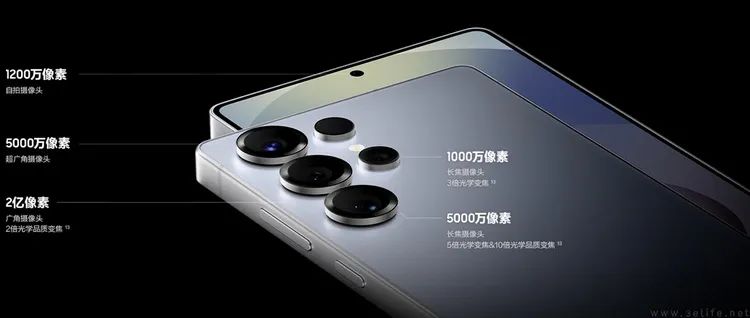
2亿像素的摄像头,为啥手机上最多只有一颗
3 6 Ke· 2025-03-31 01:37
Group 1 - The smartphone industry is increasingly adopting 200-megapixel sensors as a common feature in flagship models, following the trend of "1-inch super large sensor" CMOS technology [1][3] - Samsung's Galaxy S25 Ultra continues to utilize the exclusive HP2 main camera, which outperforms larger competitors in terms of light sensitivity and focusing capabilities under well-lit conditions [3][5] - Other brands like Vivo, Honor, and Xiaomi are also implementing 200-megapixel sensors in their flagship models, leveraging the sensor's "4x zoom" capability for enhanced image quality [5][10] Group 2 - There are questions regarding the absence of smartphones featuring multiple 200-megapixel sensors, despite the physical possibility of fitting them into current designs [6][8] - The limitation arises from the capabilities of the System on Chip (SoC) and its Image Signal Processor (ISP), which must handle data from multiple sensors simultaneously [12][14] - Current flagship SoCs can only support a maximum of 48 million pixels when processing images from multiple cameras, which restricts the use of more than one 200-megapixel sensor in flagship models [16][18]