消费电子摄像头模组

Search documents
立景创新闯关港股,“果链”龙头能否撑起225亿估值?
Zhi Tong Cai Jing· 2026-01-12 08:47
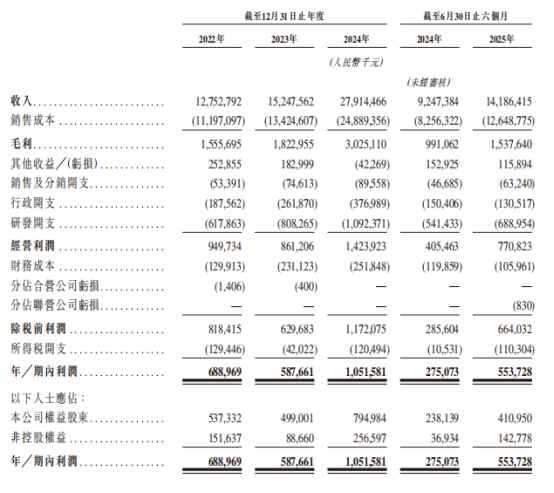
Core Viewpoint - The global consumer electronics market is entering a new recovery cycle driven by AI, presenting structural growth opportunities in the optical lens sector, highlighted by the IPO application of Lijing Innovation Technology Co., Ltd. [1] Group 1: Company Overview - Lijing Innovation, founded in 2018, has become the largest supplier of camera modules for consumer electronics in China and has entered the supply chains of major global smartphone brands like Apple and Huawei [1] - The company has raised over 5.24 billion RMB prior to its IPO, with notable investors including Hillhouse, Sequoia, IDG, and CICC [1] - By June 2025, Lijing is valued at 22.5 billion RMB and is listed in the Hurun Global Unicorn List [1] Group 2: Financial Performance - From 2022 to 2024, Lijing's revenue is projected to grow from 12.75 billion RMB to 27.91 billion RMB, doubling in size, while net profit is expected to increase from 689 million RMB to 1.05 billion RMB, a 53% growth [2] - In the first half of 2025, the company reported a 53.4% year-on-year revenue growth to 14.19 billion RMB and a net profit increase of 101.5% to 554 million RMB [2] Group 3: Market Position and Competition - Lijing is ranked second globally in the camera module sector for consumer electronics, and first among Chinese manufacturers, with significant market share in high-end smartphone camera modules [8][9] - The company has established a strong position in emerging fields such as automotive electronics and smart office applications, with over 320 global clients [9] Group 4: Customer and Supplier Concentration - The company has a high customer concentration, with the top five clients accounting for 90.7% of revenue in 2022, decreasing to 89.0% in the first half of 2025, while the largest client contributes 67.6% of revenue [4] - Supplier concentration is also notable, with the top five suppliers accounting for 56.5% of procurement in 2024, increasing to 45.9% in the first half of 2025 [5] Group 5: R&D and Growth Strategy - Lijing has significantly increased its R&D spending from 618 million RMB in 2022 to 1.09 billion RMB in 2024, with 689 million RMB spent in the first half of 2025 [4] - The company has pursued a series of acquisitions to expand its business, including entering Apple's supply chain and enhancing production capabilities for high-end optical lenses [4] Group 6: Industry Trends - The consumer electronics market is experiencing a recovery driven by AI, with a projected market size of approximately 79 billion USD for precision optical solutions by 2024, growing at a CAGR of 2.9% from 2020 to 2024 [6] - The market for AI-related consumer electronics is expected to exceed 76.4 billion USD by 2029, with a projected CAGR of 32.4% from 2025 to 2029 [6]

立景创新赴港IPO:靠“买买买”扩张商誉已近20亿 苹果既是最大客户又是最大供应商 产能利用率持续低迷
Xin Lang Cai Jing· 2025-12-11 06:23
Core Viewpoint - Lijing Innovation Technology Co., Ltd. has submitted its main board listing application to the Hong Kong Stock Exchange, aiming to leverage its strong market position in the precision optical solutions sector, despite facing significant risks related to customer concentration, high capital expenditures, and geopolitical challenges [1][6]. Group 1: Business Structure and Capital Expansion - Lijing Innovation is deeply influenced by the "Luxshare Gene," with its founder's family controlling 48.06% of the shares through Lijing Limited, employing a capital and acquisition strategy similar to Luxshare Precision [2][7]. - The company has made strategic acquisitions to enhance vertical integration, including the purchase of suppliers like GoerTek and Konica Minolta, leading to a pre-IPO valuation of 22.5 billion yuan [2][7]. - However, aggressive capital operations have increased financial risks, with goodwill reaching 1.992 billion yuan as of June 2025, posing a threat to profitability if acquired assets underperform [2][7]. Group 2: Customer Dependency Risks - Lijing Innovation faces significant risks due to its highly concentrated customer base, with the top five customers accounting for over 77% of revenue from 2022 to mid-2025, and the largest customer (widely believed to be Apple) increasing its sales share from 39.9% in 2023 to 67.6% in mid-2025 [3][8]. - This dual dependency on a major customer for both sales and procurement (with 45.9% of procurement in mid-2025) creates vulnerabilities, as any changes in customer demand could severely impact operations [3][8]. Group 3: Financial Leverage and Capacity Utilization Challenges - To support technological investments and capacity expansion, capital expenditures surged from 1 billion yuan in 2022 to 2.5 billion yuan in 2024, with leverage ratios peaking at 75% and remaining high at 57.5% as of mid-2025 [4][9]. - The company is experiencing low capacity utilization rates, with only 65.9% for consumer electronics and 33% for automotive electronics as of mid-2025, alongside declining profitability, with gross margins dropping from 12.2% in 2022 to 10.8% in mid-2025 [4][9]. Group 4: Geopolitical and Competitive Pressures - Changes in the global trade environment pose direct threats to Lijing Innovation's business model, particularly U.S. tariff policies that could reduce customer competitiveness and order volumes [5][10]. - The company is heavily reliant on the consumer electronics sector, which accounted for 88.2% of revenue in mid-2025, facing challenges from slowing growth and rapid technological advancements [5][10]. - In terms of competition, Lijing Innovation leads in the laptop camera module market but must enhance its R&D investment (approximately 3.9% in 2024) to build differentiation in emerging fields like AI vision and cockpit integration [5][11].
新股消息 | 立景科技递表港交所 为全球领先的精密光学解决方案提供商
智通财经网· 2025-12-01 03:48
Company Overview - Lijing Technology is a leading global provider of precision optical solutions, focusing on high-end optical modules and system integration for consumer electronics, automotive electronics, smart office applications, and emerging fields such as smart robotics and XR smart terminals [4][5] - The company is a key supplier for major global smartphone brands and the only precision optical solution provider capable of serving both major smartphone system ecosystems in the camera module sector [4] Market Position - According to Frost & Sullivan, Lijing Technology ranks second globally and first among Chinese manufacturers in the consumer electronics camera module market based on revenue for 2024 [5] - The company also holds the second position globally and first among Chinese manufacturers in the high-end smartphone camera module market, and ranks first in the notebook and tablet camera module sectors [5] Financial Performance - Revenue for Lijing Technology was approximately 12.75 billion RMB in 2022, 15.25 billion RMB in 2023, and is projected to reach 27.91 billion RMB in 2024 [6] - The company reported profits of 688.97 million RMB in 2022, 588.66 million RMB in 2023, and is expected to achieve 1.05 billion RMB in 2024 [7] - Gross profit margins were 12.2% in 2022, 12.0% in 2023, and are projected to be 10.8% in 2024 [9] Industry Overview - The global market for precision optical solutions in consumer electronics grew from approximately 70.5 billion USD in 2020 to about 79.6 billion USD in 2021, but declined to around 72.7 billion USD in 2023 due to economic slowdown and weak demand [11] - The market is expected to recover, reaching approximately 79 billion USD in 2024, with a compound annual growth rate (CAGR) of 2.9% from 2020 to 2024 [11] - The AI-driven growth in the market is significant, with the precision optical solutions market for AI consumer electronics projected to exceed 76.4 billion USD by 2029, growing at a CAGR of 32.4% from 2025 to 2029 [11] Camera Module Market - The global market for consumer electronics camera modules was approximately 38.9 billion USD in 2020, declining to 43.6 billion USD in 2022, but is expected to grow to 50.8 billion USD in 2024 [13] - Smartphones remain the largest application market for camera modules, expected to account for over 90% of the market share in 2024 [13] - The demand for high-pixel and multifunctional camera modules is anticipated to grow due to the increasing requirements for 3D imaging, facial recognition, and video conferencing in tablets and laptops [13]