多智能体流

Search documents
AI在线强化学习“边做边学”,斯坦福团队让7B小模型性能飙升,甚至超越GPT-4o
3 6 Ke· 2025-10-24 12:45
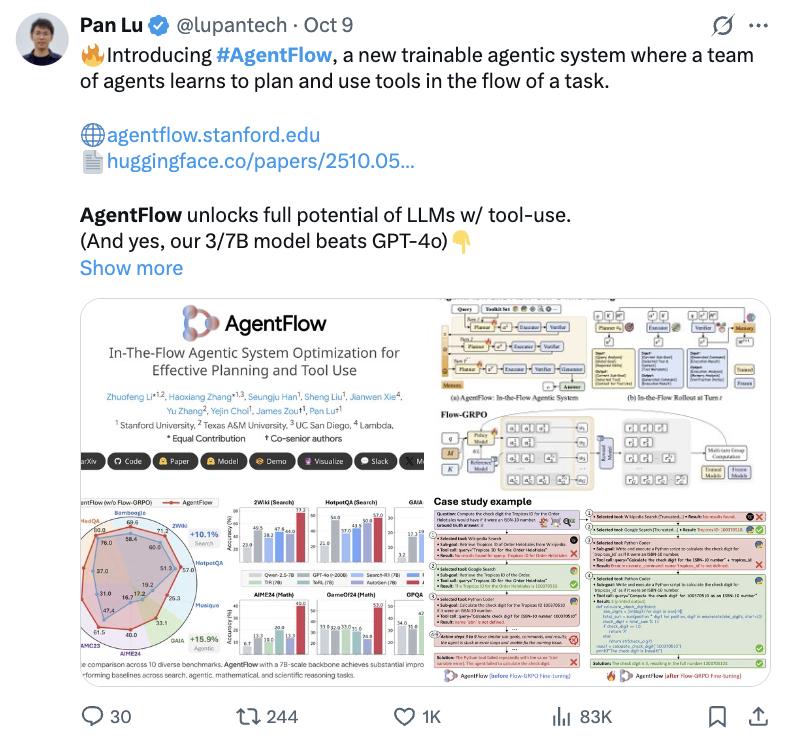
Core Insights - AgentFlow introduces a new paradigm for online reinforcement learning, enhancing the reasoning capabilities of agent systems through real-time optimization and collaboration among specialized agents [1][11][14]. Performance Metrics - AgentFlow, based on the Qwen-2.5-7B-Instruct model, shows significant improvements across various benchmark tests: 14.9% in search tasks, 14.0% in agentic reasoning tasks, 14.5% in mathematical reasoning, and 4.1% in scientific reasoning [4][19][21]. - The performance of AgentFlow surpasses that of larger models, including GPT-4o and Llama3.1-405B, demonstrating that effective system design can outperform sheer model size [21][25]. System Architecture - The architecture of AgentFlow consists of four specialized agents: a planner for task analysis and tool selection, an executor for tool invocation, a verifier for evaluating intermediate results, and a generator for synthesizing final outputs [11][13][14]. - The system employs a shared memory design that facilitates collaboration and reduces error propagation in multi-step reasoning processes [7][14]. Learning Mechanism - The on-policy optimization of the planner within the agent interaction flow is crucial for adapting to environmental changes and feedback, leading to a robust and self-evolving reasoning process [13][14][22]. - The Flow-GRPO algorithm addresses the challenges of multi-turn credit assignment in reinforcement learning, enhancing training efficiency and stability in complex reasoning tasks [15][19]. Research Findings - The study reveals that online learning in real interaction environments is essential for achieving efficient reasoning, as opposed to offline supervised learning, which can lead to performance declines [22][25]. - AgentFlow's training allows the system to autonomously discover new tool combinations and usage patterns, enhancing its problem-solving capabilities [25][29]. Future Implications - AgentFlow represents a shift from seeking a single comprehensive model to enabling agents to adapt and learn continuously within a system, highlighting the potential of collaborative intelligence in addressing complex tasks [29].