智能体系统

Search documents
英伟达大会GTC金融分析师问答
2026-03-19 02:39
Summary of Key Points from the Conference Call Company and Industry Overview - The conference call primarily discusses NVIDIA and its position in the AI and computing industry, particularly focusing on advancements in AI technology and the demand for computing power [1][2][3][4][5]. Core Insights and Arguments 1. **Shift in Computing Demand**: The demand for computing power is transitioning from dialogue-based systems to autonomous agent systems, with software development becoming a core application [1][2]. 2. **Market Visibility for Products**: There is over $1 trillion in visible orders for the Blackwell and Rubin product lines by the end of 2027, reflecting strong confidence in future sales [3]. 3. **High Gross Margin Maintenance**: The company maintains high gross margins through value premium rather than cost competition, focusing on efficiency in token production [4][5]. 4. **Business Structure**: The business is composed of 60% from large-scale cloud service providers (CSPs) and 40% from regional cloud and enterprise local deployments, with expectations for industrial AI factories to increase from 40% to 70% post-physical AI inflection point [1][7]. 5. **Core Business Focus**: The inference business is expected to become central by 2025, with nearly 100% of global computing power anticipated to be used for inference, potentially expanding the market size to $8 trillion [1][9]. 6. **Interconnect Strategy**: The company is committed to a copper-first strategy while evolving towards Co-Packaged Optics (CPO), with high-end products expected to transition to CPO in two years [1][19]. 7. **Cash Flow Allocation**: Cash flow will prioritize supply chain capacity prepayments and growth investments, with stock buybacks and dividends expected to start at 50% of free cash flow in 2026 [1][16]. Additional Important Insights 1. **AI Development Milestones**: The AI field has reached three key inflection points, with the current focus on autonomous agent systems that can perform tasks beyond simple question answering [2]. 2. **Token Production Efficiency**: The efficiency of token production is critical, with advanced mining machines expected to produce tokens at lower costs, driving customer preference for newer, higher-priced models [4][5]. 3. **Ecosystem and Partnerships**: The company has expanded its ecosystem by adding new partners like Anthropic and MetaSL, enhancing its AI platform's capabilities [6]. 4. **Market Dynamics**: The AI market is projected to grow significantly, with the potential for the software licensing market to expand from $2 trillion to $8 trillion due to the integration of AI technologies [9]. 5. **Future of AI Models**: The emergence of new AI models, such as state space models, is expected to drive demand for innovative AI solutions, with NVIDIA's architecture supporting a wide range of model types [20][21]. Conclusion The conference call highlights NVIDIA's strategic positioning in the rapidly evolving AI landscape, emphasizing the importance of innovation, partnerships, and market adaptability to maintain growth and profitability in the face of increasing competition and technological advancements.

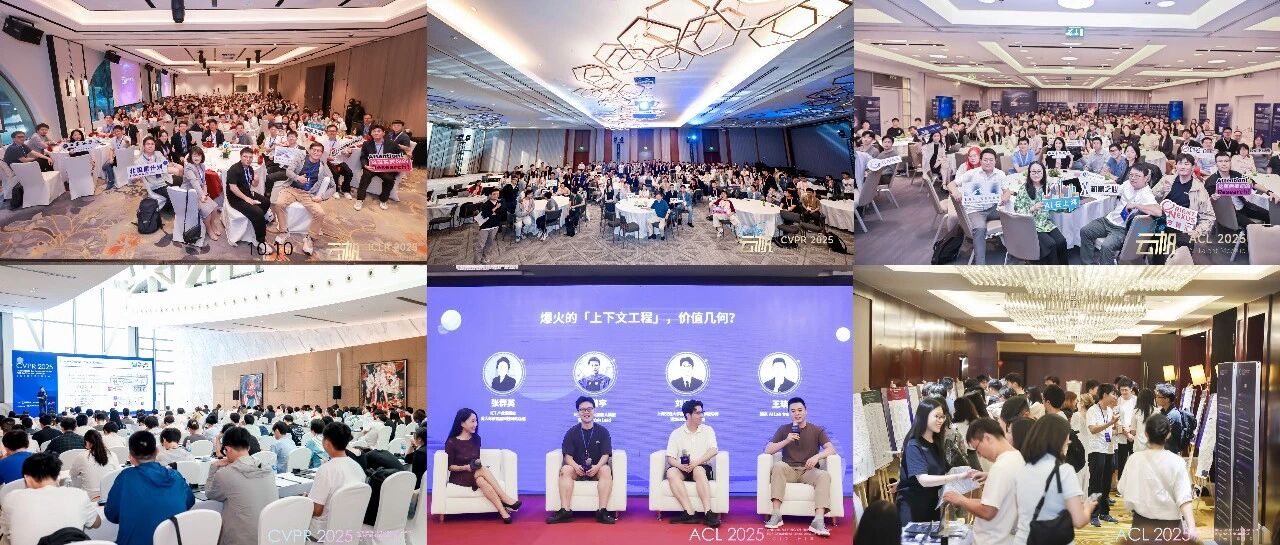
都是TOP人才!跑遍全球,和机器之心共聚AI学术顶会
机器之心· 2025-12-23 09:36
Core Insights - The article emphasizes the rapid evolution of AI technologies, highlighting the transition from multimodal large models to intelligent systems, and the importance of human connections in advancing these technologies [1][2]. Group 1: Events and Activities - In 2025, a series of events were organized around major AI conferences, including ICLR, CVPR, ACL, ICML, IROS, EMNLP, and NeurIPS, spanning across eight cities and featuring 11 activities [1][4]. - The "Paper Sharing Sessions" and "Talent Meetups" were key components of the year-long activities, aimed at fostering a warm, deep, and valuable AI communication ecosystem [4][6]. - Over 100 paper authors participated in the ICLR, CVPR, ACL, and NeurIPS paper sharing sessions in Beijing, discussing hot topics such as multimodal, agents, video generation, and large model inference [6]. Group 2: Networking and Collaboration - The "Cloud Sail" series of AI Talent Meetups held in cities like Singapore, Vienna, Vancouver, Nashville, and San Diego created a relaxed environment for meaningful exchanges among peers, leading to new collaborations and ideas [6][8]. - The events facilitated numerous introductions and reconnections among professionals, fostering an atmosphere ripe for collaboration [6]. Group 3: Future Plans - The successful conclusion of 2025's activities sets the stage for an exciting 2026, with plans for new series of events including "AI Top Conference Happy Hours" alongside the existing "Paper Sharing Sessions" and "Talent Meetups" [10][11]. - The upcoming events will cover major conferences such as ICLR, CVPR, ACL, ICML, ECCV, CoRL, IROS, and NeurIPS, with a focus on expanding the reach to more global cities [10][11].

Xiaomi MiMo-V2-Flash开源:能力比肩标杆闭源模型Claude 4.5 Sonnet
Feng Huang Wang· 2025-12-17 10:26
Group 1 - Xiaomi officially announced the open-source release of Xiaomi MiMo-V2-Flash, a MoE model with a total parameter count of 309 billion (15 billion activated), achieving top 2 in global open-source model benchmarks [1] - The model features innovations such as Hybrid attention architecture and multi-layer MTP inference acceleration, resulting in a code capability comparable to the closed-source model Claude 4.5 Sonnet, but at only 2.5% of its inference cost and with a 2x increase in generation speed [1] - Xiaomi MiMo-V2-Flash outperformed DeepSeek V3.2 and K2-Thinking in most evaluation benchmarks, reducing parameter count by 50% to 67%, and achieving low cost and high speed, with preliminary capabilities to simulate the world [1] Group 2 - The next generation of intelligent agent systems is envisioned not merely as "language simulators" but as true "intelligent agents" that understand and coexist with the human world [2] - There is a shift in agent execution capabilities from merely "answering questions" to "completing tasks," incorporating memory, reasoning, autonomous planning, decision-making, and execution abilities [2] - Unified multimodal perception is essential for understanding the physical world, which will enhance integration with smart devices like glasses [2]


加入小米一个多月后,“AI才女”罗福莉完成首秀
新华网财经· 2025-12-17 05:43
Group 1 - The core viewpoint of the article highlights the launch of Xiaomi's latest MoE model, MiMo-V2-Flash, by Luo Fuli, marking her debut at Xiaomi after joining the company [1][2] - The MiMo-V2-Flash model ranks as the second in the global open-source model evaluation list and is characterized by low cost and high speed, achieving three times the inference speed of DeepseekV3.2 at a lower cost [2] - Luo Fuli emphasizes that the next-generation intelligent agent system is not merely a "language simulator" but a true "intelligent agent" capable of understanding and coexisting with the world, with capabilities in task execution and unified multi-modal perception [2]

AI在线强化学习“边做边学”,斯坦福团队让7B小模型性能飙升,甚至超越GPT-4o
3 6 Ke· 2025-10-24 12:45
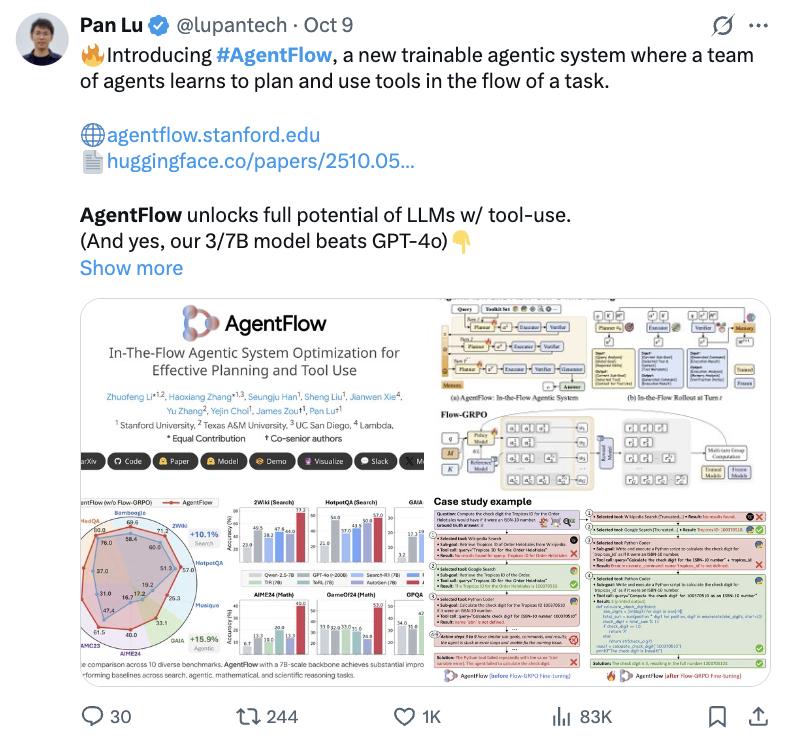
Core Insights - AgentFlow introduces a new paradigm for online reinforcement learning, enhancing the reasoning capabilities of agent systems through real-time optimization and collaboration among specialized agents [1][11][14]. Performance Metrics - AgentFlow, based on the Qwen-2.5-7B-Instruct model, shows significant improvements across various benchmark tests: 14.9% in search tasks, 14.0% in agentic reasoning tasks, 14.5% in mathematical reasoning, and 4.1% in scientific reasoning [4][19][21]. - The performance of AgentFlow surpasses that of larger models, including GPT-4o and Llama3.1-405B, demonstrating that effective system design can outperform sheer model size [21][25]. System Architecture - The architecture of AgentFlow consists of four specialized agents: a planner for task analysis and tool selection, an executor for tool invocation, a verifier for evaluating intermediate results, and a generator for synthesizing final outputs [11][13][14]. - The system employs a shared memory design that facilitates collaboration and reduces error propagation in multi-step reasoning processes [7][14]. Learning Mechanism - The on-policy optimization of the planner within the agent interaction flow is crucial for adapting to environmental changes and feedback, leading to a robust and self-evolving reasoning process [13][14][22]. - The Flow-GRPO algorithm addresses the challenges of multi-turn credit assignment in reinforcement learning, enhancing training efficiency and stability in complex reasoning tasks [15][19]. Research Findings - The study reveals that online learning in real interaction environments is essential for achieving efficient reasoning, as opposed to offline supervised learning, which can lead to performance declines [22][25]. - AgentFlow's training allows the system to autonomously discover new tool combinations and usage patterns, enhancing its problem-solving capabilities [25][29]. Future Implications - AgentFlow represents a shift from seeking a single comprehensive model to enabling agents to adapt and learn continuously within a system, highlighting the potential of collaborative intelligence in addressing complex tasks [29].
AI在线强化学习“边做边学”,斯坦福团队让7B小模型性能飙升,甚至超越GPT-4o
量子位· 2025-10-24 03:53
Core Insights - The article discusses the introduction of AgentFlow, a new paradigm in online reinforcement learning that enhances the reasoning capabilities of intelligent systems, outperforming models like GPT-4o and Llama3.1-405B [1][4][23]. Group 1: AgentFlow Overview - AgentFlow consists of a team of specialized agents including a planner, executor, verifier, and generator, which collaborate through shared memory to optimize decision-making in real-time [1][14][18]. - The Flow-GRPO method allows for on-policy optimization of the planner agent, enabling adaptive decision-making based on environmental changes and feedback from other agents [19][16]. Group 2: Performance Metrics - AgentFlow, based on the Qwen-2.5-7B-Instruct model, shows significant improvements across various benchmark tests: 14.9% in search tasks, 14.0% in agentic reasoning, 14.5% in math reasoning, and 4.1% in scientific reasoning [3][25][27]. - The model's performance surpasses that of larger models, demonstrating that effective system design and training methods can be more impactful than simply increasing model size [27]. Group 3: Learning Mechanisms - The article emphasizes the importance of "learning in the flow," indicating that online learning in real interactive environments is crucial for achieving efficient reasoning [28][29]. - AgentFlow's architecture allows for rapid error correction and improved task planning through real-time training, enhancing overall system performance [30][29]. Group 4: Innovations and Findings - The system autonomously discovers new solution paths, such as combining different search tools to enhance information retrieval, showcasing its ability to adapt and innovate [33]. - AgentFlow maintains performance improvements without significantly increasing the average reasoning steps, indicating efficient handling of complex tasks [35]. Group 5: Future Implications - The article concludes that AgentFlow presents a novel approach to intelligent agent training, advocating for systems that adapt and learn continuously rather than relying on a single comprehensive model [37][38]. - Despite the distance from research to practical application, the potential for Agentic AI remains significant, suggesting a promising future for intelligent systems [39].

微软研究院杨玉庆:Agent 的注意力系统|Attention
3 6 Ke· 2025-09-05 03:42
Core Insights - The article discusses TriangleMix, a structural optimization method for attention mechanisms in large models, which addresses the computational bottleneck during the prefill stage while maintaining performance and accuracy [2][5][10] - TriangleMix allows for a hierarchical sparse attention architecture that significantly reduces latency and memory consumption, making it suitable for long-context tasks [8][10][36] Technical Overview - TriangleMix employs a layered attention strategy, using standard dense attention in the first 16 layers and switching to a triangle-shaped mask in the subsequent layers, which reduces computational complexity from O(N²) to O(N) [5][6] - The method has been tested on models like Llama-3.1-8B-Instruct, showing a kernel latency reduction from 750ms to 49ms, achieving a speedup of 15.3x and a decrease in time to first token (TTFT) by 12%-32% [10][9] Performance Metrics - Experimental results indicate that TriangleMix retains 99.7% of the original performance while applying the triangle attention in the majority of the deep layers [8][10] - The method demonstrates significant reductions in latency and memory usage with almost no loss in accuracy across various benchmark tasks [10][9] Broader Implications - The research emphasizes the importance of viewing attention mechanisms within the larger context of agent systems, training mechanisms, and task structures, rather than as isolated components [12][26] - The ongoing work at Microsoft Research focuses on optimizing agent-native systems, which aim to enhance the efficiency and effectiveness of AI applications, particularly for users with specific needs [15][67]


OpenAI女CEO太狠了,智商148,GPT-5才是真印钞机
3 6 Ke· 2025-08-14 03:11
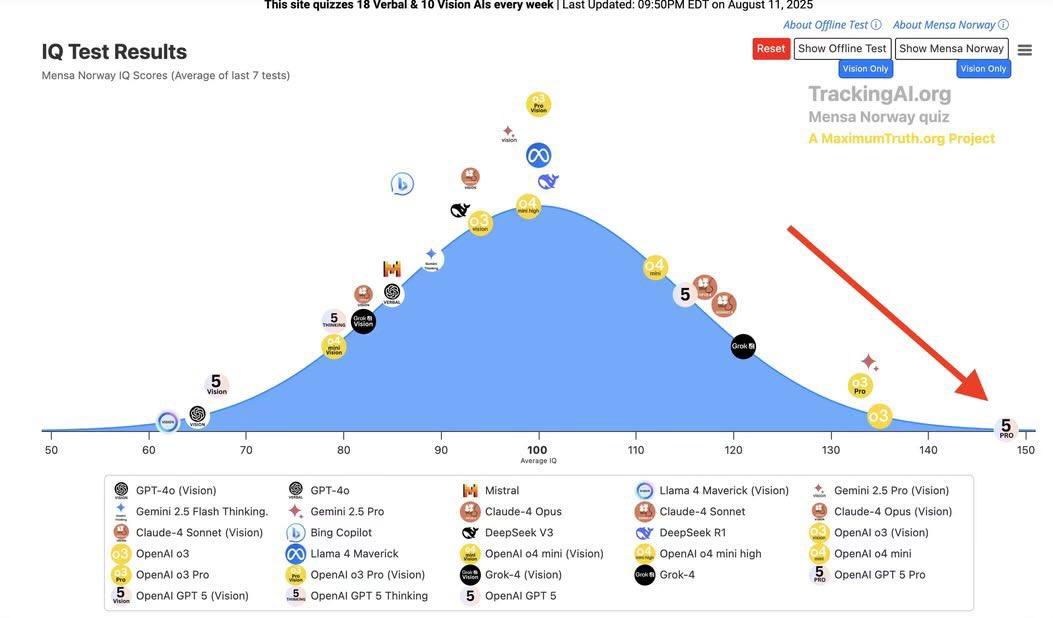
Core Insights - GPT-5 is positioned as a significant advancement in AI technology, achieving an IQ of 148 and surpassing human genius levels, particularly excelling in mathematics and programming tests [3][5][13] - OpenAI's focus with GPT-5 is not just on intelligence but on monetization strategies, particularly targeting the vast number of free users to convert them into revenue-generating customers [15][16][17] Group 1: Performance and Recognition - GPT-5 has demonstrated exceptional performance in various benchmark tests, including setting new records in mathematics and showing notable improvements in programming tests [5][13] - The model's capabilities have received recognition from Nvidia, indicating its potential in reasoning and programming applications [13] Group 2: Monetization Strategy - OpenAI aims to monetize GPT-5 by leveraging its "router" technology, which can dynamically allocate resources based on user intent and query complexity, thus optimizing operational costs and enhancing performance [20][24][26] - The router system allows for a significant increase in user engagement, with daily active users of the reasoning model surging sevenfold among free users and nearly 3.5 times among paid users [26] Group 3: User Engagement and Growth - ChatGPT's user base has rapidly expanded, now surpassing major platforms like Twitter, Reddit, and WhatsApp, and is approaching the likes of Instagram and Facebook [19] - The growth in user engagement is attributed to the router's ability to provide tailored responses, enhancing the overall user experience and increasing the likelihood of monetization through indirect payments [17][19] Group 4: Future Commercialization Potential - OpenAI's strategic direction includes integrating advertising and affiliate models into the ChatGPT experience, allowing the platform to generate revenue without compromising user experience [34][36] - The router's capability to assess the commercial value of queries positions ChatGPT to evolve into a "super app," facilitating transactions and generating revenue through commissions on sales [35][51][58]
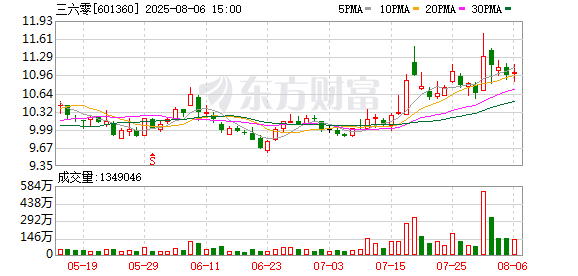
周鸿祎:不会再拍短剧,气质实在不符
Zheng Quan Shi Bao· 2025-08-06 10:05
Group 1 - The core viewpoint of the article is that Zhou Hongyi, the founder of 360, has decided not to produce short dramas anymore, stating that they do not align with his temperament [2][7] - Zhou Hongyi's first short drama, "Reigniting the Life of a Hidden Hacker," aired at the end of 2024 and sparked significant discussion due to its unique blend of a love story and an AI entrepreneurship narrative [4] - The short drama features a storyline where a wealthy father's tech company is intertwined with his son's romantic interest in a cleaning lady, who ultimately aids in the development of an AI product [4] Group 2 - Zhou Hongyi previously clarified that his interest in short dramas was business-related, not personal, after being misinterpreted by the media [5] - Following the announcement of his short drama, the National Radio and Television Administration required stricter management of "wealthy boss" micro-dramas, leading to public reactions directed at Zhou Hongyi [6] - At the ISC AI2025 conference, Zhou Hongyi expressed a shift in focus towards collaboration on animated-style short dramas, highlighting advancements in their AI tool, Nano AI, which has recently upgraded to a Level 4 intelligent system [7]

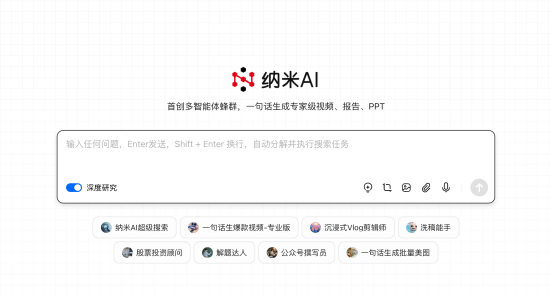
360宣布纳米AI升级为“多智能体蜂群”,可一句话生成大片
Xin Lang Ke Ji· 2025-08-02 14:17
Core Insights - 360 Group has officially announced the rebranding of Nano AI to "Multi-Agent Swarm," marking its advancement to L4 level intelligent systems, which enables a shift from "individual operation" to "group collaboration" [1] - The evolution of intelligent agents has gone through three stages: L1 chat assistants, L2 low-code workflow agents, and L3 autonomous planning agents, with the new L4 level allowing for collaborative task execution among multiple agents [1] - The new swarm collaboration framework allows over 50,000 L3 reasoning agents to work together to complete complex tasks, such as producing a 10-minute movie, with the system capable of executing over 1,000 steps continuously for 2 hours [1] Application and Efficiency - Nano AI has launched over 10 types of multi-agent swarms, covering various scenarios including video production, content creation, industry research, e-commerce, and travel planning [2] - The platform has developed the first "one-sentence blockbuster" multi-agent swarm, which can complete tasks that previously took at least 2 hours in just 20 minutes, utilizing L1 to L3 agents for scriptwriting, storyboarding, visuals, audio, music, and editing [2]