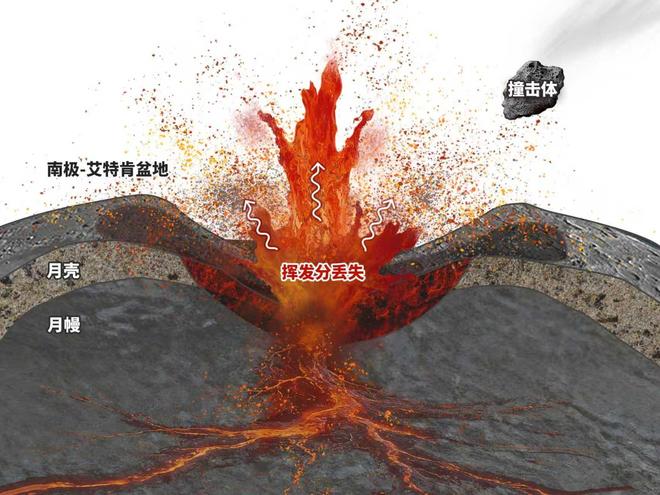
大型撞击对月球演化的影响

Search documents
【人民日报】嫦娥六号玄武岩为揭示月球地质演化历史提供关键线索
Ren Min Ri Bao· 2026-01-14 02:08
Core Insights - The research team from the Chinese Academy of Sciences has conducted high-precision potassium isotope analysis on samples collected by the Chang'e 6 mission, revealing the impact of the South Pole-Aitken basin collision on the loss of moderately volatile elements in the lunar mantle, which is crucial for understanding the evolution of the Moon and the reasons behind its dichotomy [1][2]. Group 1 - The Chang'e 6 mission collected samples from the largest impact basin on the Moon, the South Pole-Aitken basin, providing key samples for studying the effects of this large-scale impact event [1]. - High-precision isotope analysis can capture minute changes in isotope ratios, which are essential for understanding the temperature, energy, and material sources during the impact event [1]. - The isotopic system of moderately volatile elements (such as potassium, zinc, and gallium) is particularly valuable, as these elements are prone to volatilization and fractionation under high-temperature conditions generated by impacts [1]. Group 2 - The research team performed high-precision potassium isotope analysis on milligram-level single particles of Chang'e 6 basalt, finding higher potassium-41 and potassium-39 ratios compared to Apollo samples from the Moon's near side [2]. - The study confirmed that the impact event altered the potassium isotope composition of the lunar mantle, leading to potassium loss and elevated isotope ratios [2]. - During the high-temperature and high-pressure conditions of the impact, lighter isotopes (like potassium-39) tend to escape first, resulting in higher ratios in the remaining material, which may have suppressed volcanic activity on the Moon's far side, providing critical insights into the geological evolution history of the Moon [2].
巨型撞击造成月背深部物质丢失
Ke Ji Ri Bao· 2026-01-14 00:45
Core Viewpoint - The research conducted by the Chinese Academy of Sciences reveals that the large impact event approximately 4.25 billion years ago in the South Pole-Aitken Basin not only created the largest crater on the Moon but also caused the loss of certain volatile elements from the Moon's deep material due to high-temperature conditions [1][2]. Group 1: Impact of Large Collision - The South Pole-Aitken Basin is the largest impact basin on the Moon, and the samples collected by the Chang'e 6 mission provide critical insights into the effects of this large impact event [1]. - The study highlights that asteroid impacts have been the primary external force shaping the Moon's surface since its formation, leading to significant changes in its topography and chemical composition [1]. Group 2: Isotope Analysis and Findings - The research team performed high-precision potassium isotope analysis on the basalt samples returned by Chang'e 6, revealing a significantly higher proportion of the heavier potassium isotope (K-41) compared to samples from the Moon's near side [2]. - The study concluded that the early large impact event altered the potassium isotope composition of the Moon's deep mantle, with the high-temperature and high-pressure conditions during the impact causing the lighter potassium isotope (K-39) to escape, resulting in a relative enrichment of K-41 in the remaining material [2]. Group 3: Implications for Lunar Evolution - The loss of volatile elements due to the impact may have further suppressed volcanic activity on the Moon's far side, providing key scientific clues for understanding the impact of large collisions on lunar evolution [2]. - This research helps explain the geological evolution differences between the Moon's near and far sides, offering insights into the Moon's overall geological history [2].
嫦娥六号月壤揭示巨型撞击造成月背深部物质丢失
Huan Qiu Wang Zi Xun· 2026-01-13 01:35
Core Insights - The research reveals that a significant impact event approximately 4.25 billion years ago in the South Pole-Aitken Basin not only created the largest crater on the Moon but also caused the loss of certain volatile elements from the Moon's deep material due to high-temperature conditions [1][5] Group 1: Impact of the Research - The study provides critical samples from the Chang'e 6 mission, which collected basalt samples from the South Pole-Aitken Basin, aiding in understanding the effects of large impact events on the Moon's interior [1] - High-precision isotopic analysis of potassium isotopes indicates a significant enrichment of the heavier potassium isotope (K-41) in the Chang'e 6 basalt samples compared to Apollo samples from the Moon's near side [4] - The findings suggest that the loss of volatile elements during the impact may have suppressed volcanic activity on the Moon's far side in later geological periods, offering insights into the differing geological evolution of the Moon's near and far sides [5] Group 2: Methodology and Findings - The research team utilized unique isotopic systems of moderately volatile elements like potassium, zinc, and gallium to reflect the temperature, pressure, and material sources during the impact event [2] - The study systematically ruled out various factors such as cosmic ray exposure and magma activity to confirm that the early large impact event altered the potassium isotopic composition of the Moon's mantle [4] - The high-temperature and high-pressure environment during the impact led to the preferential loss of the lighter potassium isotope (K-39), resulting in a relative enrichment of the heavier K-41 in the remaining material [5]