太阳爆发

Search documents
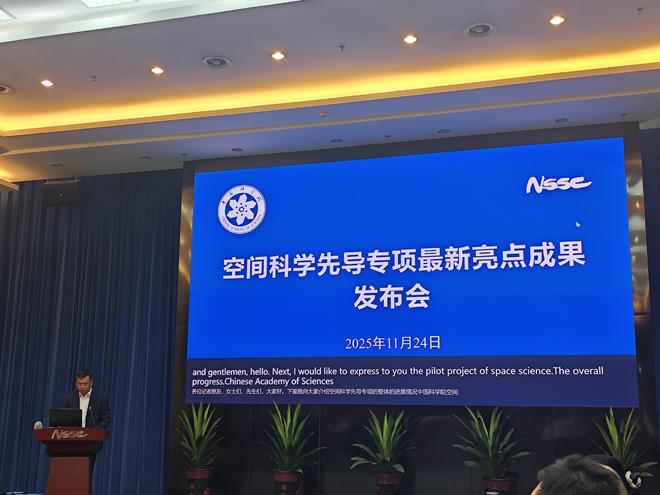
多颗卫星刷新宇宙认知!中科院空间科学先导专项发布新成果
Xin Hua She· 2025-11-24 09:20
Core Insights - China's space science is experiencing significant breakthroughs, with multiple scientific satellites achieving major original results and creating several firsts in both China and the world [3][4]. Group 1: Satellite Missions and Achievements - The space science pilot project initiated by the Chinese Academy of Sciences in 2011 has successfully developed and launched eight scientific satellites, including "Wukong," "Weiyan," "Huairou," "Kuafu," and "Tianguan," marking a rapid advancement in China's space science innovation [3][4]. - The project has expanded scientific research towards four extremes: macro, micro, extreme conditions, and interdisciplinary integration, achieving notable milestones such as the first global X-ray all-sky map and the most precise cosmic ray energy spectrum measurements [3][4]. Group 2: International Collaboration - The project has actively engaged in comprehensive international cooperation, exemplified by the "Smile" satellite, which represents a deep collaboration between the Chinese Academy of Sciences and the European Space Agency [4]. Group 3: Scientific Discoveries - The "Tianguan" satellite has discovered a new type of X-ray transient source, providing key insights into mysterious transient celestial bodies, and has opened new pathways for discovering stellar black holes [6][7]. - The "Weiyan" satellite has made significant contributions to understanding black hole accretion mechanisms and the radiation mechanisms of millisecond pulsars [6][7]. - The "Huairou" satellite has identified new subtypes of gamma-ray bursts resulting from compact star mergers, enhancing the understanding of gravitational wave electromagnetic counterparts [6][7]. - The "Wukong" satellite has achieved the first precise measurement of the boron energy spectrum of cosmic rays above 1 TeV/n, revealing important insights into cosmic ray propagation mechanisms [7]. - The "Kuafu" satellite has found that the correlation rate between high-energy C-class flares and coronal mass ejections is much lower than expected, providing new clues for understanding solar eruption mechanisms [7]. Group 4: Future Plans - Looking ahead, the Chinese Academy of Sciences plans to implement new space exploration satellite programs, including the "Hongmeng Plan" and "Kuafu II," focusing on major frontier issues such as the origins of the universe, space weather, and life [9].