
套利定价理论(APT)

Search documents
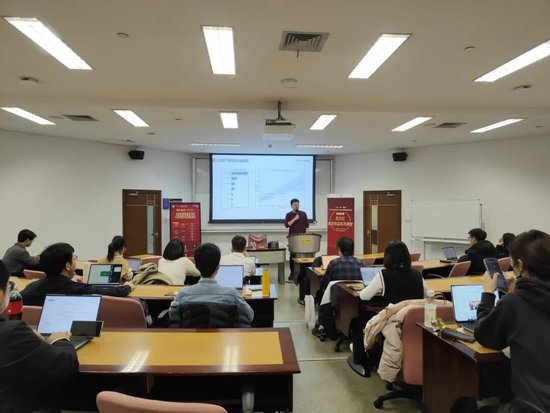
东方红资管“一司一省一高校”投教活动:提升风险管理能力,优化资产配置
Xin Lang Cai Jing· 2025-12-03 06:19
Core Insights - The event held on December 1st at Fudan University was part of the "One Company, One Province, One University" investor education initiative guided by the Asset Management Association of China, featuring a lecture on "Risk Management and Quantitative Asset Allocation" by Yu Jianfeng, a well-regarded fund manager from Dongfanghong Asset Management [1][7]. Group 1: Investment Practices - Yu Jianfeng highlighted the difficulty of accurately predicting future asset returns, emphasizing that risk prediction is more feasible. He noted that short-term volatility exhibits a "clustering" effect, where current volatility can indicate future trends [3][9]. - The lecture integrated theoretical frameworks with practical applications, reviewing the evolution of asset pricing models from Markowitz's portfolio theory to the Capital Asset Pricing Model (CAPM) and Arbitrage Pricing Theory (APT). He stressed that asset pricing models are essential for understanding asset values, and asset allocation fundamentally involves comparing the risk-return characteristics of different assets [3][9]. - Large institutional investors typically employ a mature framework that includes Strategic Asset Allocation (SAA) focused on long-term economic equilibrium and Tactical Asset Allocation (TAA) which allows for active deviations based on business cycle assessments to achieve excess returns through manageable risks [3][9]. Group 2: Macro Research and Risk Management - Yu Jianfeng pointed out that real-time forecasting of macroeconomic indicators is a critical issue in macro research. The Nowcast model, based on dynamic factor models, is commonly used to monitor and predict macro indicators, processing high-frequency data to forecast important economic variables with longer publication lags [5][11]. - In asset allocation, the goal is to optimize stock and bond positions based on target risk, managing sector risk premiums to achieve excess returns beyond traditional beta [5][11]. - The importance of "diversifying risk" in asset allocation was reiterated, with the core objective being to achieve better risk dispersion and management across all aspects of the top-down asset allocation system. Yu encouraged students to apply rigorous academic thinking to investment practices, continuously learning and iterating to establish their own risk management frameworks in uncertain markets [5][11]. Group 3: Future Directions - Dongfanghong Asset Management plans to continue its commitment to investor education, deepen cooperation with universities, and enrich the content and format of the "One Company, One Province, One University" initiative, while promoting inclusive financial development [7][13].

多因子ALPHA系列报告之(十三):考虑因子非线性特征的多因子ALPHA策略
广发证券· 2012-09-18 16:00
Quantitative Models and Factor Construction Quantitative Models and Construction Methods 1. **Model Name**: Nonlinear Multi-Factor Alpha Model **Model Construction Idea**: This model addresses the nonlinear relationship between factors and stock returns by transforming nonlinear factors into a linear form through polynomial functions[3][23]. **Model Construction Process**: - The model uses a third-degree polynomial transformation for factors with nonlinear characteristics. - The polynomial function is expressed as: $ r_{i}=aF^{3}+bF^{2}+cF+d $ where $a$, $b$, $c$, and $d$ are coefficients determined through least squares fitting[24][25]. **Model Evaluation**: This method is simple and intuitive but relies heavily on historical data and lacks rigorous economic logic[23][99]. 2. **Model Name**: Alpha Model with Additional Factors **Model Construction Idea**: This model introduces auxiliary factors to explain the nonlinear characteristics of primary factors, improving their predictive power[4][75]. **Model Construction Process**: - Identify auxiliary factors that interact with primary factors. For example, market capitalization is used as an auxiliary factor for turnover rate. - Construct a dummy variable $d_{high\_cap}$, which takes values of 0 or 1 depending on whether the stock belongs to a high or low market capitalization group. - The adjusted model is expressed as: $ r_{i}=v_{i0}+v_{i1}F_{i}+v_{i2}d_{i}F_{i}+\varepsilon_{i} $ where $d_{i}$ represents the dummy variable[78][79]. **Model Evaluation**: This method provides a more reasonable economic explanation and achieves significant improvements in factor effectiveness. However, it requires extensive pairwise comparisons and is labor-intensive[5][99]. Model Backtesting Results 1. **Nonlinear Multi-Factor Alpha Model**: - **Annualized Return**: 19.36% (in-sample), 19.19% (out-of-sample) - **Annualized Volatility**: 13.07% (in-sample), 8.97% (out-of-sample) - **IR**: 1.48 (in-sample), 2.14 (out-of-sample) - **Maximum Drawdown**: 15.33% (in-sample), 2.26% (out-of-sample)[63][67][76] 2. **Alpha Model with Additional Factors**: - **Annualized Return**: 30.90% (in-sample), 17.20% (out-of-sample) - **Annualized Volatility**: 15.43% (in-sample), 11.01% (out-of-sample) - **IR**: 2.00 (in-sample), 1.56 (out-of-sample) - **Maximum Drawdown**: 8.23% (in-sample), 1.70% (out-of-sample)[96][97][98] --- Quantitative Factors and Construction Methods 1. **Factor Name**: Debt-to-Asset Ratio **Factor Construction Idea**: This factor exhibits a nonlinear relationship with stock returns, where both high and low values are suboptimal[27]. **Factor Construction Process**: - Transform the factor using a third-degree polynomial function. - Compare cumulative returns before and after transformation. - Annualized return improved from -0.5% to 3% after transformation[27][28]. 2. **Factor Name**: Turnover Rate **Factor Construction Idea**: The factor shows a nonlinear characteristic at low turnover levels[30]. **Factor Construction Process**: - Apply a polynomial transformation to enhance linearity. - Annualized return increased from 21.7% to 28.4% after transformation[30][36]. 3. **Factor Name**: Earnings-to-Price Ratio (EP) **Factor Construction Idea**: The factor demonstrates nonlinear behavior at low EP levels[34]. **Factor Construction Process**: - Use a polynomial transformation to improve linearity. - Annualized return increased from 11% to 13.5% after transformation[34][40]. 4. **Factor Name**: Total Assets **Factor Construction Idea**: The factor is generally linear but shows nonlinear characteristics at low asset levels[38]. **Factor Construction Process**: - Apply a polynomial transformation. - Annualized return improved from 8.1% to 10% after transformation[38][44]. 5. **Factor Name**: Fixed Ratio **Factor Construction Idea**: The factor exhibits a "middle is better" nonlinear pattern[42]. **Factor Construction Process**: - Transform the factor using a polynomial function. - Annualized return increased from 2.75% to 6.57% after transformation[42][48]. 6. **Factor Name**: Current Ratio **Factor Construction Idea**: Similar to the fixed ratio, this factor also shows a "middle is better" pattern[46]. **Factor Construction Process**: - Apply a polynomial transformation. - Annualized return improved from 3.76% to 5.32% after transformation[46][52]. Factor Backtesting Results 1. **Debt-to-Asset Ratio**: Annualized return improved from -0.5% to 3%[27][28] 2. **Turnover Rate**: Annualized return improved from 21.7% to 28.4%[30][36] 3. **Earnings-to-Price Ratio (EP)**: Annualized return improved from 11% to 13.5%[34][40] 4. **Total Assets**: Annualized return improved from 8.1% to 10%[38][44] 5. **Fixed Ratio**: Annualized return improved from 2.75% to 6.57%[42][48] 6. **Current Ratio**: Annualized return improved from 3.76% to 5.32%[46][52]