战略资产配置(SAA)

Search documents
贝莱德最新发声!低利率、高波动时代,黄金、股票、债券怎么配?
2 1 Shi Ji Jing Ji Bao Dao· 2026-02-06 14:33
Core Insights - The global economic landscape is shifting, and investors are seeking "safe havens" for their capital, with BlackRock suggesting a resilient and adaptive asset allocation strategy across regional, strategic, and thematic dimensions to achieve true diversification [1][5] Group 1: Investment Strategies - BlackRock emphasizes the importance of constructing a resilient portfolio that avoids both putting all eggs in one basket and the pitfalls of pseudo-diversification [1][5] - Gold is highlighted as a long-term investment with solid allocation logic, supported by factors such as de-globalization, a weakening dollar, and ongoing central bank purchases [1][4] - The A-share market is expected to focus on technology as a core theme, with potential structural opportunities arising from new policies in consumption [1][4] Group 2: Fixed Income Insights - U.S. Treasuries are considered attractive from an absolute return perspective, but investors should be cautious of currency and volatility risks [2] - Short-term foreign bonds are viewed as relatively stable, while long-term U.S. Treasuries may present trading opportunities in the near term [2] Group 3: Asset Allocation Principles - The core principle of multi-asset allocation remains unchanged, focusing on selecting assets or strategies with genuine diversification effects and ensuring long-term value retention [3] - Strategic Asset Allocation (SAA) serves as a long-term anchor for portfolios, with adjustments made through Tactical Asset Allocation (TAA) based on market conditions [3] Group 4: Global Asset Allocation - Global asset allocation is deemed timely, especially in a high-volatility, low-interest-rate environment, as it helps diversify risks and enhance portfolio returns [5] - The long-term capital market assumptions suggest that some overseas assets still offer relative advantages in expected returns [5] Group 5: Thematic Investment Focus - The upcoming technological revolution led by AI is expected to reshape long-term growth patterns, driving productivity and corporate profit growth [6] - Sectors such as non-ferrous metals, energy, and biomedicine are identified as having significant growth potential, encouraging investors to align with these thematic trends [6]



贝莱德建信理财副总经理刘睿:黄金短期需警惕高波动性 长期依然具备配置价值
Zhong Guo Jing Ying Bao· 2026-02-05 14:51
Group 1 - The core viewpoint of the article emphasizes that "uncertainty" has become the norm in the current market environment, and the fundamental principles of multi-asset allocation remain unchanged [1] - Multi-asset allocation should focus on selecting assets or strategies that provide genuine diversification and ensure long-term value preservation and appreciation [1] - A clear methodological framework should be established, incorporating Strategic Asset Allocation (SAA) as a long-term anchor and Tactical Asset Allocation (TAA) for dynamic adjustments based on market conditions [1] Group 2 - Recent market attention on gold has significantly increased, with a 65% rise in 2025 and over 30% in January 2026 within a month, attracting retail investors, ETF funds, and physical purchases [2] - The rapid increase in gold prices has led to heightened market sentiment, which could result in panic selling during any potential corrections, as annual increases over 30% are rare [2] - Long-term, the allocation logic for gold remains solid due to structural support from factors such as de-globalization trends, a weakening dollar, and continuous accumulation by global central banks [2]
东方红资管“一司一省一高校”投教活动:提升风险管理能力,优化资产配置
Xin Lang Cai Jing· 2025-12-03 06:19
Core Insights - The event held on December 1st at Fudan University was part of the "One Company, One Province, One University" investor education initiative guided by the Asset Management Association of China, featuring a lecture on "Risk Management and Quantitative Asset Allocation" by Yu Jianfeng, a well-regarded fund manager from Dongfanghong Asset Management [1][7]. Group 1: Investment Practices - Yu Jianfeng highlighted the difficulty of accurately predicting future asset returns, emphasizing that risk prediction is more feasible. He noted that short-term volatility exhibits a "clustering" effect, where current volatility can indicate future trends [3][9]. - The lecture integrated theoretical frameworks with practical applications, reviewing the evolution of asset pricing models from Markowitz's portfolio theory to the Capital Asset Pricing Model (CAPM) and Arbitrage Pricing Theory (APT). He stressed that asset pricing models are essential for understanding asset values, and asset allocation fundamentally involves comparing the risk-return characteristics of different assets [3][9]. - Large institutional investors typically employ a mature framework that includes Strategic Asset Allocation (SAA) focused on long-term economic equilibrium and Tactical Asset Allocation (TAA) which allows for active deviations based on business cycle assessments to achieve excess returns through manageable risks [3][9]. Group 2: Macro Research and Risk Management - Yu Jianfeng pointed out that real-time forecasting of macroeconomic indicators is a critical issue in macro research. The Nowcast model, based on dynamic factor models, is commonly used to monitor and predict macro indicators, processing high-frequency data to forecast important economic variables with longer publication lags [5][11]. - In asset allocation, the goal is to optimize stock and bond positions based on target risk, managing sector risk premiums to achieve excess returns beyond traditional beta [5][11]. - The importance of "diversifying risk" in asset allocation was reiterated, with the core objective being to achieve better risk dispersion and management across all aspects of the top-down asset allocation system. Yu encouraged students to apply rigorous academic thinking to investment practices, continuously learning and iterating to establish their own risk management frameworks in uncertain markets [5][11]. Group 3: Future Directions - Dongfanghong Asset Management plans to continue its commitment to investor education, deepen cooperation with universities, and enrich the content and format of the "One Company, One Province, One University" initiative, while promoting inclusive financial development [7][13].
全新的配置理论“整体投资组合法”崛起!影响最保守也最重要的机构:主权基金和养老基金
Sou Hu Cai Jing· 2025-11-12 01:30
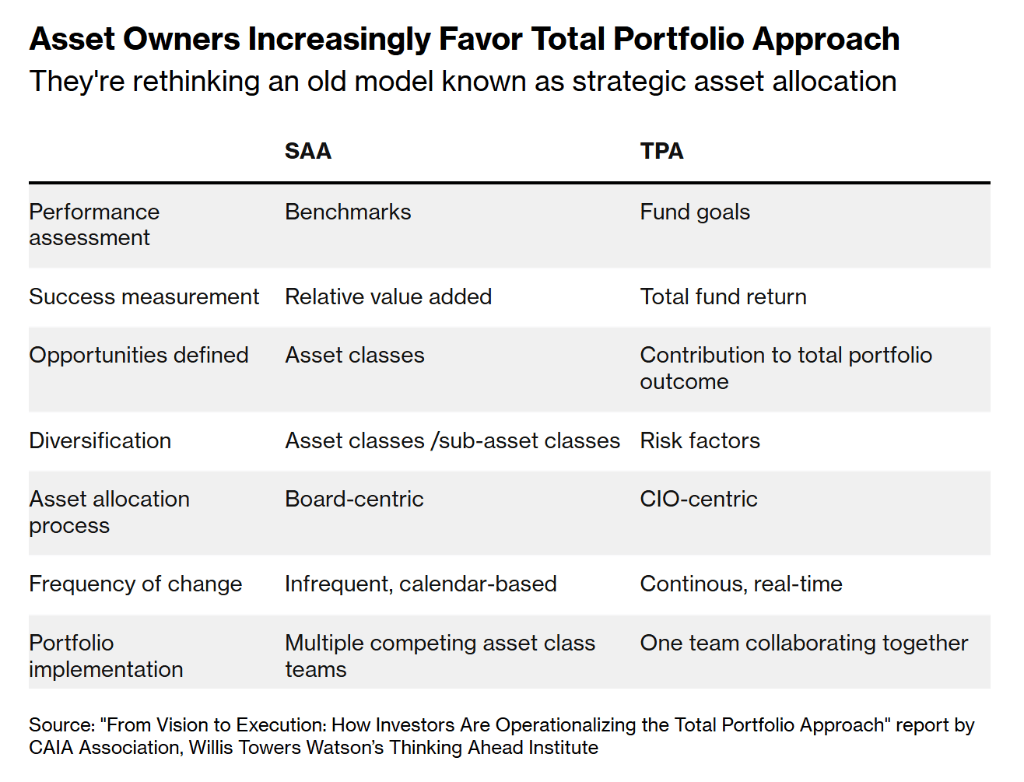
Core Viewpoint - A significant evolution is occurring in the realm of sovereign wealth funds and public pensions, with the rise of a new investment philosophy known as the "Total Portfolio Approach" (TPA), which may redefine the management rules for trillions of dollars in assets [1] Group 1: TPA Overview - TPA discards traditional asset class barriers and encourages optimization at the portfolio level rather than in isolated asset classes [1] - The California Public Employees' Retirement System (CalPERS), managing $587 billion in assets, is set to vote on adopting TPA, marking a potential breakthrough for TPA among mainstream institutional investors [2][3] Group 2: Advantages of TPA - TPA offers unparalleled flexibility, allowing funds to make trade-offs that are challenging under the classic Strategic Asset Allocation (SAA) framework [5] - TPA helps identify and avoid unintended risk concentrations, providing a holistic view that mitigates the risk of overexposure to single industries [5][6] Group 3: Implementation Challenges - Implementing TPA poses governance challenges, requiring a restructuring of accountability and decision-making processes [7] - There is a lack of consensus on the precise definition of TPA, with some viewing it as a new investment philosophy and others as an upgrade to the SAA system [7] Group 4: Practical Insights - Successful practitioners of TPA, such as the New Zealand Superannuation Fund, emphasize the importance of a collaborative culture that aligns team goals towards the overall benefit of the portfolio [8] - TPA allows for greater flexibility in moving the portfolio and breaking down departmental silos, ensuring that all teams work towards a common objective [8]