宇宙结构

Search documents
宇宙之外是什么?答案根本不是人类大脑能想象的,只能靠猜
Sou Hu Cai Jing· 2025-12-20 22:10
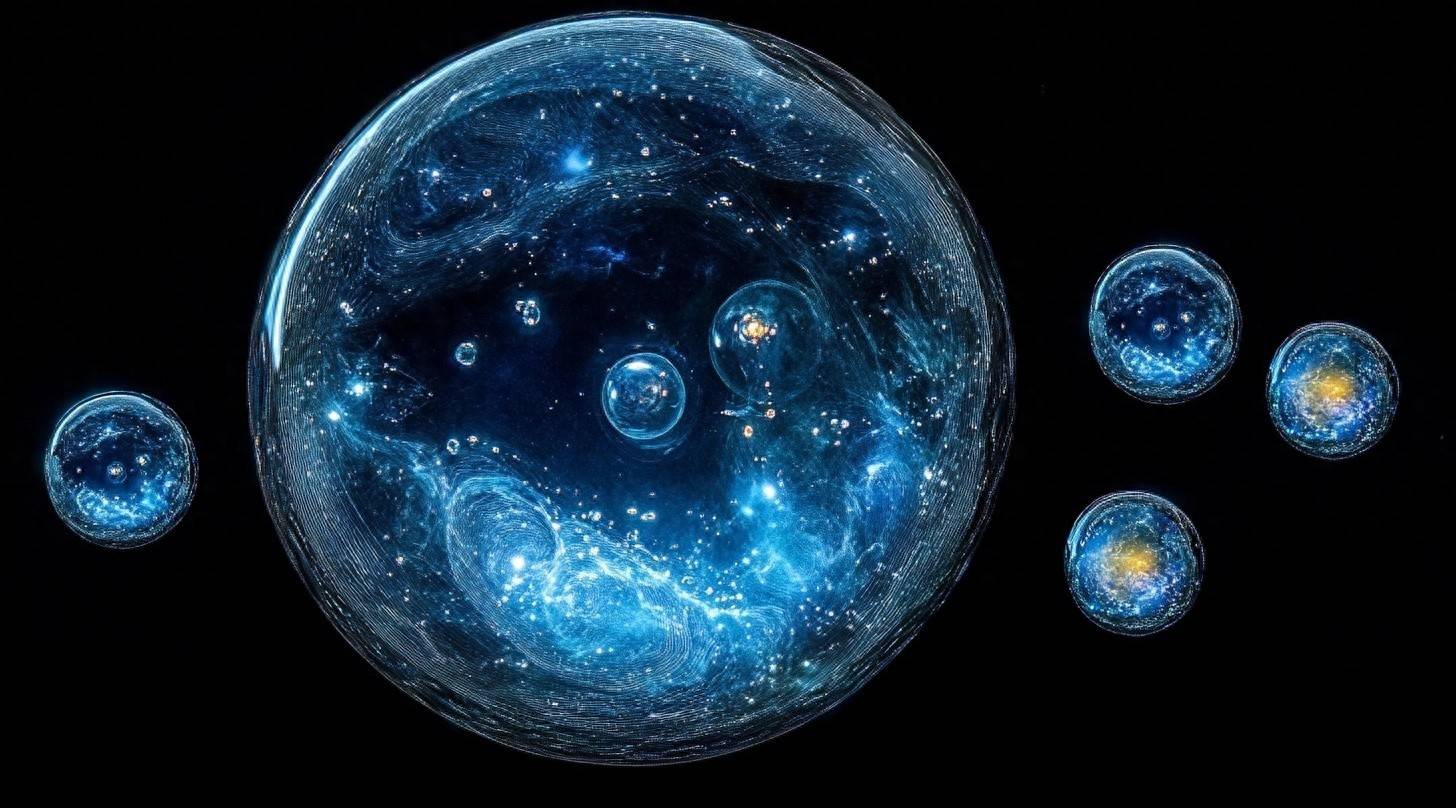
Group 1 - The universe does not have an "outside" as the concept of "outside" requires space and time, which are defined by the universe itself [3][5][11] - The observable universe has a radius of approximately 46.5 billion light-years and a diameter of about 93 billion light-years, but this is only a "horizon" set by the speed of light [5][7] - According to Hubble's law, galaxies that are far enough away are receding from us faster than the speed of light, meaning their light will never reach our observable universe [7][19] Group 2 - Understanding a "boundary-less universe" requires a topological perspective, with three main geometric models: flat infinite universe, closed universe, and open universe [8][11] - The concept of time is also tied to the universe's existence, as time began to have physical meaning only after the Big Bang [13][15] - Inflation theory explains the uniformity of distant galaxies' temperature and matter distribution, as they were once in a small region before being rapidly expanded [17][19] Group 3 - Dark energy, which constitutes about 68.3% of the universe's total energy, drives the accelerated expansion of the universe [19][21] - Potential outcomes of the universe's fate include the "Big Rip," where everything is torn apart, and "heat death," where the universe reaches maximum entropy and becomes a cold void [19][21] - The multiverse theory suggests our universe may be one of many, with different physical laws in each, leading to the anthropic principle that explains why our universe's parameters are suitable for life [21][23] Group 4 - The simulation hypothesis posits that if civilizations can create simulated universes, the number of simulated universes would far exceed real ones, supported by various physical phenomena [25][27] - The idea of the universe being a program raises questions about the nature of reality and existence beyond our perception [27][28] - The ability to contemplate the universe and its mysteries is seen as a significant aspect of human existence, highlighting the unique capacity for thought [28]