差异化竞争战略

Search documents
“比奶茶便宜”的疫苗也没人打了?从百亿利润到百亿亏损,疫苗的“黄金时代”何以终结
Hua Xia Shi Bao· 2026-01-23 01:15
Core Insights - Vaccine hesitancy is spreading from adults to children, leading to a significant decline in vaccination willingness, which has impacted company performance in the vaccine industry [1][2] Company Performance - Changchun BAK Biotech Co., Ltd. (百克生物) expects a net profit loss of 220 million to 280 million yuan for 2025, marking a year-on-year decline of 194.79% to 220.64%, the first annual loss since its listing in 2021 [1][2] - Chongqing Zhifei Biological Products Co., Ltd. (智飞生物) anticipates a loss exceeding 10 billion yuan for 2025, contrasting sharply with its net profit of over 10 billion yuan in 2021, indicating extreme volatility in performance over five years [1] - In the first three quarters of 2025, 11 sample companies in the vaccine sector reported total revenue of 17.4 billion yuan, a significant year-on-year decrease of 49.2%, and a combined net profit loss of 900 million yuan, down 121.6% [1][6] Market Dynamics - The vaccine industry is facing multiple pressures, including increased vaccine hesitancy, significant price declines, severe supply-demand imbalances, and intensified homogenization of competition [2][5] - The price of BAK Biotech's shingles vaccine was reduced from 1,369 yuan to 464 yuan, a nearly 70% decrease, aimed at improving accessibility and stimulating market demand [4] - The overall demand in the vaccine industry is weak, with core products like HPV and flu vaccines experiencing both declining issuance volumes and prices [5][6] Industry Challenges - The vaccine sector has entered a fierce price war, with many products seeing record price drops; for instance, the price of the two-valent HPV vaccine fell from 329 yuan to 86 yuan, and the three-valent flu vaccine was priced as low as 5.5 yuan [5][6] - The price war is attributed to a combination of factors, including decreased willingness for self-funded vaccinations and a shift in procurement strategies by health authorities [6] - The China Vaccine Industry Association has called for a halt to bidding below cost to encourage rational competition within the industry [6] Strategic Responses - Companies are beginning to differentiate themselves to escape the price war; BAK Biotech is diversifying its R&D pipeline, while Zhifei Biological is investing in new areas like GLP-1 [7] - Companies are urged to abandon price competition in favor of differentiated strategies that focus on unmet clinical needs and increased R&D investment to foster sustainable industry growth [7]


“比奶茶便宜”的疫苗也没人打了?疫苗的黄昏
Xin Lang Cai Jing· 2026-01-22 10:08
Core Industry Issues - Vaccine hesitancy is spreading from adult vaccines to children's vaccines, leading to a historical low in vaccination willingness [2][11] - The overall demand in the vaccine industry is weak, with significant price declines and a deteriorating competitive landscape [16][18] - The industry is experiencing a severe price war, with many products seeing record price drops, including a nearly 70% reduction in the price of the shingles vaccine [7][16] Company-Specific Challenges - Changchun Baike Biotechnology Co., Ltd. (Baike Bio) expects a net profit loss of 220.64% to 194.79% for 2025, marking its first annual loss since going public in 2021 [4][12] - Baike Bio's shingles vaccine, once a strong revenue driver, has seen a significant decline in sales, with only 21 batches approved in 2025, of which Baike Bio accounted for just 7 [4][13] - The company is responding to declining vaccination rates by reducing the price of its shingles vaccine from 1369 yuan to 464 yuan, a nearly 70% decrease [6][15] Financial Performance - In the first three quarters of 2025, 11 vaccine companies reported a combined revenue of 17.4 billion yuan, a 49.2% decrease year-on-year, with a total net profit loss of 900 million yuan, down 121.6% [8][17] - Baike Bio's core children's vaccine products are also declining due to a halved newborn birth rate over the past decade, further exacerbating financial pressures [6][15] Industry Response and Future Outlook - The China Vaccine Industry Association has called for a halt to bidding below cost to curb the ongoing price war and promote rational competition [18] - Companies are diversifying their research and development pipelines, with Baike Bio focusing on children's and therapeutic vaccines to escape the price competition trap [9][19] - Industry experts emphasize the need for companies to abandon price war strategies and focus on differentiated competition and unmet clinical needs to drive sustainable growth [19]

圣达生物:预计2025年年度净利润为5000万元~6500万元,同比增长69.93%~120.9%
Mei Ri Jing Ji Xin Wen· 2026-01-22 07:56
Group 1 - The company expects to achieve a net profit attributable to shareholders of the parent company between 50 million to 65 million yuan for the year 2025, representing an increase of 20.5755 million to 35.5755 million yuan compared to the same period last year, which translates to a year-on-year growth of 69.93% to 120.9% [1] - The main reasons for the performance change include the company's continuous promotion of refined management and technological upgrades, which further optimized operational efficiency and cost structure [1] - The company has deepened its differentiated competitive strategy and increased market expansion efforts, seizing market opportunities to enhance overall profitability [1]

调研速递|海利得接受民生证券等30家机构调研,上半年净利润增长56.16%
Xin Lang Cai Jing· 2025-09-01 10:30
Core Insights - The company held an online investor meeting on September 1, 2025, with 30 institutions to discuss its operational performance, business structure, and future strategic direction [1] Financial Performance and Business Structure - In the first half of 2025, the company achieved a revenue of 2.921 billion yuan, a year-on-year increase of 1.55% [1] - The net profit attributable to shareholders was 296 million yuan, reflecting a significant year-on-year growth of 56.16% [1] - The non-recurring net profit reached 345 million yuan, up 84.88% year-on-year [1] - The net cash flow from operating activities was 447.4 million yuan, showing a remarkable increase of 183.43% [1] - The core products, polyester industrial filament and tire cord fabric, contributed 71.49% of total revenue, indicating enhanced competitive advantages through improved product margins [1] Business Strategy and Product Development - The company's main business, polyester (PET) materials, accounts for over 70% of its operations, while polyvinyl chloride (PVC) materials are used in plastic materials, stone-plastic flooring, and film sectors [2] - The company is focused on optimizing product structure, enhancing differentiation strategies, and targeting high-end customers and high-performance material research [2] Operational Highlights - The Vietnam factory reported a net profit of 125 million yuan in the first half of the year, a substantial increase of 197%, operating at full capacity [3] - Product prices for American customers rose significantly due to US-China tariffs but are expected to stabilize as global trade policies normalize [3] - Capital expenditures will primarily support the Vietnam tire cord fabric project and polyester projects over the next three years [3] - New material developments include mass production of PPS fiber materials and sample submissions of PEEK and LCP fibers to various industry clients [3] - The company aims to transition traditional product lines while fostering new growth areas and enhancing innovation capabilities [3] Incentives and Investment Strategy - The company has clear performance targets and internal assessment mechanisms, with a focus on incentivizing the R&D technical team for innovation [3] - Current investment strategies involve seeking high-quality upstream and downstream resources that align with the research institute's strategic goals, while maintaining a cautious approach to mergers and acquisitions [3]

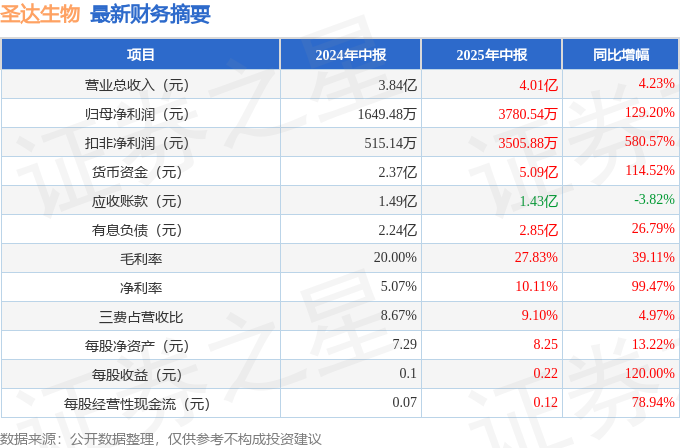
圣达生物2025年中报简析:营收净利润同比双双增长,盈利能力上升
Zheng Quan Zhi Xing· 2025-08-26 23:09
Core Viewpoint - The financial performance of Shengda Bio (603079) shows significant growth in net profit and profitability metrics for the first half of 2025 compared to the same period in 2024, indicating a positive trend in the company's operations and financial health [1] Financial Performance Summary - Total revenue for the first half of 2025 reached 401 million yuan, a year-on-year increase of 4.23% [1] - Net profit attributable to shareholders was 37.81 million yuan, up 129.2% year-on-year [1] - Gross margin improved to 27.83%, reflecting a 39.11% increase year-on-year [1] - Net margin rose to 10.11%, showing a 99.47% increase year-on-year [1] - Earnings per share increased to 0.22 yuan, a 120.0% rise compared to the previous year [1] Cost and Expense Analysis - Total selling, administrative, and financial expenses amounted to 36.46 million yuan, accounting for 9.1% of revenue, which is a 4.97% increase year-on-year [1] - Operating costs decreased by 5.96%, attributed to improved operational efficiency and cost optimization [6] Cash Flow and Capital Structure - Cash flow from operating activities saw a significant increase of 97.59%, driven by higher cash receipts from sales [8] - The company raised 61.23% in cash and cash equivalents due to issuing shares to specific investors [1][10] - Short-term borrowings decreased by 100% as the company repaid due bank loans [3] Investment and R&D - R&D expenses increased by 22.39%, indicating a commitment to innovation and product development [7] - The company has been focusing on expanding its market presence in biological preservatives and functional ingredients, contributing to revenue growth [6] Asset and Liability Management - The company’s monetary funds increased by 114.52% to 509 million yuan, reflecting strong liquidity [1] - Accounts receivable decreased by 3.82%, indicating improved collection efficiency [1] - Long-term liabilities increased by 26.79%, suggesting a rise in financial leverage [1] Business Model and Market Position - The company’s return on invested capital (ROIC) was reported at 2.05%, indicating challenges in capital efficiency [11] - The business model relies heavily on R&D and capital expenditures, necessitating careful evaluation of capital projects [11]