建筑行业可持续发展

Search documents
“纸板+土壤”制成低碳建材
Ke Ji Ri Bao· 2025-09-24 23:49
Core Insights - Australian scientists have developed an eco-friendly building material called "cardboard-reinforced rammed earth," which consists of only cardboard, water, and soil. This material has a carbon footprint approximately one-fourth that of concrete and is reusable and recyclable, providing a new pathway for sustainable development in the construction industry [1] Group 1: Environmental Impact - Over 2.2 million tons of cardboard and paper are sent to landfills in Australia each year [1] - Global carbon emissions from cement and concrete production account for about 8% of annual emissions [1] - The new material's carbon footprint is significantly lower than that of traditional concrete, making it a more sustainable option [1] Group 2: Material Properties and Cost - The innovative cardboard-reinforced rammed earth completely eliminates the need for cement, reducing costs by over two-thirds [1] - The construction process is simplified, requiring only the mixing of soil and water on-site, which reduces the need for heavy transportation of bricks, steel, or concrete [1] - Cardboard is lightweight and readily available, which significantly lowers transportation costs and simplifies the construction process [1] Group 3: Future Implications - This innovation has the potential to reshape building design and construction methods, promoting the convenient use and recycling of local materials [1] - In a related study, the research team combined carbon fiber with rammed earth to create a composite material with strength comparable to high-performance concrete [1]
行业报告解析:脱碳混凝土市场规模约1525百万美元
Sou Hu Cai Jing· 2025-08-21 04:36
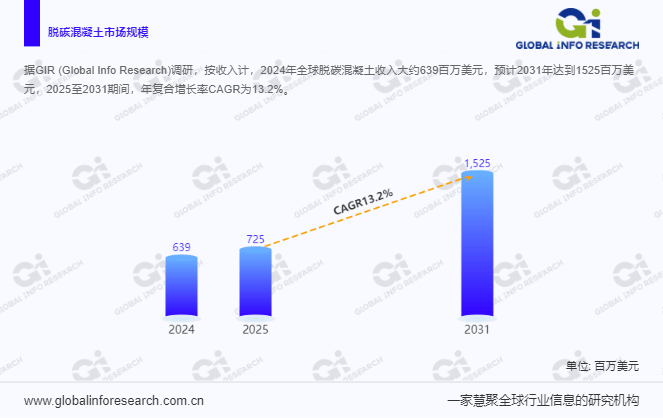
Group 1: Market Overview - The global decarbonized concrete market is projected to generate approximately $639 million in revenue in 2024, with expectations to grow to $1.525 billion by 2031, reflecting a compound annual growth rate (CAGR) of 13.2% from 2025 to 2031, indicating strong growth potential [1] - In terms of production, the global output of decarbonized concrete is expected to reach approximately 26.5 million tons in 2024, with an average selling price of $234.33 per ton [3] Group 2: Product Characteristics and Technology - Decarbonized concrete is defined as an innovative building material aimed at reducing CO₂ emissions during traditional concrete production by utilizing low-carbon raw materials, optimizing production processes, and integrating carbon capture technologies [3] - Key technological approaches include CO₂ mineralization, alternative clinker materials, and the development of completely cement-free geopolymers or biological methods, which not only reduce environmental impact but also enhance structural strength and durability [3] Group 3: Competitive Landscape - Major companies in the global decarbonized concrete market include CarbonCure Technologies, CarbiCrete, Brimstone, Sublime Systems, Hoffmann Green, C-Crete, Solidia Technologies, CarbonBuilt, Oxara, Blue Planet Systems, LafargeHolcim, Buzzi Unicem, Geopolymer Solutions, Heidelberg, and Cemex [4] - The market can be segmented into carbon-negative cement and cement-free concrete, with core applications in infrastructure, residential and commercial buildings, marine engineering, and other related fields [4] Group 4: Historical and Forecast Data - Historical data from 2020 to 2024 includes industry status, competitive landscape, production expansion, mergers and acquisitions, and market data segmented by product type, application field, and region [4] - Forecast data from 2025 to 2031 will cover industry status predictions, market size, product pricing, market share, growth rates, and competitive trends [5]

智能拆除“神器”施展绿色“魔法”——“焕新城市·科技筑家”系列报道
Ke Ji Ri Bao· 2025-07-21 09:16
Core Viewpoint - The article highlights the transformation of old residential areas in Jiangxi Province, showcasing the adoption of innovative technologies such as intelligent demolition robots, wire saw cutting technology, and recycled concrete technology, which enhance efficiency and environmental friendliness in urban renewal projects [1][2][3][4][5][6][7] Group 1: Intelligent Demolition Robots - Intelligent demolition robots are revolutionizing the construction industry by providing precise cutting and reducing safety risks associated with traditional demolition methods [2] - These robots are equipped with advanced sensors and remote control capabilities, allowing them to operate effectively in complex environments while minimizing dust and noise pollution [2][3] - The application of these robots in landmark buildings, such as the Jin Cang Wen Hua Hotel in Shanghai, demonstrates their ability to improve safety and efficiency in renovation projects [3] Group 2: Wire Saw Cutting Technology - Wire saw cutting technology significantly reduces noise pollution during demolition, making it suitable for urban areas where noise control is critical [4][5] - This technology operates with a diamond wire saw that efficiently cuts through concrete while minimizing dust and vibration, achieving noise reduction of over 80% compared to traditional methods [4][5] - The efficiency of wire saw cutting allows for quicker completion of tasks, such as cutting a cubic meter of concrete in approximately 45 minutes, compared to 1-2 days with traditional methods [5] Group 3: Recycled Concrete Technology - Recycled concrete technology enables the transformation of construction waste into reusable materials, significantly reducing the environmental impact of demolition [6][7] - The process involves sorting and processing construction debris to create recycled aggregates, which can replace natural sand and gravel in new construction [6] - The use of recycled concrete not only conserves natural resources but also reduces carbon emissions by 20% compared to traditional methods, with projects like the Beijing Workers' Club utilizing over 2,000 tons of recycled concrete [6][7]

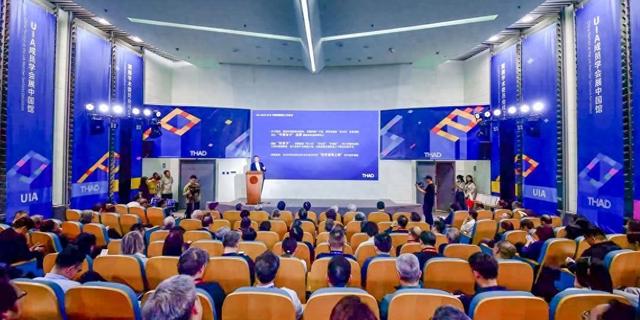
2026(巴塞罗那)世界建筑师大会中国馆策展学术委员会成立
Bei Jing Ri Bao Ke Hu Duan· 2025-04-24 01:32
Core Viewpoint - The establishment of the China Pavilion's curatorial academic committee for the 2026 UIA World Architects Congress in Barcelona aims to create a platform for international dialogue and collaboration in architecture, focusing on sustainable development and shared global challenges [3][4]. Group 1: Event Overview - The curatorial academic committee was inaugurated at Tsinghua University, with participation from authoritative experts and scholars in the architecture field [3]. - The theme of the China Pavilion is "Overview: The Dynamic Landscape of Contemporary Chinese Architecture," emphasizing architecture as a record of civilization [3]. Group 2: Objectives and Aspirations - The 2026 UIA Congress is positioned as a critical platform for addressing unprecedented challenges in the architecture industry, encouraging global architects to contribute diverse experiences and cross-cultural perspectives [3]. - The China Pavilion aims to showcase Chinese wisdom and promote global cooperation, addressing future challenges with resilient, equitable, and sustainable solutions [3][4]. Group 3: Committee Composition and Goals - The curatorial academic committee consists of over 110 members, including academicians, renowned designers, and active international architects in the Chinese market, fostering an open and equal academic exchange platform [4]. - The Tsinghua Design Institute has been committed to responsibly advancing the curatorial preparations since being confirmed as the main curatorial unit in 2023 [4].