征信管理

Search documents
9家机构合计被罚逾700万元,消金公司如何避免征信“踩红线”?
Guo Ji Jin Rong Bao· 2026-01-21 12:53
Core Viewpoint - Multiple consumer finance institutions have been penalized for improper management of credit information, highlighting a significant compliance issue within the industry [1][2][3]. Group 1: Penalties and Violations - In early 2026, several consumer finance companies, including Citic Consumer Finance, Su Yin Kai Ji Consumer Finance, and Zhongyuan Consumer Finance, were fined for violating credit information collection and management regulations, with penalties totaling 105 million, 48.4 million, and 75.6 million respectively [1][2]. - A total of 701.7 million in fines has been imposed on various consumer finance institutions for credit management issues, including Jin Meixin Consumer Finance, Hubei Consumer Finance, and others [1][3]. - Specific violations include insufficient credit information reporting, improper handling of disputes, and unauthorized queries of personal credit information [1][5]. Group 2: Regulatory Responses and Recommendations - Industry experts recommend that consumer finance institutions ensure the accuracy and completeness of credit information and enhance compliance with regulatory requirements [1][6]. - Companies are advised to establish dedicated personal credit information management mechanisms and improve compliance training for staff to avoid future violations [6][5]. - The need for improved communication with financial consumers regarding credit issues and the disclosure of dispute handling processes is emphasized to prevent recurrence of violations [6].
央行信用修复新政落地!网友晒图:我的贷款逾期记录清零了
Sou Hu Cai Jing· 2026-01-03 07:51
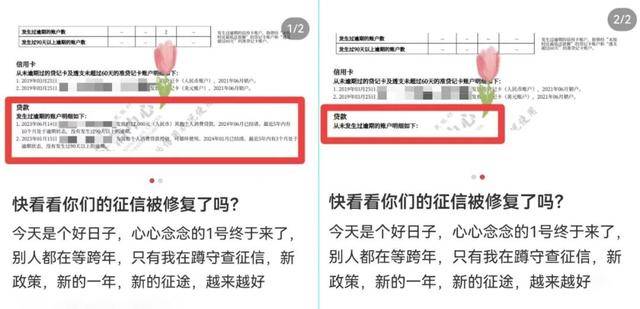
Core Viewpoint - The People's Bank of China has implemented a "one-time credit repair policy" aimed at helping individuals with damaged credit histories to restore their credit status efficiently, thereby supporting economic recovery [1][3]. Group 1: Policy Implementation - The one-time credit repair policy allows individuals with overdue loan records from January 1, 2020, to December 31, 2025, to have their overdue information not displayed if they repay their debts by March 31, 2026, with a single overdue amount not exceeding 10,000 yuan [1][3]. - Users have reported successful updates to their credit reports, with many seeing their overdue records reduced or eliminated [1][3]. Group 2: Eligibility Criteria - The policy applies only to personal overdue information displayed in the central bank's credit system, with specific conditions including the time frame of overdue records and the maximum overdue amount [3][5]. - Individuals must fully repay their overdue debts by the specified deadline to benefit from the policy, and the repayment must include any interest and penalties [4][5]. Group 3: Impact on Credit Reporting - The policy changes the status of overdue payments from overdue to normal in credit reports, but it does not delete the underlying data, which remains accessible [5][10]. - The initiative is designed to encourage individuals to actively repay their debts, thereby improving their creditworthiness and access to financial services [9][10]. Group 4: Broader Implications - The policy is expected to alleviate the long-term consequences of credit damage, allowing individuals to regain access to loans, housing, and employment opportunities [9][10]. - Financial institutions may benefit from improved asset quality as more individuals are encouraged to repay overdue debts, potentially expanding their customer base [9][10].

央行重拳出击 华夏银行、北京银行合计被罚近4000万元
Jing Ji Guan Cha Bao· 2025-11-30 06:23
Core Viewpoint - The People's Bank of China has issued significant fines to Huaxia Bank and Beijing Bank, totaling nearly 40 million yuan, highlighting deep-rooted issues in anti-money laundering, credit management, and account management within commercial banks [2][5]. Group 1: Penalties and Violations - Huaxia Bank was fined 13.655 million yuan, while Beijing Bank faced a penalty of 25.2685 million yuan, with both banks receiving warnings and having illegal gains confiscated [2][3]. - A total of 21 management personnel from both banks were held accountable, with violations spanning multiple critical departments including operations, personal business, credit card centers, and legal compliance [2][4]. - Huaxia Bank was found to have ten violations, including breaches of account management, clearing management, and anti-money laundering obligations [2][3]. Group 2: Systemic Issues and Regulatory Environment - Both banks exhibited systemic deficiencies in fulfilling core anti-money laundering obligations, particularly in customer identity verification and transaction reporting [4][6]. - The regulatory environment has intensified, with a notable increase in penalties across various banking institutions, reflecting a "zero tolerance" stance towards internal control failures and compliance deficiencies [5][6]. - The increase in penalties and the number of fines issued in 2025 compared to 2024 indicates a significant rise in regulatory scrutiny, with a 10.36% increase in the number of fines and a 49.34% increase in total penalty amounts [5]. Group 3: Structural Problems and Future Directions - The frequent violations in areas such as anti-money laundering and credit management are symptomatic of structural issues, including fragmented internal controls and outdated technological systems [6][7]. - Actions like "occupying fiscal deposits" pose direct threats to public fund safety, indicating a disregard for institutional boundaries under performance pressure [7]. - Future regulatory efforts should focus on embedding compliance into product design and operational processes, rather than solely relying on post-violation penalties [7].


小贷行业现罕见百万级高额罚单
Bei Jing Shang Bao· 2025-07-06 15:57
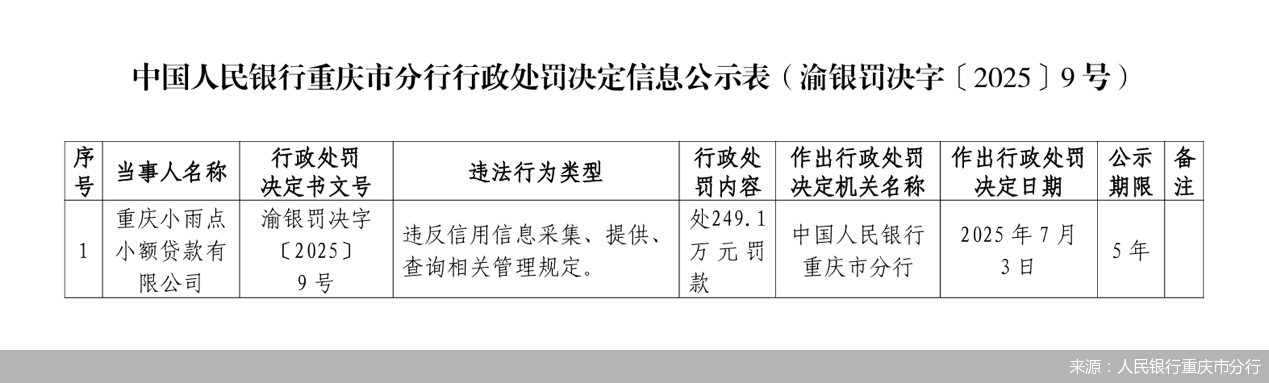
Core Viewpoint - Chongqing Xiaoyudian Microfinance Co., Ltd. has been fined 2.491 million yuan for violating credit information management regulations, marking the highest penalty issued by the People's Bank of China against a microfinance company [1][2]. Group 1: Penalty Details - The penalty consists of a dual punishment system, where not only the company was fined, but also two responsible individuals, the Chief Risk Officer and the Operations Director, were fined 142,000 yuan each [2]. - The fine was imposed after a comprehensive inspection by the People's Bank of China, which was the first on-site enforcement check since the company connected to the credit reporting system in August 2017 [2]. Group 2: Regulatory Context - The violations pertained to unauthorized collection, improper provision of information, illegal inquiries, and mishandling of adverse information, as outlined in the Credit Reporting Industry Management Regulations [2]. - The high penalty reflects ongoing stringent financial regulation and highlights compliance risks within the industry, particularly in credit information management [3]. Group 3: Industry Implications - The incident reveals vulnerabilities in credit information management processes, indicating flaws in the design of credit reporting procedures and internal compliance mechanisms [3]. - The fine may erode the company's profits and affect its market reputation, potentially influencing the choices of partner institutions [3]. - Despite the penalty, the company claims that its business operations remain stable and unaffected by the incident [3].
罚单金额创小贷纪录!背靠李兆基的小雨点被罚后,公司回应
Bei Jing Shang Bao· 2025-07-06 14:46
Core Viewpoint - The small loan industry is facing significant regulatory scrutiny, highlighted by a record fine of 2.491 million yuan imposed on Chongqing Xiaoyudian Small Loan Co., Ltd. for violations related to credit information management [1][4][5] Regulatory Actions - The fine of 2.491 million yuan is the highest ever issued by the People's Bank of China against a small loan company, indicating a strict regulatory environment [4][5] - The penalty was part of a dual punishment system, with the company's Chief Risk Officer and Operations Director also fined 142,000 yuan each, with a public disclosure period of five years [2][3] Company Response - Xiaoyudian stated that it has completed all necessary rectifications and that its business operations remain stable and unaffected by the fine [6][12] - The company emphasized that the fine resulted from a routine regulatory inspection, marking its first on-site examination since joining the credit reporting system in 2017 [3][4] Background and Operations - Xiaoyudian, established in 2015 and backed by Hong Kong's Lee Ka-shing family, primarily serves small and micro enterprises with products like Yushang Loan and Yuhua Loan, with an annual interest rate starting at 12% [7][10] - The company has served over 5.6 million users and has a cumulative loan amount of approximately 48 billion yuan, with over 80% directed towards small and micro enterprises [10][18] Consumer Issues - The company has faced criticism regarding its training loan products, with consumers reporting issues such as misleading loan inducements and high-interest rates [11][12] - Xiaoyudian has acknowledged the challenges in consumer complaints and is committed to enhancing compliance training and consumer protection measures [14][18] Strategic Focus - Moving forward, Xiaoyudian plans to concentrate on financing small and micro enterprises, addressing challenges such as credit assessment and high funding costs [19][20] - The company is collaborating with various data service providers to improve risk assessment models, particularly in the logistics sector [19][20]