
小额贷款

Search documents
个人贷款,有新规定!(附具体操作要求)
新华网财经· 2026-03-17 03:58
Core Viewpoint - The article discusses the new regulations issued by the National Financial Supervision Administration and the People's Bank of China, which require lenders to clearly disclose the comprehensive financing costs of personal loans to borrowers, enhancing transparency in the personal loan market [1][2]. Group 1: Regulatory Overview - The new regulations mandate that all lending institutions, including banks, consumer finance companies, auto finance companies, trust companies, and microloan companies, must disclose specific cost items, collection methods, standards (annualized), and the entities collecting these costs [2]. - The regulations aim to address issues of non-compliance and lack of transparency in the personal loan market, which have led to financial consumer disputes and weakened the effectiveness of interest rate policies [1]. Group 2: Implementation Details - The regulations will take effect on August 1 of this year, with a "new and old separation" principle, meaning that new business must strictly adhere to the new disclosure requirements [3]. - For in-person loan applications, borrowers must sign a confirmation on the comprehensive financing cost disclosure form before signing the loan contract or processing installments [6]. - For online loan applications, the comprehensive financing cost disclosure must be presented through a pop-up window with a mandatory reading time, requiring borrower confirmation before contract signing [6].


还需多久,阿里能让美团从地图上消失
水皮More· 2026-03-06 11:09
Core Viewpoint - The article emphasizes the importance of cash flow over accounting profits when evaluating a company's financial health, using McDonald's and Meituan as case studies to illustrate the differences between cash flow and reported losses [5][6]. Group 1: Company Analysis - McDonald's has a total asset of $59.5 billion and total liabilities of $61.3 billion, yet it maintains a strong cash flow with operating cash flow of $10.6 billion after capital expenditures and interest payments, indicating financial stability despite negative net assets [5]. - Meituan reported a significant operating cash outflow of 22.2 billion yuan in Q3 2025, despite a reported loss of 18.6 billion yuan, highlighting a discrepancy between accounting losses and cash flow realities [6]. - The increase in Meituan's prepaid items by 7.4 billion yuan suggests a substantial amount of cash is tied up in loans that have not yet been recovered, further complicating its cash flow situation [6]. Group 2: Financial Projections - As of September 30, 2025, Meituan has 99.2 billion yuan in cash and 42.1 billion yuan in short-term investments, indicating a total liquidity of approximately 140 billion yuan available for operations [6][7]. - Meituan's projected cash outflow for Q4 is estimated at 15 billion yuan, with expectations of reduced losses compared to Q3, suggesting a potential improvement in cash flow management [7]. - The company has options to raise additional funds through asset sales and debt issuance, with a recent issuance of 7.1 billion yuan in bonds indicating confidence from the debt market [7][8]. Group 3: Market Sentiment - The bond market's strong demand for Meituan's recent debt issuance, with a subscription rate of over 3.7 times, reflects a positive outlook on the company's financial health despite its current challenges [7]. - Internal confidence is further demonstrated by the company's leadership's decision to invest in acquisitions, such as the purchase of Dingdong, indicating a belief in the company's long-term viability [8].

剑指“租机贷”!多地监管部门提示风险
Xin Lang Cai Jing· 2026-02-27 05:03
Core Viewpoint - The emergence of "credit leasing," "zero down payment," and "rent-to-own" schemes represents a form of illegal high-interest loans disguised as leasing, severely harming consumer rights and disrupting financial market order [1][6]. Group 1: Regulatory Actions - The Hainan Provincial Local Financial Management Bureau issued a risk alert regarding six types of local financial organizations operating without business qualifications, including companies involved in "rental business" that violate consumer rights [2][7]. - A list of 141 unqualified local financial organizations was published, including pawnshops, commercial factoring, and financing leasing institutions [2][7]. - Following the notification on managing internet lending by commercial banks, a loan interest rate cap of 24% has been gradually enforced, leading to the emergence of more covert high-interest lending schemes [2][7]. Group 2: Consumer Cases - A case was highlighted where a Shenzhen resident, in urgent need of funds, used a rental app to lease a smartphone priced at 9,999 yuan, but ended up paying approximately 13,000 yuan in rent, resulting in a debt burden far exceeding the cash received [2][7]. Group 3: Lending Practices - In rental marketplaces, users can purchase items in installments with annualized interest rates typically between 23% and 24%, which are close to the regulatory cap [3][8]. - The "buyback" process allows users to sell back the purchased items at 50% to 70% of the original price, effectively creating a disguised loan, while users are still required to repay the original installment amounts, leading to interest rates exceeding 24% [3][8]. Group 4: Consumer Awareness - The Shenzhen Office for the Prevention and Control of Illegal Financial Activities outlined four common traps in "rent-to-own" schemes: high-interest packaging, hidden costs, misuse of personal information, and aggressive debt collection practices [4][9]. - Consumers are advised to be cautious of marketing terms like "zero down payment," "low monthly rent," and "instant approval," and to develop a rational consumption mindset to avoid excessive debt [4][9].
女子读大学时在“分期乐”网贷,年利率超32%自称为还款患抑郁病
Xin Lang Cai Jing· 2026-02-24 05:21
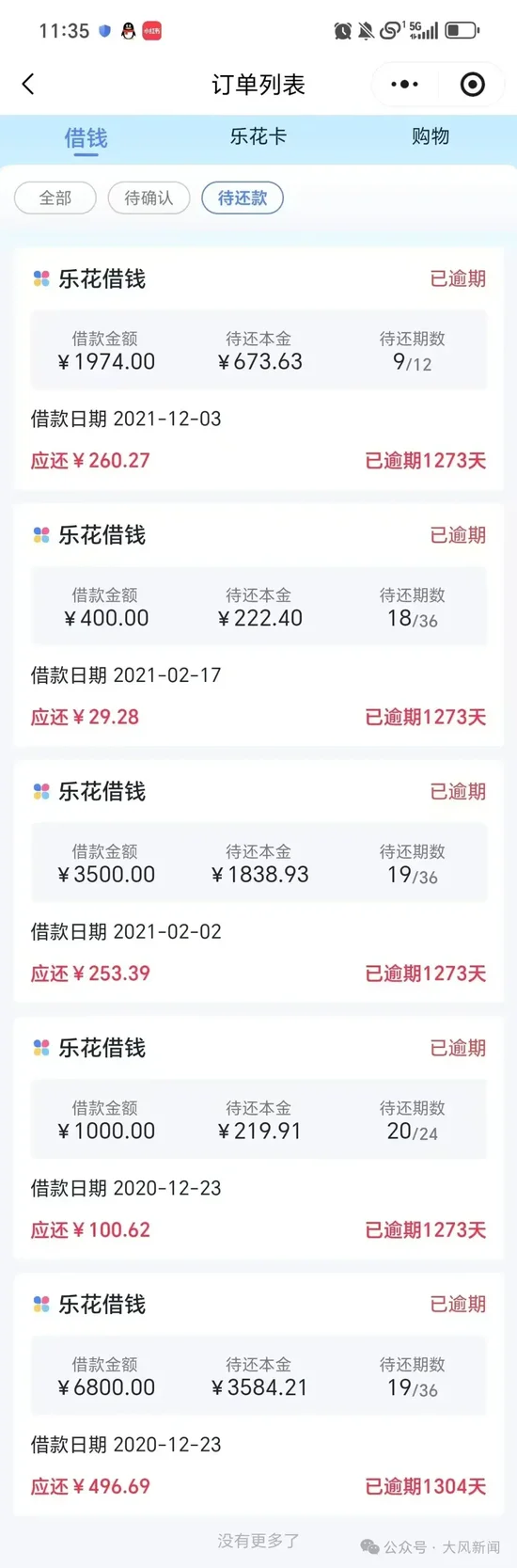
Core Viewpoint - The article highlights the financial struggles of a woman, Ms. Chen, who became overwhelmed by high-interest online loans, leading to a prolonged period of non-repayment and mental health issues due to debt stress [1][8][25]. Group 1: Loan Details - Ms. Chen borrowed a total of 13,674 yuan across five loans with annual interest rates ranging from 32.08% to 35.90% [1][9][14]. - The loans included amounts of 6,800 yuan, 1,000 yuan, 3,500 yuan, 400 yuan, and 1,974 yuan, with repayment terms varying from 12 to 36 months [2][22]. - The smallest loan of 400 yuan was split into 36 installments, resulting in a total repayment of 860.28 yuan, which included 255.89 yuan in interest [5][22][23]. Group 2: Repayment Challenges - Ms. Chen's monthly repayment obligations totaled nearly 740 yuan, which became unmanageable given her lack of income as a student [5][22]. - After ceasing repayments in August 2022, her loans have been overdue for over 1,000 days, with a remaining balance of approximately 15,000 yuan despite having repaid 11,000 yuan prior [1][14][25]. - The psychological impact of the debt has led to depression, requiring medical treatment and affecting her personal relationships [8][25]. Group 3: Regulatory Context - New regulations set to take effect by the end of 2027 will limit annual loan interest rates to no more than four times the one-year Loan Prime Rate (LPR), aiming to reduce the burden of high-interest loans [30]. - Legal experts indicate that any interest exceeding 24% may be subject to judicial review, which could impact the enforcement of existing high-interest loans [31]. - The article suggests that the recent regulatory changes provide a potential avenue for borrowers like Ms. Chen to negotiate lower repayment terms with lenders [30][31].
小额贷款哪个平台好?2026年正规小额贷款全指南
Sou Hu Wang· 2026-02-23 12:05
Core Insights - The article discusses four reputable small loan products available in the market, highlighting their features and benefits for borrowers. Group 1: Loan Products Overview - WeBank's WeLiDai offers loan amounts ranging from 500 to 200,000 yuan, with an annual interest rate of 3.06% to 23.76%, and allows for flexible repayment options including early repayment without penalties [2] - Ant Group's Jiebei provides a maximum loan amount of 300,000 yuan, with an annual interest rate between 3.6% and 24%, and allows for unlimited borrowing as long as there is available credit [3] - JD Finance's Jingdong Jintiao offers a maximum loan amount of 300,000 yuan, although specific interest rates and repayment terms are not detailed [4] - 360's Qifu Jietiao has a maximum loan amount of 200,000 yuan, with an annual interest rate ranging from 7.2% to 24%, and allows for repayment over a maximum of 24 installments [5] Group 2: Considerations for Borrowers - The choice of a small loan platform should consider factors such as safety, convenience, transparency, and alignment with personal needs, emphasizing the importance of rational borrowing [5]
律师解读女子深陷迷你贷400元分36期
Xin Lang Cai Jing· 2026-02-23 07:19
Core Viewpoint - The article discusses the implications of high-interest loans in China, particularly focusing on a case involving a woman named Chen who borrowed money at exorbitant interest rates, highlighting the regulatory changes aimed at capping loan costs to protect consumers [1] Group 1: Loan Details - Chen borrowed a total of 13,674 yuan through the Fenqile platform between 2020 and 2021, with annual interest rates ranging from 32.08% to 35.90% [1] - The loans were structured to be repaid in up to 36 installments, but Chen stopped repayments in August 2022, leading to over 1,000 days of overdue payments [1] Group 2: Regulatory Changes - On December 19, 2025, the People's Bank of China and the National Financial Regulatory Administration issued guidelines stating that the annualized comprehensive financing cost of new loans should not exceed 24% [1] - By the end of 2027, all new loans must have a comprehensive financing cost within four times the one-year Loan Prime Rate (LPR) [1] Group 3: Legal Implications - According to a 2017 Supreme People's Court opinion, any interest, compound interest, penalty interest, and other fees exceeding the 24% annual rate should be reduced by the courts [1] - Although Chen's loan contracts were signed before the new regulations, the ongoing collection of high penalty interest rates by the platform may be subject to judicial review [1] - The new regulations signal a shift from mere judicial recommendations to strict compliance requirements for licensed institutions [1]
律师解读女子借1万3要还2万6 :是否超过24%的司法保护上限,法院有权进行实质审查
Xin Lang Cai Jing· 2026-02-23 02:13
Core Viewpoint - The article discusses the legal implications of a woman's loan situation, highlighting the potential for judicial review of interest rates exceeding the 24% cap established by Chinese law, particularly in the context of new regulations set to take effect by the end of 2027 [1] Group 1: Loan Details - The woman, referred to as Chen, borrowed a total of 13,674 yuan through the Fenqi Le platform, with annual interest rates ranging from 32.08% to 35.90% [1] - Chen's loans were structured to be repaid over a maximum of 36 installments, but she ceased payments in August 2022, leading to over 1,000 days of delinquency [1] Group 2: Legal Framework - According to a 2017 ruling by the Supreme People's Court, any interest, compound interest, penalties, or other fees exceeding the annual interest rate of 24% should be reduced by the court [1] - The legal expert, Zhao Liangshan, indicated that while Chen's loan contracts were signed in 2020-2021, the platform's continued charging of high penalties in 2026 could be subject to judicial review [1] Group 3: Regulatory Changes - A new guideline issued by the People's Bank of China and the National Financial Regulatory Administration on December 19, 2025, states that the annualized comprehensive financing cost for new loans should not exceed 24% [1] - The guideline also mandates that by the end of 2027, all new loans must have a comprehensive financing cost within four times the one-year Loan Prime Rate (LPR) [1] - Zhao noted that while the 2025 regulations do not apply retroactively, they signal a shift in regulatory expectations, making the 24% cap a binding requirement for licensed institutions [1]
佐力小贷股价微跌,监管约谈出行平台规范助贷业务
Xin Lang Cai Jing· 2026-02-21 08:50
Regulatory Actions - The National Financial Regulatory Administration, in conjunction with the Market Supervision Administration and the People's Bank of China, conducted discussions with six travel platform companies, including Ctrip and Gaode Map, to regulate lending marketing practices and enhance information disclosure and consumer protection [1] - The regulatory focus is on misleading advertising and insufficient risk warnings in assistive lending services, emphasizing the need for platforms to clearly disclose lending entities to ensure rational decision-making by users [1] Market Performance - On February 20, 2026, Zoli Small Loan (06866.HK) closed at HKD 0.38, with a daily decline of 1.32% and a trading volume of only HKD 750, indicating extremely low trading activity [1] - Technically, the stock price is below the 5-day moving average (HKD 0.38), with a negative MACD histogram (-0.005) and a KDJ indicator showing the J line dropping to 58.21, suggesting weak short-term momentum [1] - The credit sector experienced a decline of 2.93% on the same day, while the Hang Seng Index fell by 1.10%, indicating increased pressure on individual stocks within the sector [1]
小额贷款平台哪个靠谱?看看这四家哪个适合你?
Sou Hu Wang· 2026-02-20 08:05
Group 1 - The article discusses the increasing popularity of online microloans as a solution for individuals needing quick financial assistance, highlighting the importance of choosing reliable platforms [1] - Four microloan products are introduced, emphasizing the need for careful comparison and judgment when selecting a platform [4] Group 2 - WeBank's WeLiDai offers loan amounts ranging from 500 yuan to 200,000 yuan, with an annual interest rate of 3.06%-23.76% and flexible repayment options [2] - Ant Group's Ant Borrow provides a maximum loan amount of 300,000 yuan, with an annual interest rate of 3.6%-24% and no hidden fees [3] - JD Finance's JD Gold Bar and Du Xiaoman also offer competitive loan amounts and interest rates, with varying repayment terms [5]
汇鑫小贷贷款协议与行业监管动态持续影响市场关注
Jing Ji Guan Cha Wang· 2026-02-13 07:37
Core Viewpoint - Huixin Microfinance (01577.HK) has not reported any significant new events recently, but its historical loan agreements and the changing regulatory environment in the industry remain focal points for the market [1] Group 1: Operating Conditions - As of the announcement at the end of December 2025, Huixin Microfinance and its subsidiaries signed multiple loan agreements totaling RMB 270 million in the second quarter of 2025, with an annual interest rate of 18%. These loans have not yet been settled as of the announcement date. The repayment progress and potential credit risks of these agreements may become key points of focus in future financial reports [2] Group 2: Industry Policies and Environment - The microfinance industry is facing ongoing stringent regulations in 2026. Data shows that as of the end of September 2025, the number of microfinance companies and the loan balance nationwide are both in a shrinking trend. Additionally, relevant management guidelines require a gradual reduction in the comprehensive financing costs of newly issued loans, with some localities accelerating the exit of non-compliant institutions. Such policies may have long-term impacts on Huixin Microfinance's interest rate pricing, profit model, and compliance operations [3] Group 3: Capital Movements - In terms of market liquidity, southbound funds in early February 2026 primarily flowed into technology stocks, with the microfinance sector not receiving significant capital attention. The industry is experiencing increased differentiation, with leading institutions enhancing their strength through capital increases, while smaller institutions face pressure to exit. Huixin Microfinance needs to pay attention to the dynamics of the funding landscape [4]