微生物趋化作用

Search documents
中瑞两国科研人员联手绘制微生物在植物根系的“定居地图”
Xin Hua She· 2025-10-03 08:46
Core Insights - The research reveals the intricate relationship between plant roots and soil microorganisms, focusing on how roots guide microbial colonization and the molecular mechanisms involved [4][5][8] Group 1: Research Findings - The study published in the journal "Science" uncovers the "settlement map" of root-associated microorganisms and decodes the "molecular code" controlling root-microbe interactions [4][5] - The research team utilized plant seedling root systems as a model, employing fluorescently labeled live microorganisms and high-resolution imaging techniques to demonstrate that microbial settlement on root surfaces follows a systematic spatial distribution [5][7] - The integrity of a specific barrier in the root, known as the "Casparian strip," is crucial for maintaining this orderly microbial settlement; any disruption leads to nutrient leakage, particularly of the amino acid glutamine [5][7] Group 2: Implications for Agriculture - The study indicates that the leakage of glutamine from roots significantly influences microbial chemotaxis, thereby regulating microbial behavior such as movement and reproduction [7][8] - The findings provide a technical pathway for the precise enrichment of beneficial microbial communities in crop rhizospheres, which is essential for advancing "carbon sequestration" green agriculture [8] - This research lays a theoretical foundation for achieving agricultural green transformation under the "dual carbon" goals, highlighting its significant scientific implications [8]

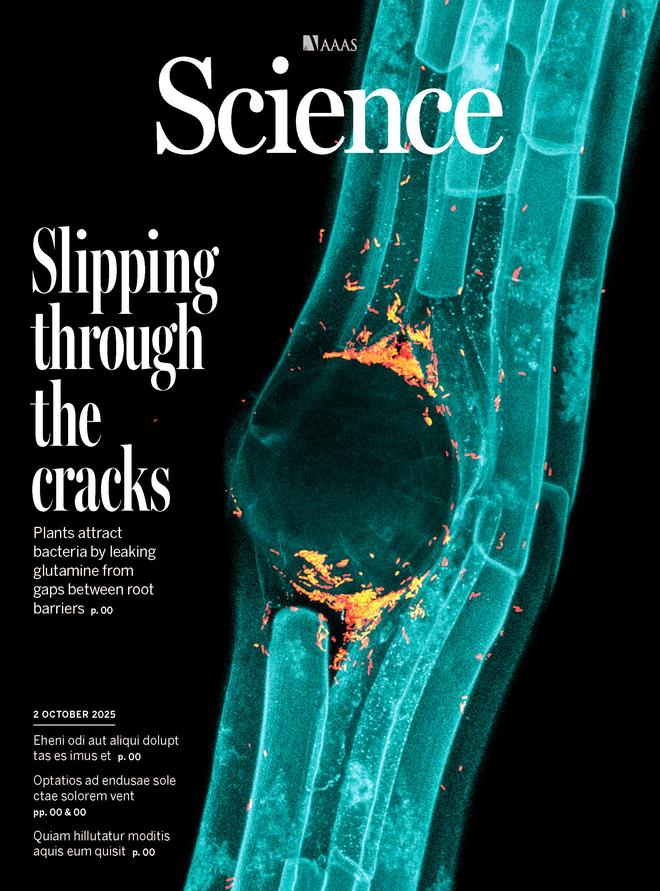
登上《科学》封面 中瑞科研团队联手揭晓根系微生物“安家”奥秘
Zhong Guo Xin Wen Wang· 2025-10-03 05:49
Core Insights - The research conducted by the team from the Chinese Academy of Sciences and the University of Lausanne reveals the mechanisms by which plant roots guide microorganisms to settle on their surfaces, creating a "settlement map" of root-associated microbes [1][3] Group 1: Research Findings - The study identifies that the settlement of microorganisms on root surfaces is not random but follows a systematic spatial distribution [3] - A critical structure called the Casparian strip acts as a "smart gate" that regulates the leakage of nutrients, particularly the amino acid glutamine, which attracts microorganisms through chemotaxis [3][4] - The research highlights the importance of the Casparian strip in maintaining a healthy balance of root-associated microbial communities by controlling nutrient leakage and preventing excessive proliferation of pathogenic microbes [4] Group 2: Practical Implications - The findings suggest the potential for designing amino acid-based microbial fertilizers to precisely guide beneficial microbial colonization, thereby enhancing crop nutrient absorption efficiency and resilience [5] Group 3: Collaborative Efforts - The research is a product of collaboration between Chinese and Swiss research teams, initiated during the postdoctoral research of the lead researcher at the University of Lausanne, which laid the groundwork for this significant discovery [8]