微纳尺度机器人制造

Search documents
全球“最小”Delta机器人!3D打印而成,论文登顶《Science Robotics》
机器人大讲堂· 2025-11-14 10:09
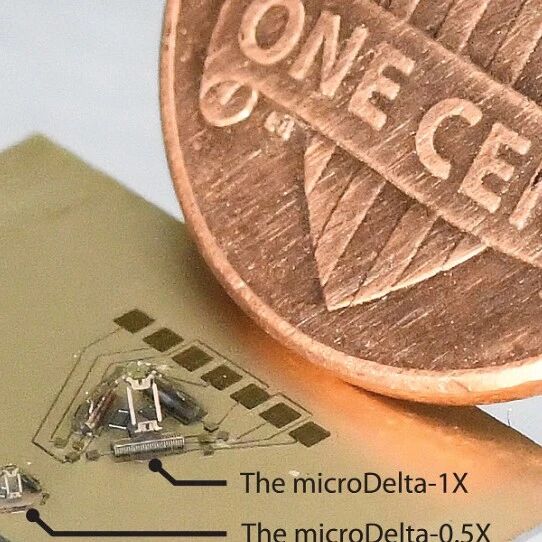
Core Viewpoint - The article discusses the development of a micro Delta robot by Carnegie Mellon University, highlighting its advanced capabilities in high-speed movement and precision at a millimeter scale, achieved through innovative 3D printing techniques and design modifications [3][6][12]. Manufacturing Breakthrough - The research team utilized "two-photon polymerization (TPP) 3D printing" technology to create structures with feature sizes below 100 nanometers, enabling the high-precision manufacturing of the entire robot mechanism in one step [8][12]. - The manufacturing process involves three key steps: integrating the robot structure using TPP, selectively etching the silicon substrate, and depositing a conductive layer for electrostatic actuation [8][12]. Performance Metrics - The microDelta-0.5X has a base diameter of 1.6 mm and a height of 0.723 mm, showcasing a significant size reduction compared to previous models [12]. - It exhibits a resonance frequency of 1050 Hz, allowing the end effector to move at a rate of 1050 times per second, outperforming existing Delta robots [12]. - The microDelta-1X achieved a root mean square error of only 4.6 μm during star-shaped trajectory movement, while the microDelta-0.5X reached a precision of 0.2 μm, suitable for high-end applications like microelectronics assembly [13]. Application Potential - The microDelta robots can perform complex tasks such as "pick-and-place" operations for micro-components and releasing biological samples, addressing core challenges in micro-manipulation [18]. - An experiment demonstrated the robot's ability to launch a 37 μg salt particle to a height of 4 mm, indicating its capacity to overcome surface adhesion forces common in micro-scale operations [18]. Theoretical vs. Practical Performance - There are discrepancies between theoretical predictions and actual performance, such as lower than expected torque and angular displacement in the microDelta-0.5X, attributed to manufacturing limitations at micro scales [19][20]. - Despite these challenges, the microDelta-0.5X achieved a resonance frequency of 3000 Hz, exceeding theoretical expectations and enhancing its high-speed capabilities [20]. Future Implications - The development of micro Delta robots illustrates the applicability of scaling laws in millimeter-scale robotics and showcases the potential of 3D printing technology in precision manufacturing [20]. - As manufacturing processes improve, future micro robots may reach μm scales, paving the way for practical "nanorobots" [20].