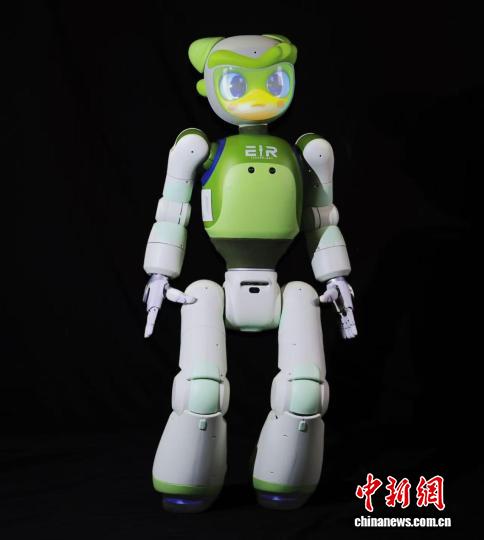
情感交互人形机器人

Search documents
全球首款情感交互人形机器人在成都亮相
Qi Lu Wan Bao· 2026-01-01 16:00
Core Viewpoint - The world's first emotional interaction humanoid robot, "Ai Qiao," developed by Sichuan Embodied Humanoid Robot Technology Co., Ltd., was unveiled in Chengdu on December 31, 2025, showcasing significant advancements in emotional recognition technology [1] Group 1: Technology and Capabilities - "Ai Qiao" can accurately identify no less than 15 different emotions, with an emotion recognition accuracy rate of no less than 85% [1] - The technological breakthroughs enable "Ai Qiao" to "perceive" human emotions such as joy, anger, sadness, and happiness, and to express resonance and feedback through facial expressions, voice, and coordinated movements [1]

全球首款情感交互人形机器人“爱湫”在成都亮相
Zhong Guo Xin Wen Wang· 2025-12-31 08:26
Group 1 - The world's first emotional interactive humanoid robot, "Ai Qiao," was unveiled in Chengdu on December 31, 2025 [1][3] - "Ai Qiao" is designed for "linking and companionship," providing warm interactions and psychological support for the elderly in care scenarios, and enhancing service experiences in cultural, commercial, and public service contexts [1][3] - The robot utilizes a self-developed "Emotion-Language-Action" model, capable of accurately recognizing at least 15 emotions with an accuracy rate of no less than 85% [1][3] Group 2 - The development team employed innovative 3D ultra-short throw projection technology to give "Ai Qiao" a lifelike face, allowing for controlled management of 59 degrees of freedom, enabling the display of subtle facial expressions [3] - The CEO and CTO of Sichuan Embodied Technology, Feng Zhenyu, stated that "Ai Qiao" currently possesses emotional intelligence and plans to undergo approximately three iterative upgrades by 2026 [3] - Chengdu has over 100 key robotics companies, forming a complete industrial chain that includes key components, robot bodies, system integration, and end applications, with the AI and robotics industry in Chengdu growing over 37% year-on-year from January to October 2025 [3]