投资谨慎策略

Search documents
守势中寻变,伯克希尔财报中的三重信号
2 1 Shi Ji Jing Ji Bao Dao· 2025-08-05 11:55
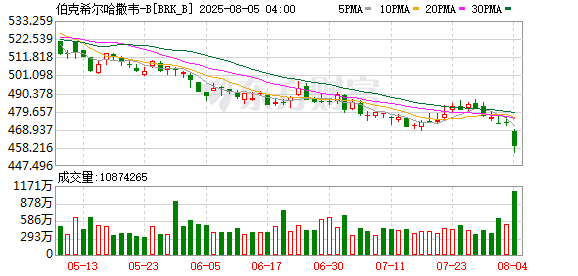
Core Viewpoint - Berkshire Hathaway's Q2 2025 financial report shows a decline in revenue and a significant drop in net profit, reflecting a cautious investment strategy amid multiple challenges, including leadership transition and economic uncertainties [2][4][9]. Group 1: Financial Performance - In Q2 2025, Berkshire achieved revenue of $92.515 billion, a slight decrease of 1.2% year-over-year; net profit fell sharply by 59% to $12.37 billion, with operating profit down 3.8% to $11.16 billion [4][5]. - The overall net profit for the first half of 2025 decreased by 60.6% compared to the previous year [4]. - The company's cash reserves reached a historical high of $344.1 billion, indicating a strong liquidity position but a reluctance to invest [4][5]. Group 2: Investment Strategy - Berkshire's cautious approach is highlighted by its decision to refrain from increasing investments despite having substantial cash reserves, reflecting concerns over international trade policies and economic uncertainties [4][5]. - A significant impairment loss of $3.76 billion was recorded on its investment in Kraft Heinz, indicating a reassessment of long-term investment fundamentals [6]. - The energy sector also presents risks, with a paper loss exceeding $5.3 billion on Western Oil shares, raising concerns about future financial performance [6]. Group 3: Leadership Transition - Warren Buffett announced his retirement as CEO, with Greg Abel set to take over, marking a pivotal moment for the company [7][8]. - Since the announcement, Berkshire's stock price has dropped over 12%, underperforming the S&P 500 index, reflecting market concerns about the leadership change [7][8]. - The transition is seen as a critical juncture, with potential implications for the company's investment and operational strategies moving forward [8][9].