
投资陪伴

Search documents
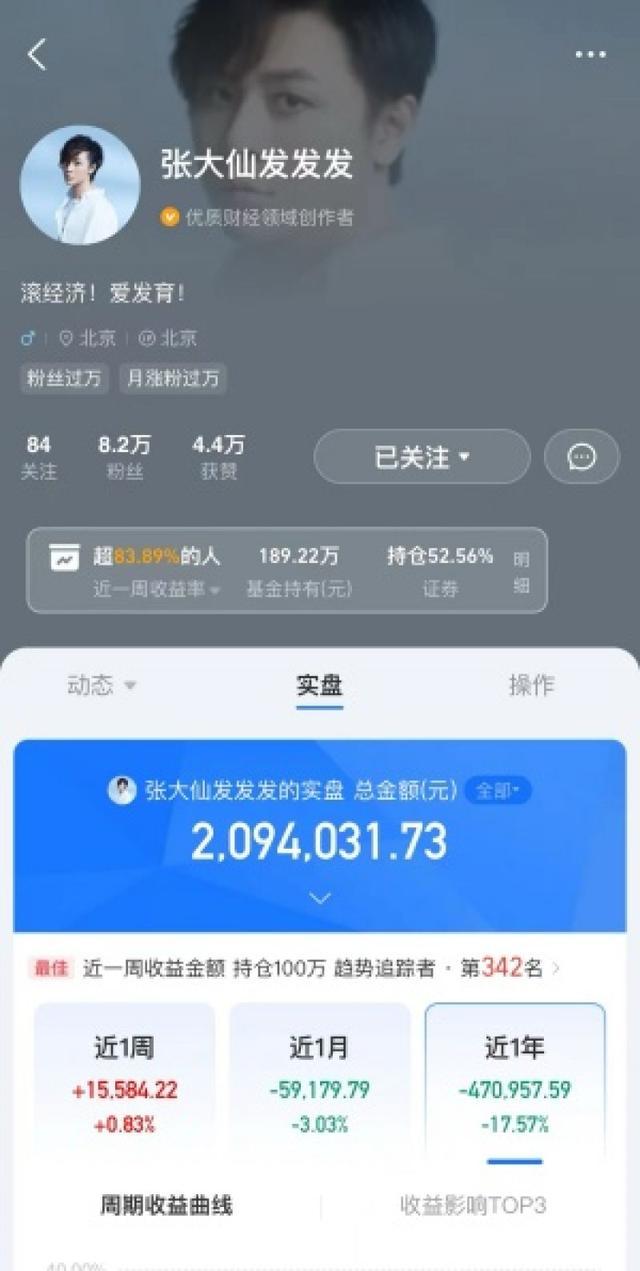
游戏主播张大仙跨界晒209万元基金实盘,近一年亏损17%
Hua Xia Shi Bao· 2025-11-12 02:53
Core Viewpoint - The article discusses the intersection of gaming and investment through the example of popular game streamer Zhang Daxian, who has recently entered the fund investment space by sharing his real-time fund operations on the Alipay platform, attracting significant attention from followers and the market [3]. Group 1: Zhang Daxian's Fund Operations - As of November 11, Zhang Daxian's total fund holdings amounted to 2.094 million yuan, with a cumulative profit of 302,700 yuan [4]. - His core holdings are concentrated in three E Fund products: E Fund CSI 300 ETF Link C (897,500 yuan), E Fund Securities Index (LOF) A (994,700 yuan), and E Fund Gold ETF Link C (181,300 yuan), with an additional 20,000 yuan in Yu'ebao [4]. - The investment strategy shows a defensive characteristic, combining broad-based products correlated with market indices, cyclical securities, and traditional safe-haven assets like gold [4]. Group 2: Investment Challenges and Market Reactions - Despite the impressive cumulative returns, the account faced a challenging investment journey over the past year, with losses reaching 470,000 yuan and a peak loss rate of -17.57% [4]. - The primary sources of loss were three now-closed funds: Tianhong CSI New Energy Vehicle Index A (149,600 yuan loss), Huaxia CSI New Energy Vehicle ETF Link A (142,700 yuan loss), and Agricultural Bank of China Modern Agriculture Flexible Allocation Mixed Fund (104,000 yuan loss) [4]. - Following Zhang Daxian's liquidation of these funds, both Tianhong and Huaxia's new energy funds experienced significant gains, each exceeding 65% [5]. Group 3: Industry Trends and Peer Comparisons - The trend of fund managers publicly sharing their real-time investment portfolios is growing, with several fund managers like Liu Junwen from Xinyuan Fund and Chen Bo from Shangyin Fund also participating [8]. - These portfolios typically consist of funds managed by the respective fund managers, with investment amounts ranging from tens of thousands to hundreds of thousands of yuan, and most accounts showing profitability [8]. - For instance, Ren Jie from Yongying Fund achieved a return of 214.85% on his investment in the Yongying Technology Smart Selection Mixed Fund, amounting to approximately 286,700 yuan in profit [8]. Group 4: Implications of Public Portfolio Sharing - The phenomenon of public portfolio sharing is seen as a way to enhance transparency and reduce information asymmetry, particularly benefiting inexperienced individual investors [11]. - However, there are concerns regarding the potential marketing aspects of such disclosures, as they may resemble "self-purchase" strategies, raising questions about compliance and the need for clearer regulations [12]. - Experts emphasize the importance of independent judgment by investors, cautioning against blindly following public figures in investment decisions [12].

基金经理“晒盘”风又起,合规边界引争议
Di Yi Cai Jing· 2025-07-14 14:06
Core Viewpoint - Recent trend of fund managers publicly sharing their actual investment portfolios, with many reporting profitable positions, raises questions about compliance and marketing implications in the industry [1][4][5] Group 1: Fund Managers' Actions - Fund managers like Liu Junwen from Xinyuan Fund and Chen Bo from Shangyin Fund have showcased their portfolios, with investments ranging from tens of thousands to millions, primarily in profitable products [1][2] - The practice of sharing actual investment performance is not new, as several fund managers have been doing so on platforms like Ant Financial for over two years [2][4] - Not all shared portfolios are profitable; for instance, Lei Tao from Debang Fund has a mixed performance with some products showing significant losses [3] Group 2: Compliance and Regulatory Concerns - The compliance boundaries for these public disclosures remain unclear, with concerns about whether such actions constitute marketing and how they align with existing regulations [1][4][5] - Current regulations require fund personnel to declare personal investments to avoid conflicts of interest, but the informal nature of sharing actual portfolios may blur these lines [5][6] - There is a need for clearer guidelines on disclosure practices, including the frequency and content of shared information to prevent misleading investors [5][6] Group 3: Marketing Implications - The act of fund managers sharing their portfolios can serve as a marketing tool, potentially attracting more investors, but it raises concerns about over-marketing and the need for adequate risk disclosures [6] - Platforms like Ant Financial and Tian Tian Fund are encouraging fund managers to engage in this practice, which adds complexity to compliance and operational processes [5][6] - The balance between showcasing performance and ensuring investor protection is a critical issue for both fund managers and distribution platforms [6]