指数家战略

Search documents
张健掌舵浦银安盛的一年:投资总监离任、ETF规模不进反退
Sou Hu Cai Jing· 2025-11-11 10:19
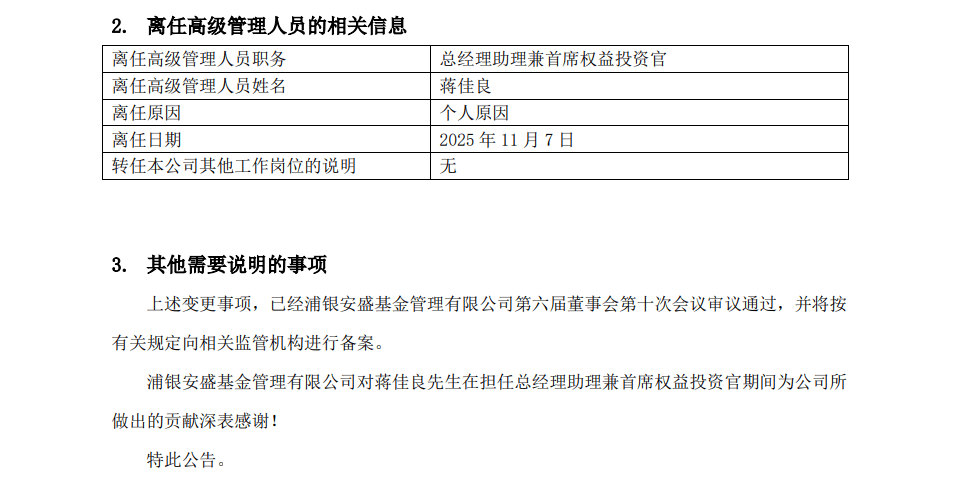
Core Viewpoint - The recent departure of Jiang Jialiang, the Assistant General Manager and Chief Equity Investment Officer of Puyin Ansheng Fund, marks a significant leadership change in the company, coinciding with a decline in its asset management performance and market ranking [1][19]. Group 1: Leadership Changes - Jiang Jialiang resigned for personal reasons, effective November 7, 2025, following the appointment of Zhang Jian as the new chairman in December 2024 [1][2]. - Jiang's departure is part of a planned transition, as evidenced by the pre-arranged succession of his managed funds to other team members [4][6]. Group 2: Performance Metrics - As of the end of Q3 2025, Puyin Ansheng's public fund assets totaled approximately 341.9 billion yuan, a decline of over 10% from the end of 2024, resulting in a drop in industry ranking from 26th to 30th [1][8]. - The company's ETF assets decreased significantly to 782 million yuan, less than one-third of the amount at the end of 2024, marking it as the weakest performing segment [1][12]. Group 3: Product and Market Dynamics - The company has seen a decline in non-monetary fund assets from 178.17 billion yuan at the end of 2024 to 149.49 billion yuan by Q3 2025, with a drop in industry ranking from 28th to 33rd [8][10]. - The bond fund assets also shrank from 162.97 billion yuan to 135.12 billion yuan, indicating significant outflows [10][11]. - Equity products, while showing slight growth, remain at the lower end of the market, with stock and mixed fund sizes at 2.443 billion yuan and 8.633 billion yuan respectively, ranking 10th among bank-affiliated funds [11][12]. Group 4: Strategic Initiatives - In August 2025, Jiang highlighted the company's push towards an "index family" strategy, focusing on passive index investments divided into ETF and quantitative segments, although recent data shows a lack of expected progress in these areas [7][19]. - The overall trend for Puyin Ansheng in 2025 has been a decline across total assets, non-monetary funds, and ETF segments, contrasting with the growth seen in many peer firms during the same period [18][19].