按效果付费商业模式

Search documents
2025外滩大会:AI打工效果买单 AI商业模式迎来分水岭
Huan Qiu Wang Zi Xun· 2025-09-15 04:33
Core Insights - The article discusses the shift in AI business models, particularly the introduction of "Result as a Service" (RaaS) by Ant Group, aiming to redefine the AI to B market by focusing on measurable business outcomes rather than just technology provision [1][4][8] Group 1: AI Business Model Transformation - Ant Group's RaaS model allows clients to pay based on the actual business growth generated by AI applications, such as increased user engagement and transaction volumes, rather than upfront costs [4][6] - This model is particularly appealing to small and medium-sized financial institutions, with some banks willing to share their entire first-year incremental revenue as a form of trust in the partnership [6] Group 2: AI in the Financial Sector - The financial industry is identified as a challenging yet valuable sector for AI implementation, with Ant Group categorizing the development of AI in finance into four stages: exploration, initiation, practice, and application [6][9] - Ant Group's financial AI model, Agentar-Fin-R1, has shown superior performance in various financial benchmarks, indicating a significant advancement in AI's applicability in finance [6][9] Group 3: Human-Machine Collaboration - Ant Group's intelligent agent platform, Agentar, has developed over a hundred solutions for various financial scenarios, enhancing productivity and redefining human-machine collaboration [7] - The digital assistants can significantly increase the number of clients a financial advisor can manage, leading to a 20% revenue increase, showcasing the quantifiable benefits of AI integration [7] Group 4: Global AI Market Context - The global AI business model is still in its early exploratory phase, with most companies relying on traditional revenue models like cloud services and API calls, making Ant Group's approach relatively unique [8] - Ant Group's strategy not only focuses on technology output but also emphasizes business methodologies and growth commitments, leveraging its extensive experience in financial services [8] Group 5: Future of AI and Business Value - The sustainability of AI solutions hinges on their ability to deliver measurable business value, with the potential for the "Result as a Service" model to expand into more complex areas like risk control and investment research [9] - The recent government initiatives encouraging AI integration with the real economy highlight the importance of measurable outcomes for the long-term viability of AI in business [9]

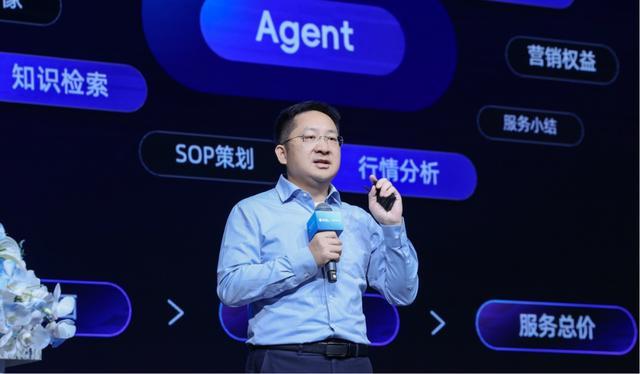
蚂蚁数科发布“按效付费”商业模式,将逐步推广至全行业
Xin Lang Ke Ji· 2025-09-12 03:47
Core Insights - Ant Group's Ant Financial announced a new "pay-for-performance" business model at the 2025 Inclusion Bund Conference, allowing enterprise clients to pay based on the actual results of large model applications, such as business growth or cost savings, rather than traditional project-based or subscription models [3][4] - The shift from technology payment to performance payment reflects the evolving role of AI as a business accelerator, emphasizing measurable outcomes over mere technology usage [3] - This model aims to lower the barriers and risks for enterprises adopting large models, particularly benefiting small and medium-sized enterprises by providing access to AI capabilities without significant infrastructure costs [3] Business Model and Implementation - The "pay-for-performance" model is designed to facilitate the widespread adoption of AI across various industries, including finance, energy, and retail, by allowing clients to pay for visible results [3] - Ant Group has already established partnerships with strategic clients based on key business outcomes, with plans to expand this model across the industry [3] - Ant Group has developed a three-step methodology called "ACE" (Align-Construct-Evaluate) for implementing large models: 1. Value positioning with clients to identify measurable and valuable business goals 2. Constructing a comprehensive solution and implementation path based on these goals 3. Ensuring business outcomes are achieved through continuous joint operations [4]