
数字债务

Search documents
中国银行保险报 | 中国东方旗下中华人寿前端基础服务平台破局数字化转型
Xin Lang Cai Jing· 2026-03-05 12:23
Core Insights - The core achievement of China United Life Insurance Co., Ltd. is the successful development of its "Front-End Basic Service Platform," which has earned two industry awards for innovation in digital transformation [1][10]. Industry Context - The insurance industry is undergoing a deep transformation driven by data and technology, with AI, large models, and big data increasingly integrated into product design, marketing, underwriting, and claims management [3][12]. - Despite advancements, insurance companies face challenges in data governance, system integration, and customer experience optimization [3][12]. Challenges Faced - The motivation behind the development of the Front-End Basic Service Platform stems from the widespread issue of "digital debt" within the insurance sector, particularly for companies that have been established for some time [4][13]. - As business scales transition from startup to growth phases, the complexity of front-end services such as sales, underwriting, and claims increases significantly, while outdated systems hinder efficiency and data sharing [4][13]. - The existing "siloed" system architecture leads to high operational costs, prolonged development cycles, and difficulties in launching innovative products that require cross-system collaboration [4][13]. Strategic Response - In response to these challenges, the company opted to build a new, unified "Front-End Basic Service Platform" rather than patching existing systems, aiming to resolve core issues of system fragmentation and data inaccessibility [5][14]. - The platform's development began in 2023, focusing on upgrading front-end sales and service systems to enhance business support capabilities and eliminate service barriers [5][14]. Platform Architecture - The platform employs a three-layer design philosophy centered on "business decomposition and architectural layering," standardizing widely used capabilities across various business scenarios [6][15]. - It integrates 51 tool capabilities into 13 categories, providing standardized APIs and components, which significantly reduces development pressure across business lines [6][15]. - The platform utilizes a SpringCloud microservices architecture, establishing a unified technical stack and interface standards, which enhances overall efficiency and security [6][15]. Service Integration - The platform supports diverse service integration methods, facilitating smooth connections between new and legacy systems and easing collaboration with third-party channels [7][16]. - This flexibility reduces technical barriers and costs for channel expansion, transforming the technical foundation into a competitive advantage for business ecosystem growth [7][16]. Value Realization - The establishment of the Front-End Basic Service Platform signifies a successful transformation approach, emphasizing the importance of solidifying foundational capabilities before pursuing application innovations [8][17]. - The platform has led to reduced development costs and delivery cycles for various business systems, enabling rapid upgrades of critical systems such as online policy maintenance and unified underwriting platforms [8][17]. - The case of China United Life illustrates the challenge of transitioning from isolated technology applications to systematic capability building in the insurance industry's digital transformation [8][17]. Industry Recognition - The awards received by China United Life are seen as a validation of a pragmatic and rational transformation path within the insurance industry, highlighting the need for both innovative exploration and the dismantling of outdated systems [9][18].


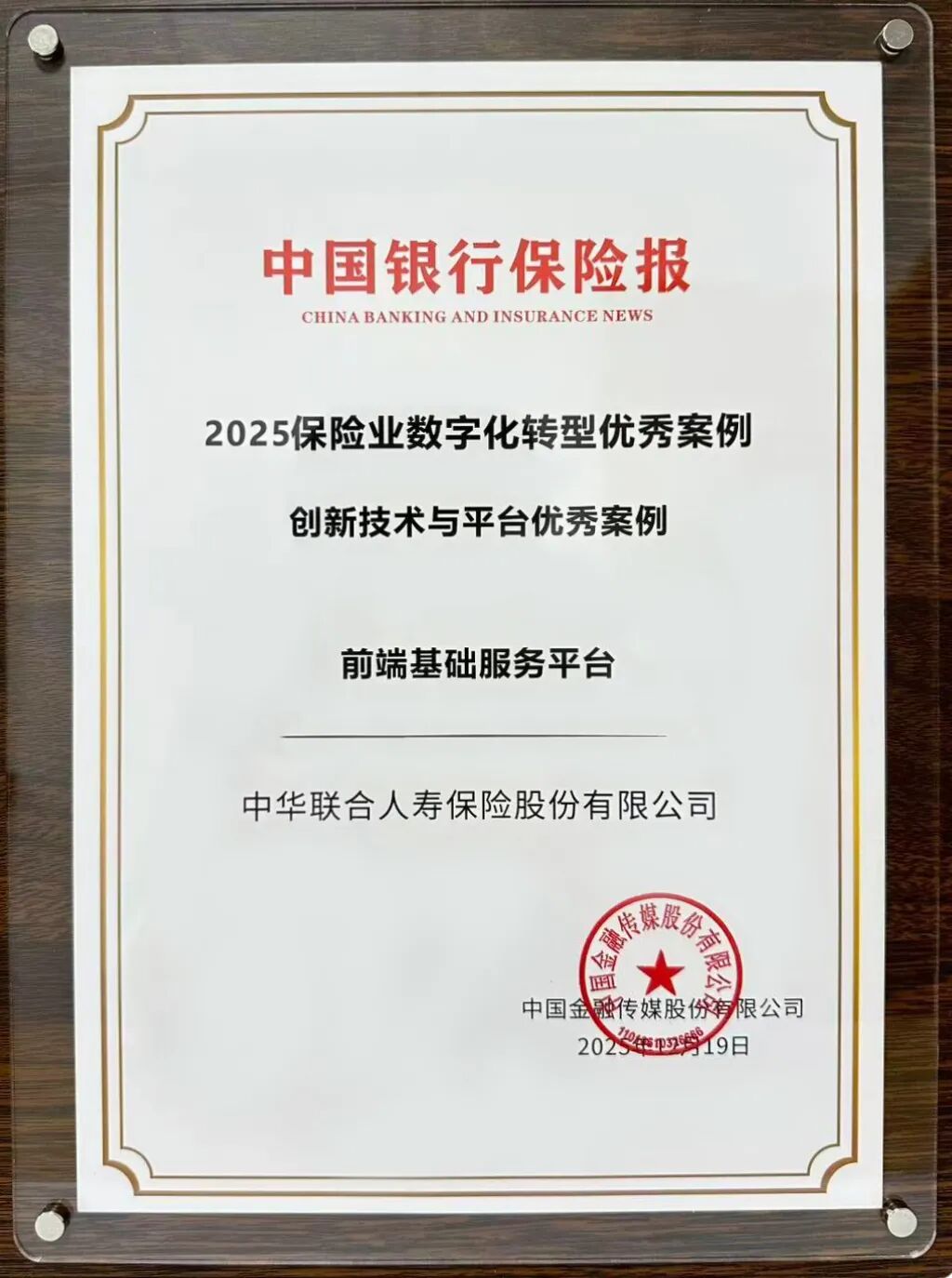
拆壁垒筑底座,中华人寿前端基础服务平台破局数字化转型
Jing Ji Guan Cha Wang· 2026-02-04 11:27
中华人寿启动前端基础服务平台建设的动因,源于一个在保险业,尤其是成立一段时间的公司中极具普 遍性的挑战——"数字债务"。随着公司业务规模从初创期迈向成长期,前端销售、核保、保全、理赔等 服务场景呈几何级数复杂化。然而,支撑这些业务的老旧系统,多数诞生于公司开业初期,受当时技术 视野和业务紧迫性所限,普遍采用"烟囱式"架构独立建设。 这种模式在早期实现了快速上线,但长期积累的代价高昂,此外,还会导致系统功能"越来越臃肿",业 务需求实现"周期越来越长",开发和运维成本"越来越高"。更深层的问题在于,各系统间数据无法共 享,标准难以统一,如同一个个信息孤岛。当公司试图推出一个需要跨系统协同的创新产品,或为用户 打造一个无缝衔接的全旅程服务体验时,这些坚固的"烟囱"便成了难以逾越的障碍。 保险机构在"数据治理、系统整合"等方面仍面临现实挑战。在行业热议AI大模型、精准营销等前沿话题 时,许多公司的创新实践却受制于底层数据割裂、接口纷繁复杂的基础环境,难以规模化落地,投入产 出比面临严峻考验。保险行业所面对的,正是如何偿还历史"数字债务",为未来智能化发展清扫基础障 碍的典型课题。 近日,中华联合人寿保险股份有限公司 ...