
数字化赋能治理现代化

Search documents
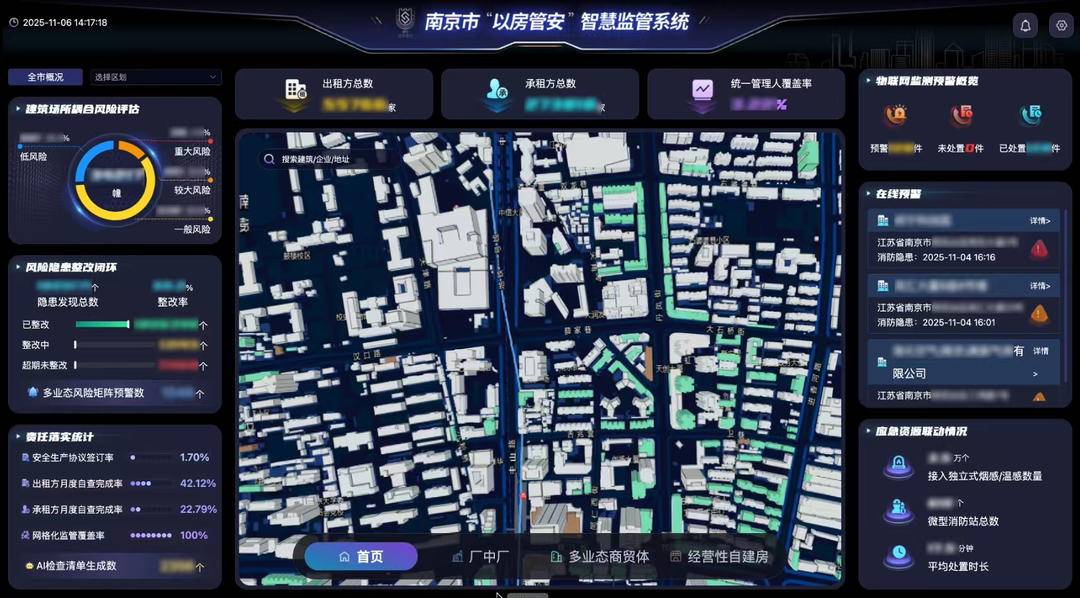
全国首个“以房管安”系统在南京上线 “AI+三维”破解复杂业态安全监管难题
Yang Zi Wan Bao Wang· 2025-11-07 13:04
Core Insights - The "Housing Safety Management" information system has been officially launched in Nanjing, marking a significant step in urban safety governance through digitalization [1][5]. Group 1: System Overview - The system utilizes Nanjing's spatiotemporal big data and emergency management platforms to address safety risks in high-risk scenarios such as "factory within factory" and multi-business commercial entities [1][3]. - It aims to transform safety management from focusing on individual enterprises to managing fixed building spaces, thereby enhancing risk identification and responsibility accountability [3][6]. Group 2: Technological Innovations - Each regulated building is assigned a unique "digital ID code," integrating static coding with dynamic early warning systems to prevent risks before they escalate [4]. - The system features a "risk conflict matrix" that identifies potential conflicts between different business operations within the same building [4]. Group 3: Emergency Response Mechanism - An intelligent emergency response mechanism has been established, which automatically matches fire alarm signals with the nearest emergency resources, generating detailed emergency response plans [5]. - The system has integrated over 35,000 sensing data sources, successfully managing 128 effective early warnings [5]. Group 4: Governance and Responsibility - The system introduces an "owner-unified manager" model to clarify responsibilities and enhance accountability in complex property ownership scenarios [6]. - It aims to create a new governance model characterized by "co-construction, co-governance, and shared benefits," addressing the challenges of risk management in large cities [6].

从“管企业”向“管空间”延伸 全国首个“以房管安”系统在南京上线
Nan Jing Ri Bao· 2025-11-07 03:36
Core Insights - The "Housing Safety Management" information system has been launched in Nanjing, marking a significant step in urban safety governance by utilizing big data and AI technologies to enhance risk management in high-risk scenarios [1][2][4] Group 1: System Overview - The system targets three high-risk scenarios: "factory within factory," multi-business commercial entities (excluding high-rise buildings), and self-built commercial properties [1] - It aims to shift the safety management paradigm from "managing enterprises" to "managing spaces," extending the basic unit of safety management from enterprises to fixed building spaces [2] Group 2: System Features - The system has integrated over 55,000 rental entities, 1,800 "unified managers," and 273,000 tenant enterprises, compiling information on over 34,000 key buildings to promote digital archiving of high-risk buildings [2] - Each regulated building is assigned a unique "digital ID code," which, combined with a risk conflict matrix, allows for dynamic risk alerts and management [2][3] Group 3: Operational Efficiency - The system employs AI to generate safety audit reports, enhancing the precision of regulatory oversight and transitioning from broad to targeted management [3] - It has integrated with a grid management system involving 5,868 grid workers, leading to the identification of over 8,700 public space hazards and the generation of more than 810 safety audit reports [3] Group 4: Emergency Response Mechanism - An intelligent emergency mechanism has been established, which automatically matches fire alerts with nearby emergency resources and generates emergency response documents for rapid action [3] - The system has connected over 35,000 sensing data sources, successfully managing 128 effective warnings [3] Group 5: Governance Innovation - The "Housing Safety Management" system represents a landmark practice in digital governance modernization, addressing complex risk management challenges in large cities and fostering a new governance model of "co-construction, co-governance, and sharing" [4][5]