数字孪生(digital twins)

Search documents
大涨4.85%!英伟达砸20亿入股EDA巨头新思科技,黄仁勋盛赞“巨大扩展机遇”、否认类似OpenAI交易闭环
美股IPO· 2025-12-01 22:29
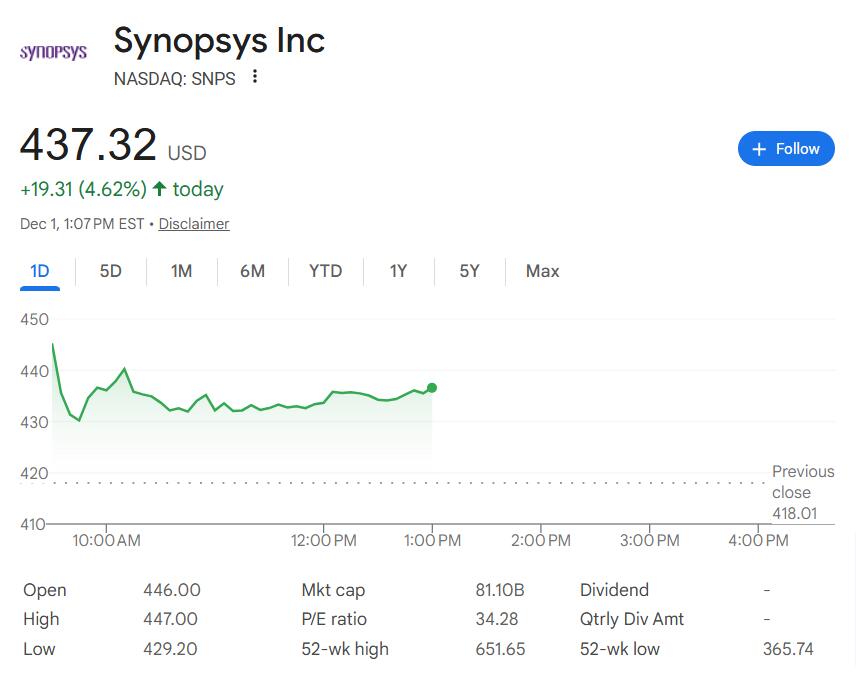
Core Viewpoint - Nvidia's strategic investment of $2 billion in Synopsys marks a significant partnership aimed at integrating AI technology into industrial design and engineering, presenting a vast market opportunity beyond consumer AI applications [1][5][10]. Investment Details - Nvidia will acquire approximately 4.8 million shares of Synopsys at a price of $414.79 per share, representing a 0.8% discount from the previous closing price [6]. - This investment will make Nvidia the seventh largest shareholder in Synopsys, holding a 2.6% stake [5][6]. Strategic Significance - The partnership is described as a transformative move for the design and engineering sectors, leveraging Nvidia's GPU acceleration to enhance Synopsys' software tools used in chip design and verification [10][11]. - Nvidia's CEO highlighted the potential market size, indicating that industrial companies spend significantly on engineering software tools, with prototyping costs potentially being 10 to 20 times higher [10]. Collaboration Scope - The collaboration will involve using Nvidia's CUDA-X libraries and AI technologies to optimize Synopsys' computational applications across various domains, including chip design and physical verification [8]. - Both companies will work on digital twin technologies to enable advanced virtual design and testing across multiple industries [8]. Non-Exclusivity of Partnership - The partnership is non-exclusive, allowing Synopsys to continue collaborating with other semiconductor manufacturers, which differentiates it from Nvidia's previous investments like OpenAI [9][13]. - This arrangement is seen as an expansion of the technology ecosystem rather than a closed commercial loop, enhancing Nvidia's influence in the EDA market [14].



英伟达砸20亿入股EDA巨头新思科技,黄仁勋盛赞“巨大扩展机遇”、否认类似OpenAI交易闭环
Hua Er Jie Jian Wen· 2025-12-01 19:25
Core Insights - Nvidia announced a strategic partnership with Synopsys, investing $2 billion to acquire a 2.6% stake, marking a significant move into the industrial design and engineering sectors [1][3][4] - The collaboration aims to integrate Nvidia's AI computing technology into the electronic design automation (EDA) field, transforming the design process from chips to systems [1][3] - Nvidia's CEO Jensen Huang emphasized the partnership's potential to tap into a trillion-dollar industrial market, far exceeding the consumer AI application space [3][7] Investment Details - Nvidia purchased approximately 4.8 million shares of Synopsys at $414.79 per share, reflecting a 0.8% discount from the previous closing price [4] - The investment positions Nvidia as Synopsys' seventh-largest shareholder, enhancing its influence in the semiconductor design software market [3][4] Strategic Collaboration - The partnership encompasses a multi-year collaboration that includes using Nvidia's CUDA-X libraries and AI physics technology to optimize Synopsys' computational applications [6] - Both companies will work on integrating Synopsys' AgentEngineer technology with Nvidia's AI technology stack to enhance EDA and simulation workflows [6] - The collaboration aims to develop advanced digital twin solutions for various industries, leveraging Nvidia's Omniverse and Cosmos technologies [6] Market Impact - Following the announcement, Synopsys' stock surged over 6.9% in early trading, while Nvidia's stock initially dipped but later rose by nearly 1.9% [1] - Huang highlighted the significant market opportunity in industrial applications, noting that spending on engineering software tools could be several billion dollars, with prototyping costs potentially 10 to 20 times higher [7] Industry Transformation - Huang described the partnership as a revolutionary shift in the design and engineering industry, moving from traditional CPU-based systems to GPU-accelerated solutions [8] - The collaboration is seen as a non-exclusive arrangement, allowing other chip manufacturers to benefit, distinguishing it from Nvidia's previous investments in AI that raised concerns about market monopolization [9][10]