文物真伪鉴定

Search documents
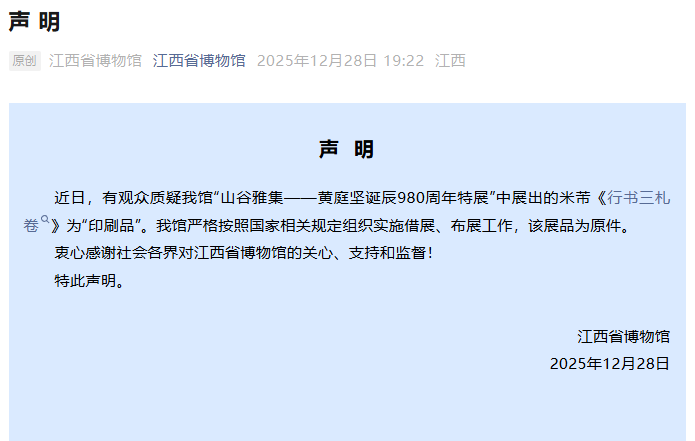
江西省博物馆回应米芾《行书三札卷》被质疑印刷品:展品为原件
Xin Lang Cai Jing· 2025-12-28 12:13
Core Viewpoint - The Jiangxi Provincial Museum has responded to public doubts regarding the authenticity of the exhibited work "Mi Fu's Three Letters" in the special exhibition commemorating the 980th anniversary of Huang Tingjian's birth, asserting that the piece is an original and not a reproduction [1][5]. Group 1 - The Jiangxi Provincial Museum announced that the special exhibition "Gathering in the Valley: Commemorating the 980th Anniversary of Huang Tingjian's Birth" will begin on December 16, 2025 [3]. - The museum's article highlighted the significance of the work "Mi Fu's Three Letters," which consists of three letters written by Mi Fu, showcasing his mature personal style [5]. - A visitor raised concerns about the authenticity of the exhibited work, claiming it lacked variations in ink color and was displayed under different lighting conditions compared to other pieces [5].

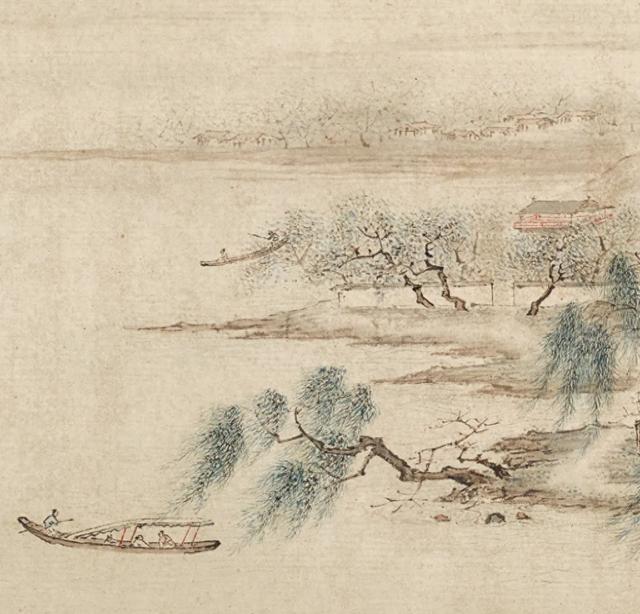
独家调查|从6800元购买的顾客到8800万元的送拍人
Xin Lang Cai Jing· 2025-12-23 06:48
Core Viewpoint - The recent auction of the painting "Jiangnan Spring," donated by the descendants of Pang Laishen to the Nanjing Museum, has sparked significant public interest and concern regarding the handling and provenance of cultural relics [1][20]. Group 1: Investigation and Response - The National Cultural Heritage Administration has formed a working group to investigate the circumstances surrounding the auction of "Jiangnan Spring" and other related issues [1][20]. - Jiangsu provincial authorities have established an investigation team to examine the management and security of donated cultural relics at the Nanjing Museum, with a commitment to address any illegal activities found [1][20]. Group 2: Auction Details and Provenance - The painting "Jiangnan Spring" was sold for 88 million yuan at auction, raising questions about its ownership and the identity of the seller, initially believed to be a local collector, Lu Ting, but later revealed to be a buyer named Zhu Guang from Ningbo [1][20]. - The Nanjing Museum had previously sold a painting identified as a forgery for 6,800 yuan in 2001, which has led to scrutiny over the ambiguous designation of "customer" on the sales receipt [3][5]. Group 3: Key Individuals and Relationships - Xu Huping, the former deputy director of the Nanjing Museum, played a crucial role in the approval and sale of the painting, raising concerns about potential conflicts of interest due to his close relationship with Lu Ting [5][10]. - Lu Ting, a prominent collector, had a significant impact on the local art scene and was known for his extensive collection, including "Jiangnan Spring," which he acquired in the 1990s [7][10]. Group 4: Legal and Ethical Considerations - The descendants of Pang Laishen argue that the Nanjing Museum's actions in selling the painting without proper notification to the original donors violate ethical standards and legal obligations [24][26]. - Legal experts suggest that the original donation agreement may provide grounds for the Pang family to reclaim the painting, especially given the museum's failure to uphold its promise to preserve the artwork [30][34]. Group 5: Cultural Significance and Historical Context - "Jiangnan Spring" is not only valued for its artistic merit but also for its historical significance, having been part of a well-documented lineage of ownership among notable collectors [42][43]. - The case highlights broader issues within the cultural heritage sector regarding the management and ethical treatment of donated artworks, emphasizing the need for transparency and accountability in museum practices [44].