
无因茶

Search documents
热搜第一!股价大跌,霸王茶姬回应“咖啡因”
Zhong Guo Ji Jin Bao· 2025-12-27 03:14
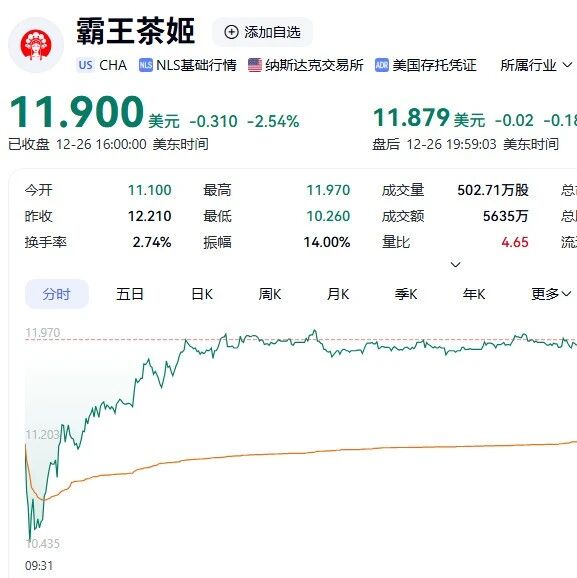
Core Viewpoint - The stock price of Bawang Chaji has significantly dropped due to a caffeine controversy, reaching a new low since its IPO, which has sparked widespread discussion on social media [1][3][7]. Group 1: Stock Performance - On December 27, Bawang Chaji's stock was trending on Weibo, indicating heightened public interest and concern [2]. - The company's stock fell by nearly 16% during trading, closing at $11.90 per share, which is over 64% lower than its price on the first day of trading in April [7]. - The stock's 52-week high was $41.80, while the low was $10.26, reflecting significant volatility [8]. Group 2: Caffeine Controversy - The controversy began when a self-media personality suggested that high-caffeine beverages like Bawang Chaji's products are "skirting the edge of being a drug" [3]. - Many consumers reported adverse effects after consuming Bawang Chaji's drinks, including insomnia and palpitations [3]. - In response to the controversy, Bawang Chaji acknowledged the concerns and stated that they would take legal action against false information [5]. Group 3: Company Response and Future Plans - Bawang Chaji emphasized that their tea drinks have caffeine levels comparable to a latte and significantly lower than an Americano, while also highlighting the health benefits of tea [9][10]. - The company has introduced a product called "Light Caffeine · Boya Jue Xuan," which reduces caffeine content by approximately 50% while maintaining the core flavor of the tea [11]. - Bawang Chaji is exploring the possibility of creating caffeine-free tea options to cater to consumers sensitive to caffeine [9][12].


霸王茶姬美股大跌!公司深夜回应
证券时报· 2025-12-27 01:34
Core Viewpoint - The article discusses the recent stock performance and public response of Bawang Tea Ji, highlighting a significant drop in stock price and the company's efforts to address concerns regarding caffeine content in their products [1][10]. Stock Performance - On December 26, Bawang Tea Ji's stock price fell over 14% at one point, reaching a new low since its listing, and closed down 2.54% at $11.90 [1][2]. - The total market capitalization of Bawang Tea Ji is approximately $2.184 billion, with a price-to-earnings (P/E) ratio of 8.89 [2]. Caffeine Content Controversy - The company acknowledged public concerns regarding caffeine levels, stating that a cup of their tea has caffeine content comparable to a latte and significantly lower than that of an Americano [3][5]. - Bawang Tea Ji emphasized that caffeine is a naturally occurring compound in tea, not an additive, and is referred to as "theine" in cultural contexts [4][10]. Product Development and Innovation - The company has been exploring the development of low-caffeine and caffeine-free tea options, having already launched products that reduce caffeine content by approximately 50% [7][10]. - Bawang Tea Ji aims to maintain the authentic flavor of tea while catering to varying consumer needs, indicating a commitment to continuous research and collaboration with industry experts [8][10]. Legal Response to Misinformation - In response to negative online discussions and accusations regarding high caffeine levels, the company has initiated legal action against the spread of false information that could harm its reputation [10].

霸王茶姬:一杯原叶现泡茶饮的咖啡因与一杯拿铁大致相当,正积极探索无因茶的可能性
Cai Jing Wang· 2025-12-27 00:53
Core Viewpoint - The company emphasizes the unique qualities of tea, particularly its natural caffeine content, and aims to educate consumers about the health benefits and flavor complexities of tea compared to coffee [1][2][3]. Group 1: Caffeine and Tea Composition - Caffeine, often associated with coffee, is also naturally present in tea, referred to as "theine" in cultural contexts, and has been recognized for thousands of years [1]. - A cup of freshly brewed tea has a caffeine content comparable to a latte and significantly lower than an Americano, highlighting tea's moderate caffeine levels [1]. - Tea contains various active compounds such as polyphenols, amino acids, and essential minerals, which contribute to its unique flavor and health benefits, working in synergy with caffeine [1]. Group 2: Brand Philosophy and Product Development - The brand's mission is to create high-quality tea that aligns with modern lifestyles while preserving authentic flavors, using whole tea leaves instead of lower-quality ingredients [2]. - The company has introduced a new product, "Light Caffeine · Boya Jue Xuan," which reduces caffeine content by approximately 50% while incorporating natural herbal elements for a milder effect [2]. - Continuous collaboration with experts and ongoing research into tea's composition are central to the brand's development strategy, aiming to cater to diverse consumer needs [2][3]. Group 3: Future Directions and Cultural Context - The company plans to maintain an exploratory approach, focusing on understanding the balance of flavors and components in tea, with aspirations to develop caffeine-free options for sensitive consumers [3]. - The historical context of coffee's evolution through scientific and cultural integration parallels the current journey of Chinese tea, which requires genuine effort in product development and cultural confidence to succeed globally [3].