日本右倾化

Search documents
【中外对话】中国学者对话日本议员:强军扩武恐将日本引向危险边缘
Zhong Guo Xin Wen Wang· 2026-02-15 13:38
Group 1 - The core viewpoint of the article highlights the increasing rightward shift in Japanese politics, particularly in the realm of security policy, which poses a threat to regional stability [1] - The Japanese government's recent actions towards military expansion are seen as undermining the "defensive defense" policy concept, raising concerns about regional security [1] - The dialogue with local Japanese council member Hanatani Shiro emphasizes that aggressive modifications to security policies could lead Japan to a precarious position in the Asia-Pacific region [1]
加速向右转 日本正走在危险道路上
Xin Lang Cai Jing· 2026-02-14 07:11
Group 1 - The Japanese government will convene a special parliament session on the 18th of this month for the prime ministerial election, with high expectations for Kishi Sanae's victory due to the ruling Liberal Democratic Party's (LDP) significant majority in the House of Representatives [1] - Kishi Sanae's ambitions have grown following the LDP's overwhelming victory in the House of Representatives elections, as she aims to expedite the revision of Japan's security documents and push for constitutional amendments [3] - Analysts suggest that while the chances of successful constitutional amendments are low due to various political hurdles, the revision of security documents is highly probable, as it requires a simple legislative process [3] Group 2 - Kishi Sanae's foreign policy has been criticized as hypocritical, as she advocates for dialogue with Russia while simultaneously supporting sanctions against it, reflecting a dual approach that raises concerns [4] - There is a growing rightward shift in Japanese society, with a recent poll indicating that 55% of respondents view the LDP's victory positively, and 63% among the 18-39 age group, suggesting a potential rise in nationalist sentiments [5] - The phenomenon of young people idolizing Kishi Sanae and the emergence of terms like "Kishi life" indicate a cultural shift that may further fuel conservative trends in Japan, driven by historical amnesia and economic pressures [5]
外国媒体眼里的高市历史性胜利
日经中文网· 2026-02-13 08:29
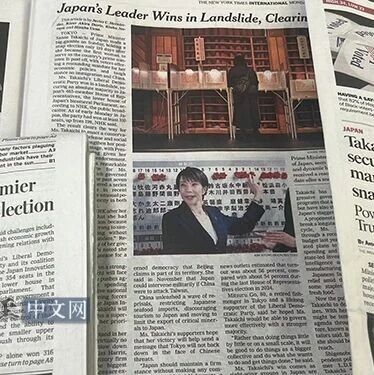
Core Viewpoint - The article highlights the historic victory of Prime Minister Sanna Hayashi in the Japanese House of Representatives election, which has garnered significant attention from international media, particularly in the U.S. and Europe, while also raising concerns about Japan's political shift to the right from Chinese and Russian perspectives [2][4][10]. Group 1: Election Results and Media Reactions - The Liberal Democratic Party (LDP) led by Hayashi secured over two-thirds of the seats in the election, marking a historic win [2][4]. - U.S. media described Hayashi's victory with terms like "avalanche victory" and noted her popularity among voters, attributing it to her decisiveness, communication style, and optimistic attitude [6][8]. - International media, including German outlets, suggested that Hayashi's "Japan First" policy could serve as a model for other countries facing similar political polarization [7]. Group 2: Political Implications and Concerns - Hayashi's victory is seen as a significant shift for the LDP, which had faced challenges due to rising prices and political scandals [6]. - Reports indicate that Hayashi may push for constitutional amendments, including recognizing the Self-Defense Forces as a military, which could face opposition from other political parties and segments of the public [8][9]. - Concerns about Japan's rightward shift were echoed in Chinese and Russian media, with warnings about potential changes to Japan's pacifist constitution and military policies [10][11]. Group 3: Young Voter Support and Social Media Influence - Young voters have shown strong support for Hayashi, with media highlighting her ability to engage with them through social media and relatable communication [8]. - The use of affectionate terms like "Sanae-chan" among young supporters reflects her popularity and connection with the youth demographic [8]. Group 4: Regional and International Relations - ASEAN media expressed concern over the implications of Hayashi's hawkish stance on China, predicting that her victory could exacerbate tensions between Japan and China [12]. - The article notes that the opposition parties in Japan failed to present a significant challenge, partly due to their fragmentation [12].

高市早苗胜选,东亚局势将去向何处?
Xin Lang Cai Jing· 2026-02-11 15:36
Group 1 - The core viewpoint of the article highlights the overwhelming victory of Kishi Sanae and the Liberal Democratic Party (LDP) in the Japanese House of Representatives election, where the LDP secured 316 seats, marking the first time since World War II that the party has controlled two-thirds of the House alone [1] - Kishi's victory is attributed to her election strategy, particularly the early dissolution of the House, which left opposition parties unprepared [1] - The article notes that Kishi's right-leaning stance on security and Taiwan issues has resonated with Japanese nationalist sentiments, potentially increasing regional uncertainties in East Asia [1] Group 2 - Kishi's economic promises, including a stimulus plan and a two-year suspension of consumption tax on food, are seen as significant factors contributing to her electoral success, especially amid Japan's current challenges of yen depreciation and inflation [2] - The article discusses the contradiction between Kishi's right-wing political maneuvers and the need for Japan to engage cooperatively with East Asian countries to improve its economy, as Japan is heavily reliant on this region for both raw materials and markets [2] - The potential for increased regional tensions due to Kishi's political actions is emphasized, as her right-wing rhetoric may provoke backlash from neighboring countries, complicating Japan's economic recovery efforts [2][3]
中国社交媒体许多贴文表达对日右倾担忧 外交部回应
Xin Lang Cai Jing· 2026-02-09 07:58
Core Viewpoint - The Chinese Foreign Ministry spokesperson Lin Jian expressed concerns regarding Japan's rightward shift following the recent House of Representatives election results, emphasizing the historical lessons from Japan's militaristic past and the need for Japan to choose a path of peaceful development [1]. Group 1 - The Chinese government highlights the historical consequences of Japan's militarism, which led to aggression against Asian neighbors and significant suffering for the Japanese people [1]. - Lin Jian calls for Japan to reflect on its historical actions and consider whether it will adhere to a path of peaceful development or challenge the post-war international order [1].
日本战败投降80周年,日媒关注石破茂“8·15”是否讲话
Huan Qiu Shi Bao· 2025-08-14 22:20
Group 1 - The Japanese government will hold a memorial ceremony on August 15 to commemorate the 80th anniversary of Japan's defeat in World War II, with a statement reaffirming the commitment to achieving permanent peace [1][3] - Prime Minister Kishida Fumio has decided not to issue a formal cabinet resolution for the 80th anniversary statement, but he still hopes to express his personal views on the lessons learned from Japan's history of aggression and colonial rule [1][4] - The ceremony will be attended by approximately 3,400 relatives of war dead, the Emperor and Empress of Japan, and Prime Minister Kishida, with a moment of silence scheduled at noon [3] Group 2 - There is significant media attention on whether Prime Minister Kishida will make a statement similar to those made in previous anniversaries, as past statements have included apologies for Japan's wartime actions [4] - The conservative factions within the ruling party are opposed to Kishida making any statements that could undermine the previous apologies made by former Prime Minister Abe during the 70th anniversary [4] - Japanese media has shown a tendency to portray Japan as a victim in historical narratives, often neglecting the context of Japan's wartime actions and their consequences [5][6] Group 3 - Japan's military activities have increased, with the government recently passing the 2025 Defense White Paper, which claims that China's military activities pose a serious threat to Japan's security [7] - The Japanese government is exploring the export of decommissioned naval vessels to countries like the Philippines, Indonesia, and Vietnam, which may challenge existing defense export principles [7][8] - There is a growing trend in Japan to move away from the "self-defense" principle and the constraints of the "peace constitution," as the government seeks to redefine its military posture in response to perceived threats [8]