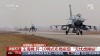
有源相控阵雷达系统

Search documents
歼-10系列飞机有哪些优越性能?总师详解
Huan Qiu Wang· 2025-10-06 01:40
Core Viewpoint - The J-10 series, particularly the J-10C, represents a significant advancement in China's military aviation capabilities, showcasing improvements in design, performance, and operational versatility [1][3][5]. Group 1: Design and Performance Enhancements - The J-10 features a unique canard-delta wing configuration, which enhances stability and maneuverability during high-speed operations, allowing pilots to operate without concerns [1][5]. - The J-10C has undergone a generational upgrade in its combat systems, making it a multi-role fighter capable of comprehensive operational tasks [3][5]. - The J-10C's weapon load capacity has significantly increased, allowing it to carry over 40 different types of weapons compared to the earlier J-10's capability of just over 10 types [5]. Group 2: Technological Advancements - The J-10C is equipped with an advanced avionics system, including an active electronically scanned array (AESA) radar, which provides superior target detection and tracking capabilities compared to traditional mechanical radars [5]. - The electronic warfare capabilities of the J-10C enable a "see but not be seen" advantage in modern combat scenarios, enhancing its battlefield awareness [5][7]. - The thrust vectoring technology demonstrated by the J-10B has set a precedent for future aircraft development, showcasing advanced maneuverability through adjustable nozzle directions [7]. Group 3: Historical Significance - The development of the J-10 began in the 1980s, culminating in its first flight in March 1998, marking a pivotal moment in China's transition from imitation to independent innovation in aviation [9][14]. - The successful first flight of the J-10 was a moment of emotional significance for the team involved, symbolizing years of hard work and dedication in the aviation industry [11][14].