机器人手术技术

Search documents
每周股票复盘:天智航(688277)2025年手术量占比超70%
Sou Hu Cai Jing· 2026-01-24 17:58
Core Viewpoint - Tianzhihang (688277) has shown a significant increase in stock price and market performance, indicating strong growth potential in the orthopedic surgical robot market, where it holds a leading position [1]. Group 1: Company Performance - As of January 23, 2026, Tianzhihang's stock closed at 23.99 yuan, up 4.62% from the previous week [1]. - The company reached a market capitalization of 10.939 billion yuan, ranking 36th out of 127 in the medical device sector and 1939th out of 5182 in the A-share market [1]. - On January 21, 2026, Tianzhihang recorded two block trades with a total transaction value of 4.0034 million yuan [3]. Group 2: Market Position and Growth - In 2025, the domestic market for orthopedic surgical robots is expected to see over 100 units awarded in procurement, with a year-on-year growth rate of approximately 35% [1]. - Tianzhihang maintains the largest market share in the domestic orthopedic surgical robot sector, with over 70% of the total surgical volume, translating to more than 35,000 surgeries out of 48,500 performed in the first three quarters of 2025 [1][3]. Group 3: Strategic Initiatives - The company is exploring new models such as "purchasing technology services" to reduce upfront costs for medical institutions and enhance the accessibility of surgical robots [1]. - Tianzhihang is actively pursuing international expansion by participating in overseas exhibitions and developing differentiated market strategies to enhance its global competitiveness [1]. - The company's products have received CE certification from the EU, allowing them to meet the demands of high-end markets in developed countries while also being cost-effective for developing nations [1]. Group 4: Industry Developments - The National Healthcare Security Administration has released a guideline to establish a unified pricing project for surgical and treatment auxiliary services, promoting the adoption of robotic surgical technology [2]. - The guideline aims to incentivize companies to develop high-value technologies and guide the industry towards high-quality, standardized development [2].

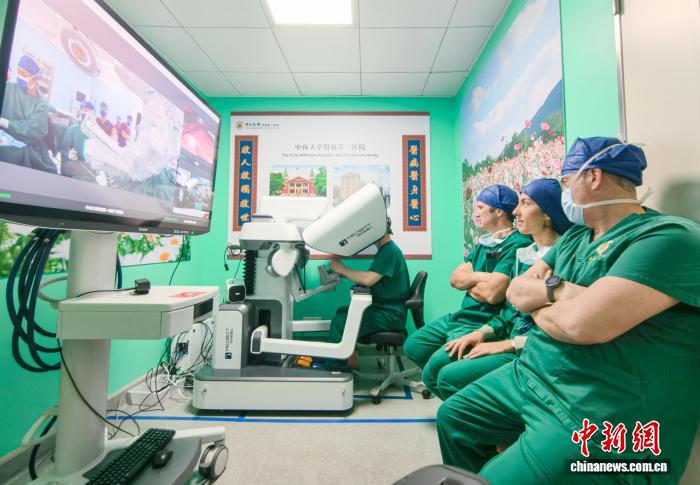
法国医生广州取经:中国机器人手术技术超预期
Zhong Guo Xin Wen Wang· 2026-01-15 05:21
Core Insights - French doctors visited Guangzhou to observe and learn about advanced robotic surgery techniques, particularly in pancreatic surgery, which exceeded their expectations [1][3][4] Group 1: Observations and Learning - The French medical team, led by Raphaël Bourdariat, spent five days at Sun Yat-sen University First Affiliated Hospital, focusing on robotic pancreatic surgery and remote robotic surgery techniques [1][3] - The team participated in rounds and observed several complex robotic pancreaticoduodenectomies, engaging in discussions with the local medical team about related surgical issues [3] - French surgeon Azadeh Bourdariat noted that most hospitals in France still perform open surgeries for pancreaticoduodenectomy, while China has made significant academic advancements in minimally invasive techniques [3] Group 2: Technical and Collaborative Insights - The senior nurse Wilfrid Bolopion emphasized the importance of learning about preoperative preparation and postoperative care in robotic pancreatic surgery [3] - François Mithieux, a consulting surgeon, highlighted the clear division of labor among the medical staff in Guangzhou, which enhances both clinical and research capabilities [3] - The annual pancreatic surgery volume at the French hospital is approximately 140 cases, with around 30 being robotic surgeries, indicating a high capacity for pancreatic treatment in Europe [3] Group 3: Future Collaborations - Bourdariat expressed intentions to promote the introduction of Chinese-made surgical robots in France and to invite Chinese teams for cross-border remote surgeries [4] - A consensus was reached to establish a virtual joint tumor committee, exchange surgical technique videos, and expand international residency exchanges [4] - The visit is seen as a starting point for deepening technical research and talent training interactions, with plans to apply learned techniques in France for the benefit of patients in both countries [4]