机器人操作多感协同

Search documents
北大、BIGAI重磅推出TacThru传感器 实现触觉、视觉双感知突破操作精度直线飙升
机器人大讲堂· 2026-01-18 04:03
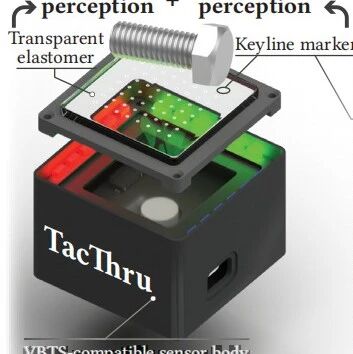
Core Viewpoint - The TacThru sensor developed by a research team from Peking University and Beijing General Artificial Intelligence Research Institute integrates tactile and visual perception, enhancing the precision of robots in delicate operations and contact-intensive tasks [3][4]. Group 1: Sensor Design and Functionality - TacThru employs a fully transparent elastic material, allowing the embedded camera to "see through" and capture tactile signals simultaneously, eliminating the need for complex mode-switching [10]. - The sensor features innovative "Keyline Markers," designed with concentric circles that maintain visibility even in complex backgrounds, enhancing tracking capabilities [12]. - Utilizing a Kalman filter algorithm, TacThru can accurately track the displacement of 64 markers, processing each frame in just 6.08 milliseconds, supporting high-frequency perception and real-time operations [15]. Group 2: Learning Framework and Data Integration - The TacThru-UMI imitation learning framework combines the TacThru sensor with a Transformer-based diffusion policy, creating an end-to-end learning system that intelligently integrates multimodal signals [16][19]. - The system processes four types of inputs: global visual information from a wrist camera, close-range visual images from TacThru, tactile data from marker displacements, and proprioceptive information from the robot, enabling dynamic attention allocation based on the scenario [19]. Group 3: Performance Validation - In five typical robotic operation tasks, TacThru-UMI achieved an average success rate of 85.5%, significantly outperforming pure visual (55.4%) and traditional tactile-visual solutions (66.3%) [20][24]. - In the "tissue extraction" task, TacThru excelled by capturing the position and deformation of soft tissues in real-time, achieving a much higher success rate compared to traditional methods [21]. - The "bolt sorting" task demonstrated TacThru's ability to distinguish subtle geometric and color differences, achieving an 85% success rate, far exceeding the 45% of traditional solutions [22]. Group 4: Paradigm Shift in Robotic Operations - TacThru represents a shift from single-sensor reliance to multimodal collaboration in robotic operations, allowing robots to adaptively choose between visual and tactile feedback [25]. - This transition expands operational boundaries, enhances robustness in complex environments, and lowers application barriers by being compatible with existing manufacturing processes [25].