
权力游戏

Search documents
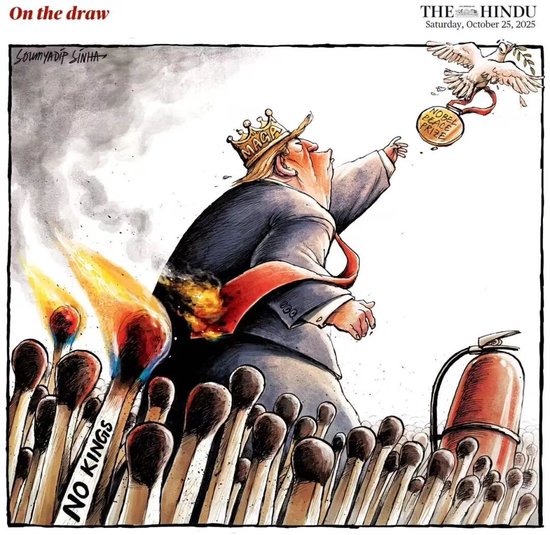
牛弹琴:公开打脸 诺奖气坏了
Xin Lang Cai Jing· 2026-01-15 23:55
Core Viewpoint - The article discusses the controversial awarding of the Nobel Peace Prize by Venezuelan opposition leader Maria Machado to Donald Trump, highlighting the intersection of power, politics, and the integrity of the Nobel Prize itself [3][10][17]. Group 1: Awarding of the Nobel Prize - On January 15, after meeting with Trump, Machado announced she had awarded him the Nobel Peace Prize, drawing a historical parallel to Simon Bolivar receiving a medal from Marquis de Lafayette [3][10][30]. - The Nobel Committee's rules state that awards cannot be shared or transferred, yet Machado proceeded to present the award to Trump, disregarding these guidelines [17][42]. Group 2: Political Implications - Trump's desire for the Nobel Prize is well-known, as he has claimed credit for ending multiple conflicts, leading various leaders to nominate him for the award [7][32]. - The article suggests that Machado's acceptance of the Nobel Prize was a political misstep, as it alienated Trump and could have jeopardized her position in Venezuela [38][41]. Group 3: Reactions and Consequences - The article notes that Trump's reaction to Machado's acceptance of the Nobel Prize was one of anger, leading to a military intervention in Venezuela [12][37]. - The situation illustrates the fragility of the Nobel Prize's authority when confronted with political power, as the committee's objections were rendered ineffective [17][52].

闫红:不要回答!
Xin Lang Cai Jing· 2026-01-10 12:16
Core Viewpoint - The article emphasizes the importance of not responding to various calls or temptations in life, which can lead to being controlled or manipulated by external forces or internal anxieties [4][5][10]. Group 1: Literary References - The article references Lu Xun's story about a scholar who is lured by a beautiful woman, highlighting the danger of responding to unknown calls [4]. - It compares this to the story in "Journey to the West," where responding to a call can lead to dire consequences, suggesting that ignoring such calls is a form of self-protection [5]. Group 2: Psychological Insights - The article discusses how responding to external pressures, such as social media or emotional demands, can lead to a loss of autonomy and control [5][7]. - It explains that anxiety can impair rational thinking, causing individuals to feel compelled to respond to internal or external calls, which can exacerbate feelings of distress [8][10]. Group 3: Personal Reflections - The author reflects on personal experiences of feeling compelled to respond to questions or concerns, illustrating the struggle between the desire to engage and the need for self-preservation [6][7]. - It is noted that sometimes, ignoring one's own internal calls can be beneficial, as it allows for a clearer mind and reduces anxiety [10].

1美元换140万!资源、文明、人口样样不缺,伊朗为何反而成了负资产?
Xin Lang Cai Jing· 2026-01-04 23:35
Core Viewpoint - The article discusses the severe economic crisis in Iran, highlighting the extreme devaluation of its currency, with 1 USD equating to 1.4 million Iranian rials, and explores the underlying causes of this situation, including external sanctions and internal economic mismanagement [1][2]. Group 1: Economic Breakdown - The article identifies a "break in the economic lifeblood," detailing how the failure of the "shadow fleet" and rampant money printing have contributed to the crisis, exacerbated by external "Snapback" sanctions that have cut off vital resources [1][2]. - It emphasizes the role of a privileged economy that has drained the last drops of nourishment from the country, leading to widespread economic despair [1][2]. Group 2: Social Disparity - The stark contrast between the elite and the general populace is highlighted, with citizens scavenging for food while the wealthy elite in northern Tehran enjoy luxury cars and private zoos, illustrating a painful societal divide [1][2]. - The Revolutionary Guard's control over the economic empire is noted as a significant factor contributing to public despair and societal fragmentation [1][2]. Group 3: Geopolitical Dynamics - The article questions why nuclear capability remains an elusive dream for Iran, suggesting that there are unspoken rules among the "P5" nations regarding the prevention of Iran's nuclear ambitions, indicating a complex geopolitical landscape [1][2]. - It discusses the surprising consensus among major powers in addressing the Iranian nuclear issue, framing it as a brutal power game [1][2]. Group 4: Future Uncertainties - The article raises concerns about the future of Iran, mentioning the targeted elimination of top elites and the significant technological gap represented by military assets like the S400 and F35, which contribute to a sense of despair [1][2]. - It posits that the internal strife and external pressures may create a power vacuum behind the aging leadership, potentially leading to further instability [1][2]. - The narrative concludes that Iran's tragedy is a result of both internal decay and external strangulation, despite its rich resources and historical significance [1][2].
美加征39%高关税后 瑞士领导人赴美谈判感慨“权力游戏”
Yang Shi Xin Wen· 2025-08-08 00:33
Core Viewpoint - The U.S. has imposed a 39% import tariff on Swiss goods, marking a significant diplomatic and economic challenge for Switzerland, which is now one of the most affected countries in U.S.-EU relations [1][2]. Group 1: Diplomatic Response - Switzerland's federal government is actively seeking dialogue with the U.S. to address the tariff issue, despite the current situation being difficult to reverse [1][6]. - A high-level Swiss delegation was sent to Washington to negotiate, but the discussions did not yield any changes to the impending tariff [2][6]. - The Swiss President expressed disappointment over the lack of engagement from U.S. President Trump, who criticized the Swiss delegation on social media [2][3]. Group 2: Public Sentiment - A public poll indicated that 82% of Swiss citizens oppose making further concessions to the U.S. regarding the tariffs, reflecting a strong national sentiment against compromising on sovereignty and dignity [5]. Group 3: Military Cooperation - Despite the tariff imposition, Switzerland has not halted its military procurement plans with the U.S., including multi-billion dollar purchases of F-35 fighter jets and Patriot missile systems, signaling a commitment to maintaining a reliable partnership [4][6]. Group 4: Future Outlook - The Swiss government acknowledges the unpredictability of the Trump administration and is focusing on maintaining stability and predictability in its diplomatic approach [6]. - Switzerland aims to continue negotiations and hopes that rationality and sincerity will eventually lead to a resolution with the U.S. [6].