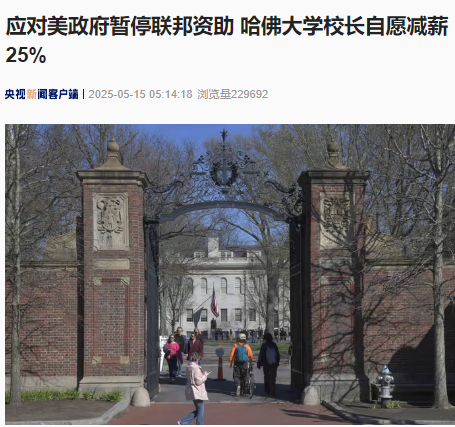
校园反犹主义

Search documents
施压哈佛,特朗普加码“索赔”10亿
Huan Qiu Shi Bao· 2026-02-03 22:57
【环球时报报道 记者 周扬】当地时间2月2日,特朗普政府与哈佛大学围绕校园反犹主义、学术自由及 联邦拨款等问题的持续冲突又迎来两度反转:在美国《纽约时报》报道"特朗普政府已放弃此前要求哈 佛大学支付2亿美元作为和解条件"数小时后,美国总统特朗普在其社交平台"真实社交"上宣布,美国政 府正寻求向哈佛"索赔"10亿美元。 报道发出几小时后,特朗普就发帖宣布提高"索赔"金额至10亿美元,并在帖文中指责哈佛"强烈反犹", 批评哈佛大学校长加伯未能有效纠正这一严重局面,"不仅损害了学校,也危及国家"。他还表示,"今 后不想再与哈佛有任何瓜葛"。特朗普在其帖子中引用了《纽约时报》的报道,批评哈佛向"日渐衰落的 《纽约时报》灌输大量'胡言乱语'"。 BBC称,自重返白宫以来,特朗普政府多次将矛头指向美国高校,尤其盯上哈佛大学、哥伦比亚大学、 宾夕法尼亚大学等常青藤盟校,指控其纵容反犹言论,推行"激进左翼"意识形态。作为施压手段,特朗 普政府曾于2025年4月单方面撤销哈佛大学超过20亿美元的联邦研究经费,并冻结其他拨款。哈佛随即 提起诉讼,指政府试图"掌控学术决策",侵犯大学权利。2025年9月,美国一名联邦法官裁定特朗普 ...
白宫公告:对哈佛大学国际学生签证限制立即生效,暂停入境六个月
Xin Lang Cai Jing· 2025-06-05 02:05
Core Points - The U.S. White House announced visa restrictions for international students at Harvard University due to national security concerns [1] - The order, effective immediately, suspends entry for Harvard students holding student and exchange visitor visas for a period of six months, with potential for extension [1] - The order also mandates a review of current international students at Harvard and allows the State Department to consider revoking existing visas based on specific circumstances [1] Group 1 - The announcement cites Harvard's failure to comply with federal regulations as a reason for the restrictions [1] - The order effectively bypasses a temporary court injunction that allowed Harvard to continue enrolling international students [1] - The announcement reflects broader criticisms from the Trump administration regarding Harvard's policies and alleged connections to foreign governments [2] Group 2 - Specific grievances listed include rising campus crime rates, support for diversity and inclusion policies, and accusations of anti-Semitism [2] - The Trump administration claims that financial ties between Harvard and foreign governments could allow adversaries to exploit U.S. academic institutions for strategic gains [2]
美国联邦法官“叫停”禁止哈佛大学招收国际学生政策!特朗普政府改立场提出“30天限期”
Mei Ri Jing Ji Xin Wen· 2025-05-29 22:45
Core Points - A federal judge in Massachusetts has approved Harvard University's request for a preliminary injunction against the Trump administration's policy to revoke its eligibility to enroll international students [1][2] - The Trump administration had previously announced the cancellation of Harvard's student and exchange visitor program eligibility, which led to Harvard filing a lawsuit [2][3] - The judge's temporary restraining order will remain in effect while parties negotiate and submit proposals for further court consideration [1][2] Summary by Sections Legal Proceedings - The Massachusetts federal court held a hearing on May 29, where the judge issued a temporary restraining order to maintain the status quo before a final decision is made [1][2] - The Trump administration has given Harvard 30 days to contest the revocation of its eligibility, indicating a potential shift in the government's hardline stance following judicial intervention [2][3] Government Actions - The Trump administration's actions against Harvard are part of a broader strategy to pressure the university, which includes freezing billions in funding and threatening to revoke its tax-exempt status [3] - The administration's demands focus on addressing perceived issues such as anti-Semitism on campus and the diversity initiatives favoring minority groups [3] Impact on Harvard and International Students - Harvard's international student population exceeds 27%, with nearly 6,800 students from over 140 countries, highlighting the significance of international enrollment to the university's academic environment [2][3] - Students and faculty at Harvard have expressed concerns that the ban on international students would undermine the university's global academic standing and negatively impact the U.S. educational system [4][6][8] - The proposed ban could affect over a quarter of Harvard's total student body, potentially leading to a talent drain in the U.S. education and research sectors [8]

特朗普政府暂停留学生新签证面谈
第一财经· 2025-05-27 23:36
Group 1 - The Trump administration has suspended new student visa interviews and is considering expanding social media scrutiny for international students [1] - A telegram signed by Secretary of State Rubio indicates that all international students applying to study in the U.S. may be required to undergo social media reviews [1] - The potential implementation of this scrutiny could significantly slow down the processing of student visas and negatively impact U.S. universities that rely on international students for financial revenue [1] Group 2 - The Trump administration has targeted several U.S. universities, demanding the eradication of anti-Semitism on campuses and the abolition of diversity initiatives favoring minority groups [2] - There is a perception that the Trump administration is particularly focused on institutions like Harvard University, which are viewed as strongholds of leftist liberalism or the Democratic Party [2]
特朗普 被紧急叫停!
Zhong Guo Ji Jin Bao· 2025-05-25 16:07
Core Viewpoint - Harvard University has achieved a preliminary victory in a significant legal battle against the Trump administration, obtaining a temporary order from the court to block a government directive that would limit the admission of international students, which could have widespread implications for the U.S. higher education system [2][3] Group 1: Legal Developments - A federal judge ruled that the government cannot enforce the recently issued ban on international students at Harvard, stating that the directive could cause "immediate and irreparable harm" to the university [2] - Harvard filed a lawsuit against the U.S. government, claiming that the directive infringes on the university's rights to free speech and due process, and does not comply with federal regulations [3] - The temporary restraining order (TRO) will remain in effect until a court hearing on Harvard's request for a permanent injunction, scheduled for May 29 [3] Group 2: Impact on International Students - Approximately 27% of Harvard's student body consists of international students, totaling around 6,800 individuals, a significant increase from 19.6% in 2006 [3] - The government's directive has created uncertainty for thousands of foreign students, affecting both current and admitted students who are now unsure of their next steps [3][4] - The directive could deter international students from pursuing education in the U.S., despite no similar measures being taken against other universities [4] Group 3: Government's Position - The U.S. government justified its actions against Harvard by citing concerns over the university's handling of anti-Semitism and the need for stricter oversight of foreign students [2][3] - A White House spokesperson indicated that if Harvard were more concerned about addressing issues related to anti-American sentiments on campus, they would not be in this situation [3] - The Department of Homeland Security emphasized that admitting foreign students is a privilege, not a right, and criticized Harvard's lawsuit as an attempt to undermine presidential authority [3] Group 4: Financial Implications - Harvard's endowment, valued at $53 billion, is largely earmarked for specific uses, and the potential loss of its tax-exempt status could have significant financial repercussions for the university [4] - The government's directive implies that Harvard may not be able to admit any new international students for at least two academic years, which could further impact its financial stability [4] Group 5: Reactions from Other Institutions - Other universities, such as the Hong Kong University of Science and Technology, have begun to extend invitations to Harvard's current and admitted students in light of the situation [5] - MIT's president expressed shock at the government's directive, stating that it undermines the spirit of excellence and innovation in the U.S. [5]
最新!应对美政府暂停联邦资助,他自愿减薪25%!此前哈佛校长的年薪曾高达100万美元
Mei Ri Jing Ji Xin Wen· 2025-05-15 01:46
Core Points - Harvard University is facing financial challenges due to the suspension of approximately $2.7 billion in federal funding by the Trump administration, leading the university president to voluntarily reduce his salary by 25% for the fiscal year 2026 [1][3] - Harvard plans to allocate $250 million of its own funds to support researchers in their scientific endeavors [3] - The Trump administration has threatened to cut an additional $450 million in funding and has accused Harvard of failing to report foreign funding sources, which has led to a freeze on federal grants [3][4] Funding and Financial Impact - The Trump administration's actions include freezing $2.2 billion in multi-year grants and $60 million in multi-year contract funds to Harvard [4] - The university's president, Alan Michael Garber, previously had an annual salary that reached $1 million, although his current salary has not been disclosed [3] - The federal government has indicated that it will no longer provide new funding to Harvard, as stated by Education Secretary Linda McMahon [3] Government Relations and Legal Actions - Harvard has filed a lawsuit against the Trump administration, claiming that the government is attempting to manipulate the university's academic decisions through funding freezes [6] - The Trump administration has demanded significant governance reforms from Harvard, including changes to admissions policies and the elimination of diversity-related programs [4][6] - The administration's scrutiny of Harvard is part of a broader trend of targeting several large universities for alleged violations related to foreign funding [4][6]